
TL;DR:
- Hyperlocal targeting allows small businesses to focus advertising on customers within a very small geographic area, increasing relevance and reducing wasted ad spend. It relies on technologies like geo-fencing, Bluetooth beacons, and Wi-Fi positioning to deliver timely, location-specific promotions that drive foot traffic. Focusing on precise, time-sensitive offers within tight neighborhoods enhances conversion rates and competitive advantage.
Hyperlocal targeting is the practice of delivering ads and promotions to customers within a very small geographic area, such as a single neighborhood, a few city blocks, or even one street. Unlike broad regional campaigns, this approach uses GPS data, geo-fencing, and mobile location signals to reach people at the exact moment they are physically close enough to act. Platforms like Google Ads and Meta (Facebook) both support hyperlocal campaign setups, making this strategy accessible to businesses of any size. For small business owners, the core appeal is simple: stop paying to reach people who will never walk through your door.
What is hyperlocal targeting and how does it differ from local marketing?
Hyperlocal targeting focuses ads on a tight radius around a specific location, often as small as one or two city blocks, rather than a ZIP code or metro area. Traditional local marketing might target an entire city or county. Hyperlocal narrows that down to the street level, which changes everything about how relevant your message feels to the person receiving it.
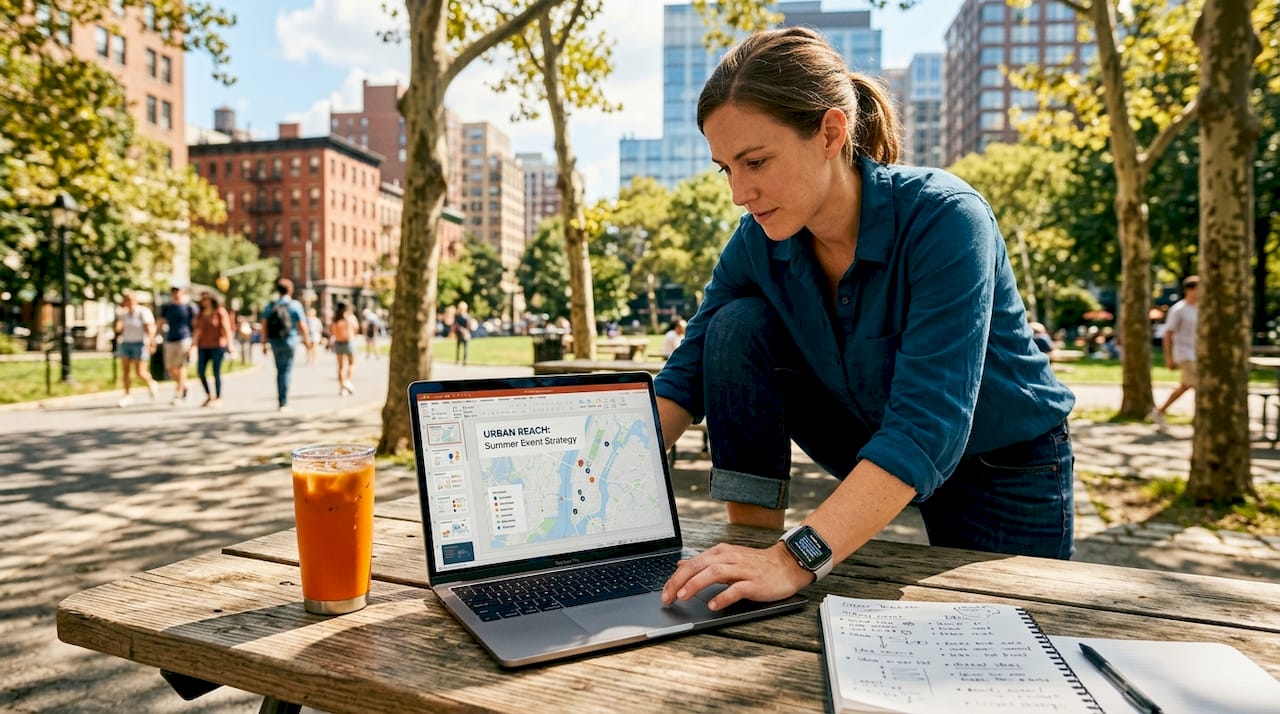
The practical difference shows up in your budget. When you target a five-mile radius around your bakery, you pay to reach thousands of people who live too far away to visit on a Tuesday morning. When you target a two-block radius during the morning commute, nearly every impression lands on someone who could realistically walk in. That precision directly improves your return on ad spend.
Here is how the three tiers of geographic targeting compare:
| Targeting type | Geographic radius | Best use case |
|---|---|---|
| Regional marketing | 25+ miles or full metro area | Brand awareness, franchise chains |
| Local marketing | City or ZIP code level | Service businesses with broad coverage |
| Hyperlocal targeting | A few blocks to 1-2 miles | Foot traffic, time-sensitive offers, events |
The scenarios where hyperlocal delivers the clearest advantage include:
- A restaurant running lunch specials wants to reach office workers within a five-minute walk, not the entire city.
- A boutique promoting a weekend pop-up sale targets only the two surrounding neighborhoods where its core customers live.
- A gym offering a free trial class sends ads only to people currently in the adjacent residential blocks.
Geolocation data in mobile advertising increases promotion relevance and consumer receptivity, particularly for customers who are physically close to a store. That peer-reviewed finding confirms what most experienced local marketers already know from practice: proximity makes people pay attention.
What technologies make hyperlocal targeting work?
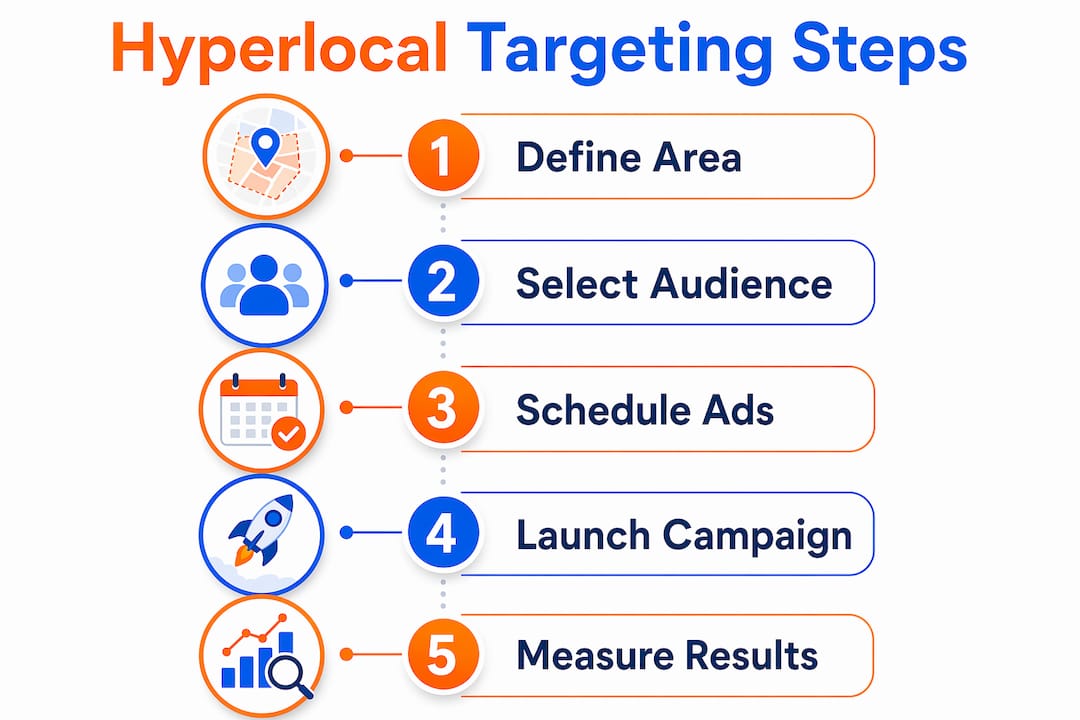
The engine behind hyperlocal targeting is geo-fencing. Geo-fencing creates virtual geographic boundaries that trigger ad delivery the moment a user’s device enters a defined area. The boundary is drawn on a map using latitude and longitude coordinates, and the system checks a device’s GPS signal continuously to determine whether that device is inside or outside the fence.
Beyond GPS, three additional technologies contribute to hyperlocal precision:
- Bluetooth beacons. Small physical devices installed in or near a store broadcast a signal to nearby smartphones. Retailers use beacons to trigger in-app notifications when a customer enters the building, down to the aisle level.
- Wi-Fi positioning. When a device connects to or detects a Wi-Fi network, its location can be estimated even when GPS signal is weak. This works well in dense urban areas and indoor environments like malls.
- IP address targeting. Less precise than GPS but useful for desktop users, IP targeting narrows delivery to a neighborhood or building cluster based on the internet connection’s registered location.
Platforms like Google Ads and Meta use a combination of these signals alongside behavioral data, such as search history and app usage, to refine who sees your ad within the geo-fence. Artificial intelligence layers on top of that data to predict which users inside the boundary are most likely to convert, so your budget concentrates on the highest-probability prospects.
Pro Tip: Combine location targeting with dayparting, which means scheduling your ads to run only during specific hours. A coffee shop geo-fence set for a two-block radius is far more effective from 6:30 a.m. to 9:00 a.m. than running all day. Pair timing with a time-sensitive offer and your click-through rate will reflect the difference.
For a deeper look at how location signals translate into customer acquisition, Ibrand’s guide on geotargeting for local customers walks through the setup process step by step.
Hyperlocal advertising examples small businesses can actually use
The most effective hyperlocal advertising examples share one trait: the offer matches the moment. Customers need multiple proximity-based touchpoints before purchasing, and hyperlocal targeting places your business in front of them precisely when they are ready to act.
Consider these real-world applications:
- Coffee shop morning push. A café sets a geo-fence covering a two-block radius and runs a “buy one, get one before 9 a.m.” offer exclusively to people within that boundary during weekday mornings. Digital coupons sent within a two-block radius drive measurable foot traffic increases compared to untargeted promotions.
- Boutique neighborhood ads. A clothing store targets Instagram and Facebook ads to two specific zip codes where its best customers live, promoting a local event collaboration with a nearby gallery. The creative references the neighborhood by name, which increases engagement because it feels personal rather than generic.
- Restaurant delivery zone targeting. A pizza restaurant uses Meta’s radius targeting to show ads only to households within its actual delivery boundary during the 5 p.m. to 8 p.m. window. This eliminates wasted impressions from people who would order and then discover delivery is unavailable to their address.
- Website content personalization. Geographic customization of website content increases time on site and decreases bounce rates by showing visitors locally relevant information. A plumber serving three distinct neighborhoods can show different testimonials and service highlights depending on which area the visitor is browsing from.
One advanced tactic worth knowing is geo-conquesting. Geo-conquesting targets ads near competitor locations to attract their customers without cannibalizing your existing base. A gym could geo-fence a rival gym’s parking lot and serve ads offering a free week trial to anyone who enters. This expands reach into new market segments with surgical precision.
“Hyperlocal marketing connects the online and offline customer journey, because customers do not see your website and your physical store as separate entities.” — Shopify
That insight reframes how you should think about your hyperlocal strategy. Every ad you serve near your location is also a signal about your brand’s digital presence. The two reinforce each other.
How to measure and optimize your hyperlocal campaigns
Clicks alone do not tell you whether a hyperlocal campaign is working. Tracking offline lift metrics such as store visits, phone calls, and foot traffic gives a far more accurate picture of true campaign impact than click-through rate.
The metrics that matter most for hyperlocal campaigns fall into two categories:
Digital signals:
- Impressions served within the geo-fence boundary
- Click-through rate segmented by time of day and day of week
- Conversion rate on the landing page tied to the local offer
- Call tracking volume from ad-specific phone numbers
Offline signals:
- Store visit lift measured through Google Ads store visit conversions
- Foot traffic data from platforms like Placer.ai or Foursquare
- Coupon redemption rates for offers tied to the campaign
- Phone call volume during campaign windows versus baseline periods
Pro Tip: Run A/B tests with neighborhood-specific creative. An ad that says “Serving the Oak Park neighborhood since 2018” will outperform a generic “Visit us today” message for residents of that area. Test two versions simultaneously within the same geo-fence and let the data decide which creative to scale.
Common pitfalls that waste budget in hyperlocal campaigns include setting the geo-fence too large (which defeats the purpose), running ads around the clock instead of during peak intent windows, and failing to align the ad’s promise with what the business can actually deliver. Hyperlocal marketing must align with actual service area to avoid poor lead quality and customer friction. If your ad targets a neighborhood you cannot serve within a reasonable time, you generate complaints, not customers.
One more consideration: certain regulations restrict geo-fencing near sensitive locations. Washington’s My Health My Data Act includes specific geofencing prohibitions for health-related advertising. Check applicable state laws before building fences around hospitals, clinics, or pharmacies.
For broader context on why precise targeting pays off, Ibrand’s breakdown of local advertising benefits covers the ROI case in detail.
Key takeaways
Hyperlocal targeting works because it combines geographic precision with behavioral timing to reach customers at the exact moment and place they are most likely to convert.
| Point | Details |
|---|---|
| Definition and scope | Hyperlocal targeting covers areas as small as a city block using GPS, geo-fencing, and mobile data. |
| Technology stack | Geo-fencing, Bluetooth beacons, Wi-Fi positioning, and AI combine to deliver precise audience segmentation. |
| Practical applications | Coffee shops, boutiques, and restaurants all use radius-based ads and geo-conquesting to drive foot traffic. |
| Measurement priority | Track store visits and call volume, not just clicks, to measure true campaign impact. |
| Legal awareness | Regulations like Washington’s My Health My Data Act restrict geo-fencing near sensitive locations. |
Why most small businesses underuse this tool
I have worked with dozens of local business owners who spend their entire ad budget targeting a five-mile radius and then wonder why their cost per customer keeps climbing. The answer is almost always the same: they are paying to reach people who will never convert because the distance is too far, the timing is wrong, or both.
The shift to hyperlocal targeting is not complicated, but it does require a mindset change. You are no longer trying to maximize reach. You are trying to maximize relevance within a tight physical window. That means accepting a smaller audience in exchange for a much higher probability that each person in that audience will act.
What I have seen work consistently is pairing a geo-fence with a specific, time-limited offer and neighborhood-level creative. A generic ad inside a tight geo-fence still underperforms. The location data gives you the opportunity. The creative has to close it.
The next frontier worth watching is AI-driven hyperlocal SEO. Search engines are increasingly surfacing results based on a user’s precise location at the moment of search, not just their city. Small businesses that optimize their Google Business Profile, build neighborhood-specific landing pages, and earn local citations will have a structural advantage as this shift accelerates. The businesses that treat hyperlocal as a paid-ads-only strategy will miss half the opportunity.
— TONY
Ready to put hyperlocal targeting to work for your business?
Ibrand specializes in helping small businesses build location-based marketing strategies that generate real foot traffic and measurable sales, not just impressions.
Whether you need a geo-fencing campaign built from scratch, a Google Business Profile overhaul, or a neighborhood-specific content strategy, Ibrand’s team handles the technical setup and ongoing optimization. The agency’s local SEO services are designed specifically for small businesses that need results without a large agency budget. If you want a step-by-step plan for reaching customers in your area, Ibrand’s local marketing guide is the right starting point.
FAQ
What is hyperlocal targeting in simple terms?
Hyperlocal targeting is a form of location-based advertising that delivers ads to people within a very small geographic area, such as a few city blocks or a single neighborhood. It uses GPS and geo-fencing technology to reach customers who are physically close enough to visit your business.
How does geo-fencing work for small businesses?
Geo-fencing draws a virtual boundary on a map around a specific location. When a mobile device enters that boundary, the system serves a pre-set ad or notification to that device. Small businesses use this to send time-sensitive offers to nearby customers.
What are the main benefits of hyperlocal targeting?
The primary benefits include higher ad relevance, lower wasted spend, and better conversion rates because you reach people who are already near your location and more likely to act. Geolocation data also increases consumer receptivity to promotions compared to untargeted campaigns.
Can hyperlocal targeting work without a large budget?
Yes. Platforms like Google Ads and Meta allow radius targeting with daily budgets as low as a few dollars. The key is keeping the geo-fence tight and the offer specific, which maximizes the impact of every dollar spent.
What is geo-conquesting and should small businesses use it?
Geo-conquesting means placing a geo-fence around a competitor’s location to serve ads to their customers. Research shows it can access new market segments without cannibalizing existing sales, making it a practical option for businesses in competitive local markets.
Recent Comments