
NAP consistency means your business Name, Address, and Phone number match everywhere they appear online, and NAP+W adds the website URL to that trio. The single fastest fix is to set one master NAP on your website and Google Business Profile, then hunt down and correct every mismatch. Getting this right reduces listing suppression and helps your business show up in the local results people actually click.
TL;DR:
- Correcting NAP to match a single master format on your website and Google Business Profile can significantly improve local search rankings and prevent visibility issues.
- Inconsistent formatting, duplicate listings, outdated information from moves, and unclaimed profiles are the most common issues that damage NAP accuracy and trust signals.
- Updating your website first, especially structured data and crawlable contact info, should be the priority before fixing Google and directory listings for the quickest results.
- Multi-location businesses must ensure consistent naming, categories, and profiles across all sites, avoiding duplicate profiles created during expansion.
- Regular monitoring, with at least monthly reviews, is essential to prevent listing drift, particularly after relocations or staff changes, or consider agency help for larger operations.
Table of Contents
- What NAP consistency means and where it shows up online
- Why NAP consistency affects local search and customer experience
- Common NAP problems to watch for (diagnostic checklist)
- How to audit your NAP: prioritized, step-by-step checklist
- How to fix NAP issues: stepwise remediation and monitoring routine
- Multi-location and franchise rules: name and category consistency at scale
- Website and technical checks: make the site the authoritative source of truth
- What actually moves the needle when cleaning up NAP
- Ibrand.media: an option to manage NAP consistency and local listings for you
- Authoritative reference links to official guidance and reputable explainers
- Sources
- FAQ
What NAP consistency means and where it shows up online
NAP stands for Name, Address, and Phone number. NAP+W adds the website URL when a platform includes it. Consistency does not mean every listing has to be letter-for-letter identical forever, but it does mean you pick one format and stick to it: “Street” or “St.”, “Suite 4” or “Ste 4”, pick one and repeat it everywhere.
Your business information shows up in more places than most owners realize:
- Your own website footer and contact page
- Your Google Business Profile
- Data aggregators and directories like Yelp, Yellow Pages, and Bing Places
- Social profiles such as Facebook and Instagram
- News mentions, press releases, and local news citations
That first format you choose becomes your master NAP, the exact string every other listing should match. Small inconsistencies compound across dozens of platforms, so nailing this down early saves hours later.
Why NAP consistency affects local search and customer experience
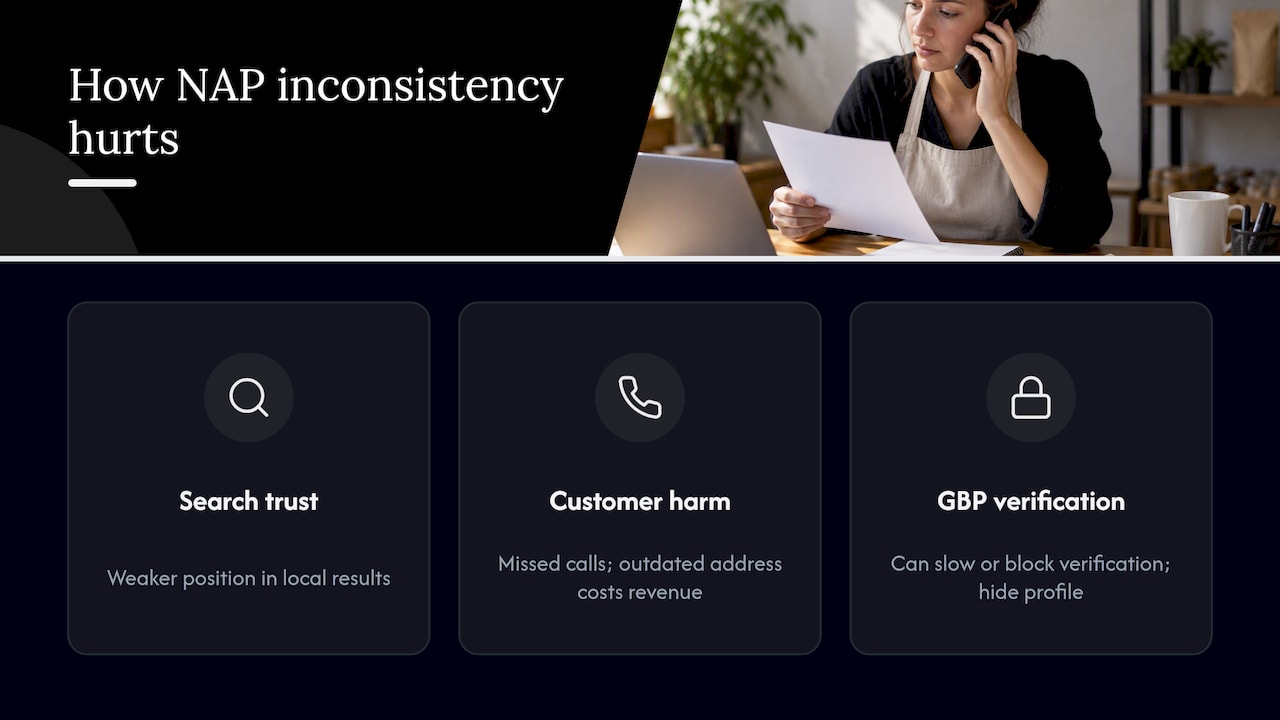
Search engines cross-reference your name, address, and phone number across the web to confirm your business is real and located where you say it is. Mismatched listings weaken that confidence, and a weaker trust signal often means a weaker position in local results.
The customer-facing damage is more immediate. A wrong phone number means missed calls. An outdated address sends someone to a location you left two years ago. Both cost you revenue, and both erode the trust that got the customer looking for you in the first place.
There is also a direct line between NAP accuracy and your Google Business Profile’s standing. Google’s own guidance says a profile should represent your business as it exists in the real world, and mismatches between what you claim and what is verifiable can slow or block verification, which keeps your profile from appearing on Search and Maps at all.
Common NAP problems to watch for (diagnostic checklist)
Most NAP damage comes from a short list of repeat offenders. Before you fix anything, find where these show up:
- Formatting differences: “Ave” versus “Avenue”, missing suite numbers, or a phone number written with parentheses on one listing and dashes on another
- Duplicate or unclaimed listings created automatically by aggregators, often with stale or wrong data
- Call-tracking numbers that replace your real number on a listing without documentation, breaking ownership and routing calls to a dead end if a vendor contract lapses
- Outdated listings left over from a move, a merger, or a temporary closure that was never updated afterward
Pro Tip: Search your business name in quotes alongside your city to surface old listings you forgot existed, including ones under a previous name or address.
How to audit your NAP: prioritized, step-by-step checklist
Start with a plan, not a scramble. Work through these steps in order:
- Write down your master NAP exactly as it should appear: business name, full street address, and the one phone number you want everywhere.
- Check your Google Business Profile first since it carries the most local search weight and requires verification to appear on Search and Maps.
- Search the priority directories and aggregators next, focusing on the platforms most likely to influence rankings or send you traffic.
- Log every mismatch you find in a spreadsheet with the platform name, the wrong data, and the correct replacement.
The platforms worth checking first, in rough order of impact:
- Google Business Profile
- Your own website footer and contact page
- High-traffic directories like Yelp, Bing Places, and Apple Maps
- Data aggregators that feed dozens of smaller sites at once
- Industry-specific or local chamber directories
Triage by visibility: fix Google Business Profile and your website before chasing long-tail directory listings that see little traffic anyway.
How to fix NAP issues: stepwise remediation and monitoring routine
Fixing NAP problems works best as a sequence, not a scattershot cleanup:
- Update your website first, including the footer, contact page, and any JSON-LD structured data, so your crawlable source of truth is correct.
- Edit and verify your Google Business Profile, keeping in mind Google may contact your verified phone number and review changes before they go live.
- Submit corrections to major directories and aggregators, then follow up in a few weeks since some sync slowly.
- Note who made each change and when, so you have a record if a listing reverts or a dispute comes up later.
- Handle call-tracking numbers carefully: document who owns each number and prefer a number under the business’s own control when a listing requires long-term ownership.
Pro Tip: Assign one person, internal or external, to own NAP monitoring on a set schedule (monthly for active businesses) so drift does not creep back in after your cleanup.
Multi-location and franchise rules: name and category consistency at scale
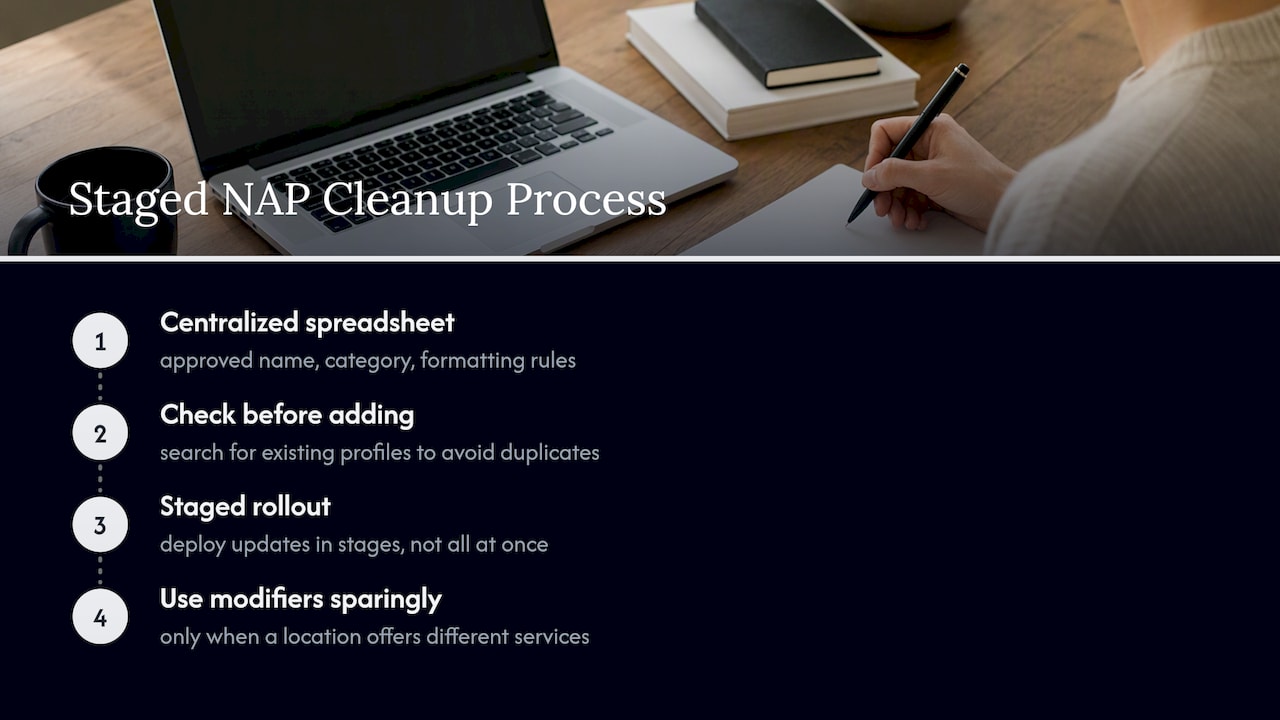
Google’s guidance is clear on naming: use the same business name across every location unless your physical signage genuinely differs from one site to another. The same logic applies to categories: locations offering the same core service should share the same primary category, with modifiers reserved for real differences in what a specific location offers.
The most common multi-location mistake is duplicate profiles created when a new location is added without checking for an existing listing first. A centralized spreadsheet with your approved name, category, and formatting rules, rolled out through a staged update process rather than an all-at-once change, keeps that from happening. For deeper guidance on rolling out changes across locations, see this multi-location SEO breakdown.
Website and technical checks: make the site the authoritative source of truth
Your website should be the version of NAP that every other listing gets checked against, which means it needs to be both correct and readable by search engines.
- Put your NAP in the footer and on the contact page as actual crawlable text, never as an image
- Add LocalBusiness or Organization JSON-LD structured data that matches your master NAP exactly, string for string
- Use tel: links for phone numbers so mobile visitors can tap to call
- Confirm Googlebot is not blocked from these pages, and check Search Console for coverage issues that might hide them
A website that disagrees with its own Google Business Profile creates a trust gap no amount of directory cleanup fixes on its own. The site is where search engines and customers both go to settle the question.
What actually moves the needle when cleaning up NAP
Three fixes tend to produce the fastest visible results: making the website the canonical source, cleaning up the Google Business Profile itself, and correcting the handful of aggregators that feed dozens of smaller directories at once. Everything else is slower-moving maintenance.
Whether to handle this yourself or bring in help usually comes down to scale and time. A single location with a straightforward history can often manage a cleanup in an afternoon. A business with multiple locations, a history of address changes, or years of neglected listings usually benefits from a dedicated hand, simply because the volume of corrections and the follow-up required outgrows what one person can track on the side.
— TONY
Ibrand.media: an option to manage NAP consistency and local listings for you
If the audit above sounds like more hours than you have this month, a digital marketing agency may help close that gap. Some agencies offer local marketing and SEO optimization services including Google Business Profile management, listing cleanup across directories, and ongoing monitoring to maintain accuracy over time.

Reaching out makes the most sense when you are managing several locations, when your internal team has no spare hours for citation cleanup, or when your listings have a track record of drifting out of sync after every move or staff change. You can see the full range of services, including local SEO and profile management, at Ibrand and start a conversation about what a cleanup and monitoring plan would look like for your business.
Authoritative reference links to official guidance and reputable explainers
For the underlying rules, see Google’s guidelines for representing your business and its instructions for editing your Business Profile. Moz and BrightLocal also publish reputable explainers on citation building and local SEO fundamentals worth cross-checking as guidance evolves.
FAQ
What does NAP consistency mean in the context of SEO?
NAP consistency means your business name, address, and phone number appear the same way across your website, Google Business Profile, and every directory or citation. Search engines use that match to confirm your business is legitimate and located where you claim, which supports local ranking.
What is a NAP in SEO?
NAP is shorthand for Name, Address, and Phone number, the three core identifiers that local search engines use to verify and rank a business. When a website URL is included as a fourth identifier, it is often called NAP+W.
How do I check NAP consistency?
Start by writing down your master NAP exactly as it should read, then check your Google Business Profile followed by your website and major directories. Log every mismatch in a spreadsheet so you can track fixes and confirm they stick.
Why is NAP consistency important?
Consistent NAP data helps search engines trust that your business is real and correctly located, which supports local visibility. It also prevents practical problems like missed calls from an outdated number or customers driving to an address you left long ago.
How often should I recheck my listings for NAP issues?
A monthly check is reasonable for an active business, especially after any move, rebrand, or change in phone provider. Businesses with several locations or a history of listing drift often benefit from assigning ongoing ownership rather than checking only when a problem surfaces.
Recent Comments