
The fastest way to get more plumbing leads right now is to activate Google Local Services Ads, lock down your Google Business Profile, and answer every inbound call within five minutes. Do those three things this week and you will see booked jobs before the month ends.
This playbook covers every channel worth your time: paid search, local SEO, lead marketplaces, social ads, referrals, reviews, email, and the operational systems that turn a ringing phone into a paid job. Each section includes specific steps, realistic cost ranges, and honest trade-offs so you can prioritize by budget and timeline.
Your first 7 days:
- Day 1: Claim and fully complete your Google Business Profile (hours, services, photos, license info).
- Day 2–3: Apply for Google Local Services Ads and start the background-check verification.
- Day 4–5: Set up a dedicated call-tracking number and connect it to a simple CRM.
- Day 6–7: Send a review-request text to your last 20 customers.
Time-to-impact by channel:
- LSA / Google Ads: Leads within hours of approval.
- Google Business Profile: Meaningful map-pack visibility in days to weeks.
- Local SEO (service pages, citations): Compounding traffic in 3–6 months.
- Referral program: First referrals within 2–4 weeks of launch.
- Email/SMS reactivation: Booked jobs within 48 hours of the first send.
The three highest-priority moves are LSA activation, GBP completion, and a sub-five-minute speed-to-lead protocol. Everything else in this guide builds on that foundation.
Key Takeaways
The fastest path to more plumbing leads is a stacked system: LSA and GBP for immediate visibility, local SEO and referrals for compounding growth, and a five-minute response SLA to convert what you generate.
| Point | Details |
|---|---|
| Start with LSA and GBP | These two channels produce booked jobs within days and require no long-term SEO investment to activate. |
| Speed-to-lead is the biggest conversion lever | Leads contacted within five minutes are far more likely to book than those reached after 30 minutes. |
| Reviews compound your rankings | A consistent review-request workflow improves both LSA ranking and map-pack visibility over time. |
| Track cost per booked job, not cost per lead | Close rate by channel determines true ROI; a cheap lead with a 10% close rate costs more than an expensive one at 50%. |
| Ibrand manages the full system | Ibrand handles local SEO, LSA, ads, and conversion tracking so plumbing businesses can focus on the work. |
Table of Contents
- How to get plumbing leads by buying them: marketplaces and pay-per-lead
- How do you show up when homeowners search for a plumber?
- Does your website actually convert visitors into calls?
- How do referral programs and local platforms like Angi and Nextdoor actually work?
- Can Facebook, Instagram, and Nextdoor actually generate plumbing leads?
- How do online reviews increase your call volume?
- How email and SMS marketing keep past customers calling you back
- How do you track where your plumbing leads actually come from?
- How do you turn an incoming lead into a booked job?
- Your 90-day plan to build a predictable plumbing lead engine
- Why integrated marketing and operations is the only approach that compounds
- Ibrand handles your plumbing lead generation so you can focus on the jobs
- Sources
- FAQ
How to get plumbing leads by buying them: marketplaces and pay-per-lead
Purchased leads are not a strategy. They are a gap-filler while your owned channels build momentum. Understanding the mechanics keeps you from bleeding margin.
How the pricing models differ
Pay-per-lead platforms like Angi Pro charge you for each lead delivered, regardless of whether you win the job. Leads are often shared with two to four other plumbers simultaneously, so you are competing on speed and price the moment the notification hits your phone. Pay-per-call models charge only when a consumer dials a tracked number, which filters out some tire-kickers. Exclusive leads cost more upfront but go to you alone, which typically produces a higher close rate and a better cost-per-booked-job.
Shared leads on Angi and similar platforms can vary widely in price depending on the job type and your market. Emergency plumbing leads in high-cost metros tend to sit at the top of that range. Exclusive leads from premium tiers or specialty networks can be more expensive, but a single booked water heater replacement or repiping job can justify that expense quickly.
When buying leads makes sense
Buy leads when you are entering a new service area and need volume fast, when you have a seasonal gap in your pipeline, or when you are testing a new service type before investing in SEO. Avoid relying on purchased leads as your primary channel long-term. ServiceTitan’s analysis of plumbing lead generation makes the trade-off clear: buying leads costs more per booked job than owned channels, and that gap widens as your organic presence matures.
Operational rules to protect your margin
- Set a maximum cost-per-lead threshold before you sign up. Know your average job value and your close rate so you can calculate the break-even point.
- Respond to every purchased lead within 90 seconds. Shared leads go cold fast.
- Log every lead in your CRM with its source. Track close rate and revenue by platform monthly.
- Dispute leads that are clearly outside your service area, duplicate, or fraudulent. Most platforms have a credit process.
- Pause any platform where your cost-per-booked-job exceeds 15–20% of average job revenue for two consecutive months.
Pro Tip: Set up a dedicated phone number for each lead marketplace. When a call comes in, your team knows immediately which platform sent it, which makes ROI tracking clean and disputes easy to document.
How do you show up when homeowners search for a plumber?
The answer is a three-layer Google stack: your Google Business Profile in the map pack, Local Services Ads above the organic results, and Google Search Ads for high-intent keywords. Each layer serves a different moment in the buyer’s journey, and together they cover the full first page.
Google Business Profile: your free lead machine
A complete, active GBP listing is the single highest-ROI move in local plumbing marketing. Plumber Magazine’s Google playbook confirms that complete and active listings appear far more often in the map pack and capture a disproportionate share of local clicks.
GBP completion checklist:
- Verify your business name, address, and phone number exactly as they appear on your website and every directory listing.
- Select the correct primary category (“Plumber”) and add relevant secondary categories (drain cleaning, water heater installation, etc.).
- Upload at least 10 photos: your truck, your team, completed jobs, your license certificate.
- Write a 250-word business description that includes your service area and two or three specialty services.
- Add every service you offer with individual descriptions and price ranges where possible.
- Set your service area by zip code or city, not just your physical address.
- Enable messaging and respond within an hour.
- Post a GBP update at least once per week (a seasonal tip, a completed job photo, a promotion).
- Build a review-request workflow so new reviews arrive consistently (more on this in the reviews section).
Pro Tip: Google rewards recency. A GBP with a post from yesterday outranks one with a post from six months ago, all else equal. Schedule 15 minutes every Monday to post a job photo or a seasonal tip.
Google Local Services Ads: the Google Guaranteed badge
LSAs appear above both paid search ads and organic results. You pay per lead, not per click, and the Google Guaranteed badge signals to homeowners that Google has verified your license and insurance. That badge alone increases call rates meaningfully.
LSA setup steps:
- Go to the LSA portal and create a business profile.
- Submit your business license, insurance certificate, and consent to a background check.
- Set your weekly budget and the job types you want to receive leads for.
- Respond to every LSA lead within the platform within 24 hours or your ranking drops.
- Mark booked jobs as “booked” in the LSA dashboard. Google uses this signal to rank you higher.
LSA ranking factors include your review count, review rating, responsiveness, and proximity to the searcher. The fastest way to climb LSA rankings is to collect more reviews and answer every lead fast.
Google Search Ads: capture high-intent clicks
Search Ads (PPC) let you target specific keywords like “emergency plumber near me,” “water heater replacement [city],” or “drain cleaning service.” Unlike LSAs, you pay per click, so keyword selection and negative keywords determine whether you profit or bleed.
High-intent keyword strategy for plumbers:
- Target service-plus-location phrases: “plumber [city],” “water heater repair [zip code].”
- Add emergency modifiers: “24-hour plumber,” “emergency drain cleaning.”
- Use exact and phrase match to control spend.
- Add negative keywords from day one: “plumbing school,” “plumbing jobs hiring,” “DIY plumbing,” “plumbing license exam.”
- Write ad copy that leads with the emergency or urgency: “Burst Pipe? We’re There in 60 Min. Licensed & Insured. Call Now.”
For local plumbing ad ideas that book jobs, the creative and copy decisions matter as much as the bid strategy.
Local SEO: service pages and citations
Local SEO takes longer than paid channels but compounds over time. The foundation is service-area pages (one page per city or neighborhood you serve), consistent NAP (name, address, phone) across every directory, and basic schema markup on your website.
Build a citation profile on Google, Yelp, Bing Places, Apple Maps, and the major data aggregators (Data Axle, Localeze). Every listing must show identical NAP. A single inconsistency across dozens of directories suppresses your map-pack ranking. The NearLeap plumbing growth playbook identifies GBP and referral channels as the top free assets that compound over time, which is exactly why citation consistency is worth the one-time cleanup effort.
Does your website actually convert visitors into calls?
Most plumbing websites lose leads before the phone rings. The visitor lands, can’t find a phone number above the fold, sees a slow-loading page on mobile, and hits the back button. Here is the checklist that fixes that.
Conversion checklist:
- Phone number in the top-right corner of every page, click-to-call enabled on mobile.
- “Request a Quote” or “Book Now” button visible without scrolling on every service page.
- Trust signals above the fold: license number, insurance badge, years in business, Google rating.
- Service-specific landing pages for each major service (water heater, drain cleaning, leak detection, etc.) with a unique phone number per page for call tracking.
- Before-and-after photos on every service page.
- Clear scope statements: what is included, what is not, and when you charge a diagnostic fee.
- A short “How It Works” section (call, we quote, we fix, you pay) to reduce friction for first-time callers.
Technical checklist:
- Mobile-first design. Over 60% of local service searches happen on a phone.
- Page load time under 3 seconds. Use Google PageSpeed Insights to identify the biggest offenders (usually uncompressed images and render-blocking scripts).
- LocalBusiness schema markup on your homepage and service pages so Google can read your NAP, hours, and service area directly.
- HTTPS across the entire site.
- A sitemap submitted to Google Search Console.
Simple booking flow:
- Visitor lands on a service page from a Google ad or organic search.
- They see a click-to-call button and a short form: name, zip code, service needed, preferred time.
- Form submission triggers an immediate SMS confirmation and a CRM entry.
- Your dispatcher calls back within five minutes.
- Job is scheduled, and an automated confirmation text goes out with the technician’s name and arrival window.
Tools like ServiceTitan, Housecall Pro, or a basic Calendly-plus-Zapier setup can handle steps 3–5 without custom development. For website design basics that support local conversion, the structure of your service pages matters as much as the copy on them.
How do referral programs and local platforms like Angi and Nextdoor actually work?
Third-party platforms and structured referrals can produce leads at a lower cost-per-job than paid search, but only if you manage them actively. Passive profiles on Angi or Nextdoor generate almost nothing.
Platform checklist
- Angi / HomeAdvisor: Complete every field in your pro profile. Upload photos of completed jobs. Collect at least 10 reviews before running paid placements. Respond to every lead within 90 seconds.
- Thumbtack: Set your preferences tightly so you only receive leads for jobs you actually want. Thumbtack’s instant match sends you leads automatically, so a slow response tanks your profile ranking.
- Yelp: Claim your listing, add photos, and respond to every review within 24 hours. Yelp’s free traffic can be significant in dense urban markets.
- Nextdoor: Create a business page and post in relevant neighborhood threads (seasonal tips, emergency availability). Nextdoor’s “Neighborhood Favorites” badge is earned through recommendations, not paid placement.
Pro Tip: On Nextdoor, a single post offering a free winterization check in October can generate 10–20 direct messages from homeowners in your service area. It costs nothing and positions you as the neighborhood plumber before the cold-weather emergency calls start.
Structuring a referral program
The best time to ask for a referral is within 24 hours of completing a job, when satisfaction is highest. A structured referral program has three components: a specific ask, a clear incentive, and a frictionless sharing method.

Post-job referral text template:
“Hi [Name], thanks for choosing [Your Company] today! If you know anyone who needs a plumber, send them our way and we’ll give you a $25 credit on your next service. Here’s a link to share: [short URL to your booking page].”
Post-job email template:
Subject: Thanks from [Your Company] — and a small thank-you for referrals
Body: “We appreciate your business. If a neighbor or friend ever needs a plumber, we’d love the introduction. Anyone you refer gets $25 off their first service, and you get a $25 credit on your account. Just have them mention your name when they call.”
Evaluate each platform quarterly. Calculate cost-per-booked-job (total platform spend divided by jobs booked from that source). The math usually favors exclusivity or organic referrals over shared lead volume.
Can Facebook, Instagram, and Nextdoor actually generate plumbing leads?
Yes, but not the way most plumbers run them. Posting a photo of a pipe and hoping for calls does not work. Paid social with precise local targeting does.
Pew Research’s 2025 data on Americans’ social media use shows that a large share of adults use social platforms regularly, and many use them to find and vet local businesses. That audience is reachable with a $300–$500 monthly ad budget.
Audience targeting checklist for Meta (Facebook/Instagram):
- Geographic targeting: 10–15 mile radius around your service area, or specific zip codes.
- Homeowner status: use the “homeowners” interest filter or target by household income and property type.
- Age: 30–65 skews toward homeowners with disposable income and older homes.
- Retargeting: upload your customer email list to create a Custom Audience, then build a Lookalike Audience from it to find similar homeowners nearby.
Ad creative examples:
- Seasonal check campaign: “Is your water heater ready for winter? We’re offering free 15-minute inspections this month. Book online in 60 seconds.” Pair with a photo of a technician inspecting a water heater.
- Emergency funnel: “Burst pipe? Flooded basement? We answer 24/7 and arrive within the hour.” Use a short video of a technician arriving at a job.
- Service promo: “$50 off drain cleaning this week only. Licensed, insured, same-day service.” Simple graphic with your phone number large and centered.
For home service digital ad campaigns, the creative format matters: video outperforms static images for emergency services, while static graphics work fine for seasonal promotions.
Budget guidance: Start with $300–$500 per month on Meta. Expect 10–25 leads per month at that spend level in a mid-size market, depending on your targeting precision and creative quality. Track every lead back to its ad set using UTM parameters and a dedicated landing page or phone number.
Feed social leads directly into your CRM the moment they submit a form. A lead that sits in a Facebook inbox for four hours is a lost job.
How do online reviews increase your call volume?
Reviews are not just social proof. They are a ranking signal for both Google’s map pack and LSA. Statista’s tracking of consumer reliance on online reviews shows that a significant share of consumers read reviews before hiring a local service provider. For plumbing, where trust is the primary purchase driver, a strong review profile is often the deciding factor between your listing and a competitor’s.
Building a repeatable review system
- Send a review request via SMS within two hours of job completion. Response rates are highest when the technician is still on-site or just left.
- Use a short link that goes directly to your Google review form. Every extra click loses a percentage of respondents.
- Follow up with an email 24 hours later if no review was left.
- Train technicians to mention the review request verbally before they leave: “If everything looked good today, a quick Google review really helps us out. I’ll text you a link.”
- Respond to every review, positive or negative, within 24 hours.
Review request SMS template:
“Hi [Name], thanks for having us out today! If you have 60 seconds, a Google review means a lot to a small business: [direct link]. Thanks, [Your Name] at [Company].”
Response template for a positive review:
“Thank you, [Name]! We’re glad the [service] went smoothly. We look forward to being your go-to plumber whenever you need us.”
Response template for a negative review:
“[Name], we’re sorry to hear this wasn’t the experience you expected. Please call us at [phone] so we can make it right. We stand behind our work.”
Metrics to track monthly:
- Review request rate: what percentage of completed jobs result in a review request being sent.
- Review conversion rate: what percentage of requests result in a posted review.
- Average star rating across all platforms.
- Response time: aim for under 24 hours on every review.
A plumbing business with 50 reviews at 4.8 stars will consistently outrank one with 10 reviews at 5.0 stars in the map pack. Volume and recency matter more than perfection.
How email and SMS marketing keep past customers calling you back
Past customers are your cheapest leads. They already trust you, they know your number, and they have a home that will need plumbing work again. A simple email and SMS sequence keeps you top of mind without any ad spend.
Core sequence templates:
- Welcome (sent after first job): Thank the customer, confirm warranty or follow-up policy, introduce your referral program.
- Seasonal maintenance reminder (sent 3–4 months before relevant season): “Winter is coming. Is your water heater ready? Reply to this text to schedule a free inspection.”
- Annual service reminder: Sent 11 months after the last job. “It’s been about a year since we serviced your [system]. Ready to schedule a check-up?”
- Referral prompt (sent 30 days after job): Short text asking if they know anyone who needs a plumber, with a referral incentive.
- Win-back (sent to customers with no activity in 18 months): A simple “We miss you” offer with a discount on the next service.
Segmentation examples:
- Past customers (by service type: water heater, drain, HVAC, etc.) for targeted seasonal campaigns.
- Leads who requested a quote but did not book: follow up with a time-limited offer within 72 hours.
- Contractor and property manager contacts: monthly newsletter with bulk-service pricing and priority scheduling.
For plumber email marketing sequences that book jobs, the timing and subject line matter more than the length of the message.
TCPA compliance note: For SMS marketing, you must have explicit written consent from each recipient before sending promotional texts. Use a compliant opt-in at the point of booking or on your website. Keep records of consent. Violations carry significant per-message penalties. Platforms like EZTexting, SimpleTexting, or Klaviyo handle opt-in management and unsubscribe processing automatically.
Track click-to-book rate (how many openers schedule a job) and reactivation rate (what percentage of dormant customers book again within 60 days of a win-back campaign).
How do you track where your plumbing leads actually come from?
Most plumbing businesses cannot answer this question accurately, which means they are spending money on channels that do not work and starving the ones that do. A basic measurement stack fixes that in a week.
The essential tracking tech stack
- Call tracking numbers: Assign a unique phone number to each channel (Google Ads, LSA, Facebook, your website, Angi, Nextdoor). CallRail and CallTrackingMetrics are the two most widely used platforms for this. Every call is recorded, transcribed, and tagged to its source.
- UTM parameters: Tag every paid ad URL with UTM source, medium, and campaign parameters. This lets Google Analytics 4 show you exactly which campaign drove a form submission or call.
- CRM entry points: Every lead, regardless of source, enters your CRM at the moment of first contact. ServiceTitan, Housecall Pro, and Jobber all support source tagging. Even a simple spreadsheet with source, date, job type, and outcome beats nothing.
- Conversion webhooks: Connect your booking form to your CRM via Zapier or a native integration so no lead is manually entered.
Step-by-step call tracking setup:
- Create a CallRail account and generate a unique tracking number for each channel.
- Replace the phone number on each channel’s landing page or ad with its dedicated tracking number.
- Forward all tracking numbers to your main business line.
- Connect CallRail to Google Ads so call conversions are reported automatically.
- Tag every call with its outcome (booked, not booked, wrong number) in CallRail or your CRM.
Sample KPI table
Running simple A/B tests: Change one variable at a time (ad headline, landing page CTA, or call script). Run each variant for at least two weeks and 50 leads before drawing conclusions. Pause any channel where cost-per-booked-job exceeds your threshold for two consecutive months. The Method CRM guide to plumbing lead tactics recommends mixing fast-response channels with long-term owned assets, which is exactly what the KPI table above is designed to monitor.
How do you turn an incoming lead into a booked job?
Getting the lead is half the battle. The other half is what happens in the next five minutes. Speed-to-lead is the single biggest operational lever most plumbing businesses ignore.
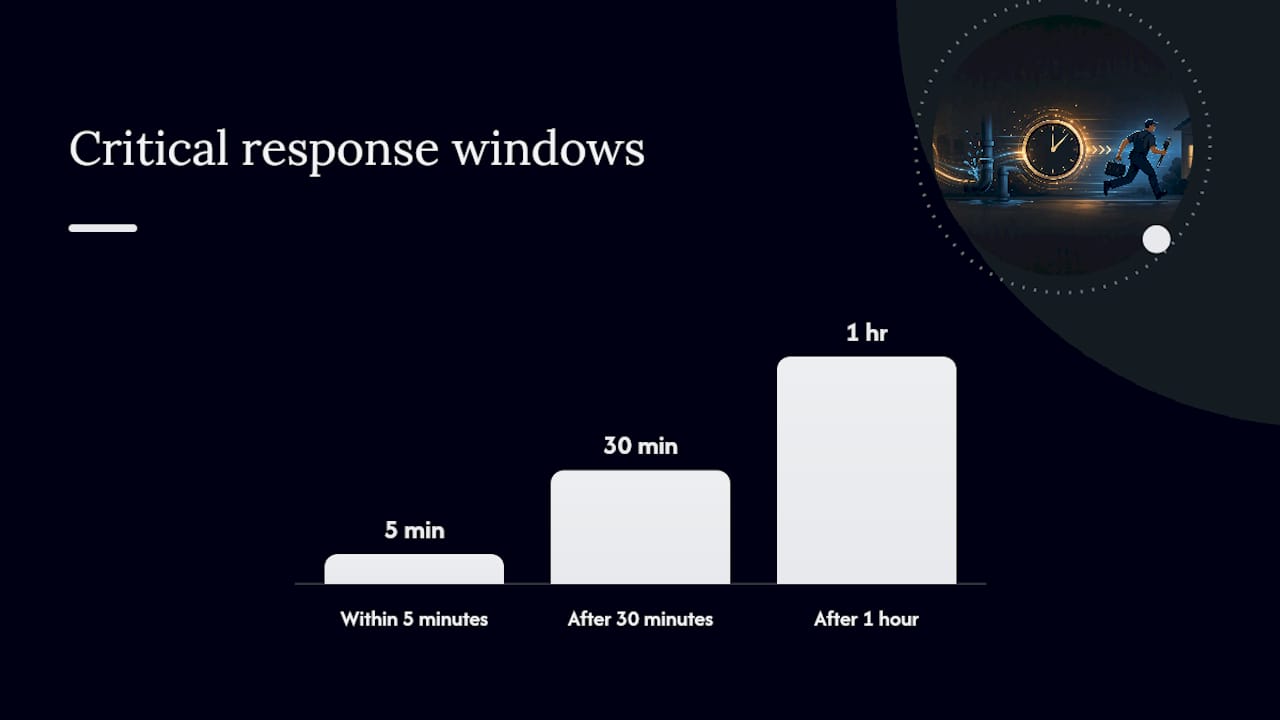
A lead contacted within five minutes is dramatically more likely to book than one contacted after 30 minutes. After an hour, most homeowners have already called someone else. This is not a marketing problem. It is an operations problem.
Initial contact scripts:
Phone script (inbound):
“Thank you for calling [Company Name], this is [Name]. Are you dealing with an emergency right now, or is this something we can schedule? Great. Let me get your address and a quick description of the issue so I can give you an accurate time window.”
Text script (for missed calls or form submissions):
“Hi [Name], this is [Name] from [Company]. We just got your request for [service]. We have availability today. What time works best for you? Reply here or call us at [number].”
Booking and quoting flow:
- Capture: name, address, service type, best contact number, preferred time window.
- Qualify: ask two diagnostic questions to estimate job complexity before dispatch (e.g., “Is water actively leaking right now?” or “How old is the water heater?”).
- Quote: give a range on the phone for standard jobs. Avoid “I’ll have to see it first” for common services. Homeowners who get a number are more likely to book.
- Confirm: send an automated text with the technician’s name, photo, and arrival window.
- Reduce no-shows: send a reminder text one hour before arrival.
SLA recommendations:
- Inbound calls: answered within three rings or called back within five minutes.
- Form submissions: text response within five minutes during business hours.
- After-hours leads: auto-response text with an estimated callback time and an emergency line option.
Follow-up cadence for leads that did not book:
- Same-day text: “Still looking for a plumber? We have openings tomorrow.”
- Day 3 text: “Just checking in. We can usually get out within 24 hours.”
- Day 7 email: Include a testimonial or before-and-after photo from a similar job.
After day 7, move the lead to your long-term nurture list. Do not abandon them. A homeowner who did not book today will need a plumber again. For common plumbing marketing mistakes that kill conversion, slow response and no follow-up system are the two most expensive errors.
It is response time, quoting confidence, or a missing follow-up sequence. Fix those before spending more on ads.*
Your 90-day plan to build a predictable plumbing lead engine
Top-performing plumbing businesses do not rely on a single channel. They build what amounts to a stacked system: LSA and PPC for immediate volume, GBP and local SEO for compounding organic leads, and referrals and reviews for the lowest-cost, highest-converting traffic. Sovereign’s 50-leads-per-month roadmap maps exactly this kind of channel stacking to predictable monthly lead volumes.
Week-by-week schedule
Weeks 1–2 (Foundation):
- Complete GBP profile fully. Submit LSA application and background check.
- Set up call tracking numbers for each planned channel.
- Audit website for mobile speed, click-to-call, and service page completeness.
- Send review requests to the last 30 customers.
Weeks 3–4 (Paid activation):
- Launch LSA once approved. Set a conservative weekly budget ($200–$400).
- Launch Google Search Ads for your top three service types with tight geo-targeting.
- Set up a basic CRM (Housecall Pro, Jobber, or ServiceTitan) and connect it to call tracking.
Weeks 5–8 (Content and referrals):
- Publish service-area landing pages for your top three cities or neighborhoods.
- Launch your referral program with a post-job text template.
- Optimize Angi, Thumbtack, and Yelp profiles. Decide which, if any, warrant paid placement.
- Begin a monthly email to past customers (seasonal tip plus a service offer).
Weeks 9–12 (Optimization and scale):
- Review KPIs: cost per lead, close rate, and cost per booked job by channel.
- Pause or reduce spend on underperforming channels. Increase budget on the top two performers.
- Launch a Meta retargeting campaign using your customer email list.
- Add one new service-area page per week based on search demand data from Google Search Console.
Sample budget allocation
These ranges reflect mid-size U.S. markets. Dense metros will see higher costs per lead; smaller markets will see lower costs but also lower volume ceilings. The Invoice Fly 24-tactic plumbing lead guide validates this multi-channel approach as the standard for businesses targeting consistent monthly lead volume.
How to measure the 90-day experiment: At day 90, you should have clean data on cost-per-lead and cost-per-booked-job for at least three channels. The goal is not to run all channels forever, it is to identify the two or three that produce the best cost-per-booked-job for your market and service mix, then double down.
Pro Tip: As your GBP ranking and organic SEO improve, shift budget from paid channels toward content and review generation. Organic leads from a well-ranked GBP cost near zero in direct media spend. The goal is to reduce your paid dependency over 12–18 months, not to run ads indefinitely.
For a complete digital marketing framework for plumbers, the 90-day structure above is the starting point, not the ceiling.
Why integrated marketing and operations is the only approach that compounds
Most plumbing businesses treat marketing and operations as separate problems. Marketing runs ads. Operations answers calls. The two teams rarely talk, and the result is a leaky bucket: you spend money to fill it, but leads drain out through slow response times, missed calls, and no follow-up system.
The businesses that grow predictably do something different. They treat every channel as one part of a connected system, where a lead generated by an LSA ad flows into a CRM, triggers a five-minute callback, gets a quote on the first call, and receives a review request two hours after the job closes. That review then improves the LSA ranking, which lowers the cost of the next lead. The loop compounds.
Consider a plumbing business running LSA and GBP with no CRM and no review workflow. They generate 30 leads per month, close 12, and collect two reviews. Now add a five-minute response SLA, a post-job review text, and a 30-day follow-up sequence for unconverted leads. The same 30 leads produce 18 booked jobs and 14 new reviews. The LSA ranking climbs. Month three, the same budget generates 40 leads. This is the compounding effect that Ibrand’s sector experience consistently points to: the marketing investment does not change, but the operational layer multiplies its output.
The handoff between marketing and operations is where most small plumbing businesses lose money. A clear SLA (who calls back, in how many minutes, with what script) is worth more than doubling the ad budget. Measurement makes the handoff visible: when you track lead source, response time, and close rate in one place, you can see exactly where leads are dropping and fix it.
Ibrand handles your plumbing lead generation so you can focus on the jobs
Plumbing businesses that want more qualified leads without managing a dozen platforms themselves have a direct route: Ibrand’s local marketing service covers local SEO for small businesses, Google Business Profile optimization, LSA management, and paid ad campaigns built specifically for home service contractors.
Ibrand builds the full system: a conversion-ready website, tracked ad campaigns, a review-generation workflow, and monthly reporting that shows cost per lead and cost per booked job by channel. Clients in the home services space typically see their first qualified leads within the first two weeks of campaign launch, with organic lead volume growing month over month as GBP rankings and local SEO compound.
The next step is a free strategy call where Ibrand reviews your current lead sources, identifies the fastest gaps to close, and builds a channel plan matched to your service area and budget. Get your local marketing plan and see what a fully managed system looks like for your business.
Sources
- Get more plumbing leads: 7 ways to make Google work for you — Plumber Magazine
- Statista — Online review customer opinion
- Americans’ social media use — Pew Research Center
- Plumbing growth playbook — NearLeap Resources
- How to increase plumbing leads: Buy, generate, or both? — ServiceTitan
- Google Business Profile — Google
- Angi Pro signup — Angi
FAQ
What is the best way to get plumbing leads?
The highest-impact combination is Google Local Services Ads for immediate paid leads and a fully optimized Google Business Profile for free map-pack visibility. Add a structured review-request workflow and a five-minute response SLA, and those three moves alone can produce a consistent flow of booked jobs.
How do plumbers find customers in a new service area?
Start with LSA and Google Search Ads targeting the new zip codes, and claim your GBP with the correct service-area settings. Buying leads from Angi or Thumbtack can fill the pipeline while organic rankings build, but track cost-per-booked-job closely so you know when to scale back purchased volume.
Where can I find plumbing leads besides Google?
Angi, Thumbtack, Yelp, Nextdoor, and Facebook/Meta Ads all produce plumbing leads at varying costs. Referrals from past customers typically convert at the highest rate and cost the least per booked job, making a structured referral program one of the most underused sources in the industry.
How do I convert more of the leads I already get?
Response time is the primary driver. Leads contacted within five minutes convert at a significantly higher rate than those reached after 30 minutes. Add a follow-up sequence for leads that do not book on the first contact, and train your team to give a price range on the first call rather than deferring to an on-site estimate.
How much should a plumbing business spend on lead generation?
The right budget depends on your average job value and close rate. Calculate your maximum cost-per-booked-job first, then work backward to set channel budgets.
Recent Comments