
TikTok ads can drive sales for many U.S. small businesses, but only when your creative feels native and your tracking is airtight. Start with one small in-feed or Spark Ads test, install the TikTok Pixel, and add a promo code or UTM-tagged landing page. Judge the test on cost per purchase or cost per lead, not on views.
TL;DR:
- TikTok sets a $20 daily minimum per ad group, so multiple groups raise the floor; begin with one group and maximum delivery.
- Use three to five vertical creatives, open with the strongest moment, and compare purchase or lead costs with profit rather than views.
- Install Pixel events and verify they fire before launch; for phone, appointment, or in person sales, send closed deal data through CRM or offline events.
- Wait 24 to 48 hours before judging, change one variable at a time, and scale gradually only when cost per result stays within target.
Table of Contents
- Why TikTok can make sense for small businesses
- Which TikTok ad formats should small businesses try first?
- What does TikTok advertising cost, and how should you budget a test?
- How do you set up TikTok ads step by step?
- Which creative and targeting practices actually move the needle?
- How do you measure whether TikTok ads really drive sales?
- How do you test and scale on a small budget without breaking what works?
- What do small-business TikTok tests look like in practice?
- How do you fix underperforming TikTok ads using real-time stats?
- How do TikTok ads work alongside local SEO and email marketing?
- What compliance and policy rules should U.S. small businesses watch?
- How should you budget and bid once you outgrow the minimums?
- What is a simple testing and scaling workflow for small budgets?
- What we recommend for U.S. small businesses
- How we can help you launch your first TikTok test
- FAQ
- Sources
Why TikTok can make sense for small businesses
TikTok reaches nearly two billion monthly active users, and many of them discover new brands on the platform. That matters for a small business because the feed is driven by what people watch, not only by who they follow. A well-made video from an unknown shop can land in front of strangers who have never heard of you, something that is hard to do on channels that favor big follower counts.
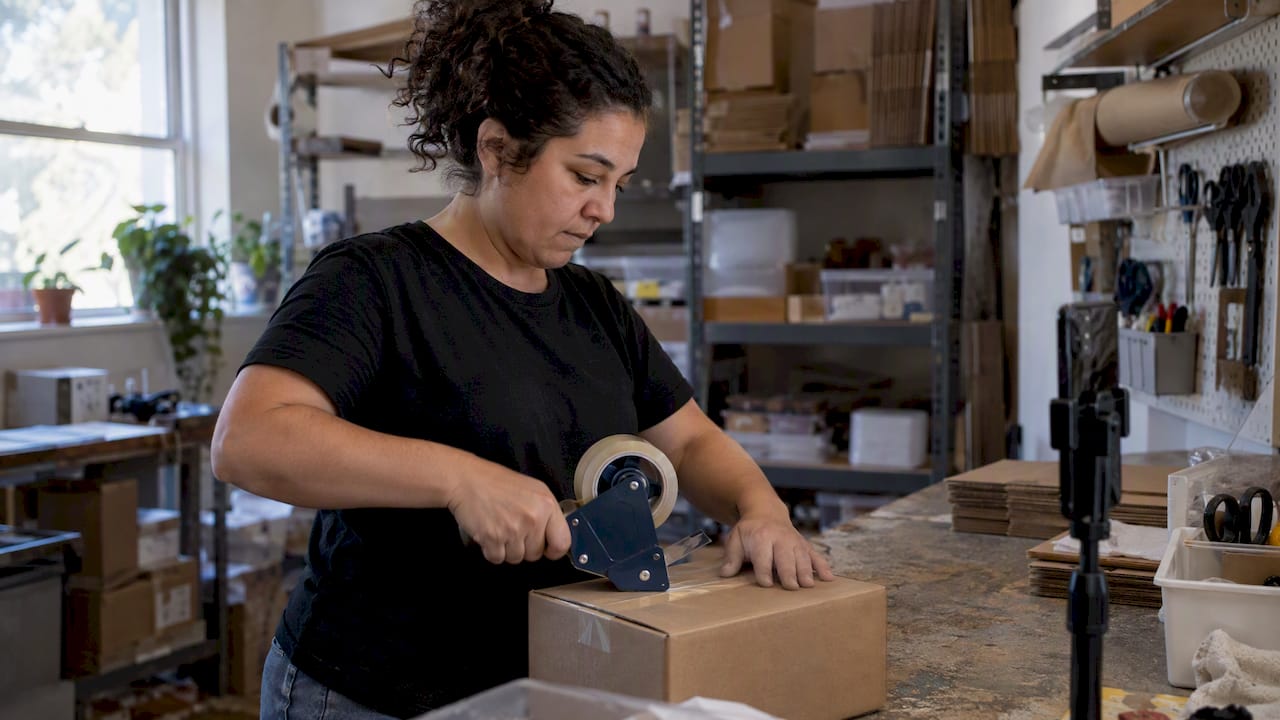
Authenticity beats polish here. A phone-shot video of you packing an order, fixing a customer’s problem, or explaining a product in plain words often looks more at home in the feed than a glossy commercial. People scroll past anything that looks like a traditional ad, so the closer your video feels to the organic content around it, the better your odds.
The younger audience is the strongest part of the platform, but you should not assume TikTok is only for teenagers. Test your own offer against the age groups you actually sell to rather than relying on a general reputation.
Some business types tend to be easier first tests than others:
- Ecommerce and product sellers: Visual products, gifts, beauty, food and home goods are easy to show in 20 seconds.
- Local services with a visible result: Cleaning, landscaping, salons, auto detailing and renovations produce before-and-after clips naturally.
- Restaurants, cafes and venues: Food, atmosphere and events photograph well, and a promo code makes sales easy to trace.
- Coaches and educators: Short tips can build trust before someone fills out a lead form.
- B2B and high-ticket services: These deserve a more cautious test with a smaller budget, since buyers rarely purchase straight from a short video.
Set realistic expectations on resources, too. You need someone who can shoot and edit simple vertical video each week, plus a person who checks results daily during a test. If that sounds like too much to juggle, our social media management basics walk through how small teams keep creative flowing. If you are still weighing channels, this comparison of social media platform differences can help you decide whether TikTok is your best first move.
Which TikTok ad formats should small businesses try first?
TikTok offers several formats, and they are not equally friendly to a small budget. Knowing what each one does keeps you from paying for placements you do not need yet.
In-feed ads blend with organic content and can carry a call to action that pushes viewers to your site or form. They appear between regular videos, so they feel like part of the scroll.
Spark Ads let you promote a post that already exists, whether it is your own organic video or a video from a creator who has given you permission. Because the post keeps its original likes and comments, it looks more like real content and less like an ad.
TopView and Brand Takeover are premium placements that show up first when someone opens the app. They are typically higher-cost, which puts them out of reach for most first tests.
Branded Hashtag Challenges and Branded Effects invite users to create content around your brand. They can build awareness, but they usually need a large budget and a lot of creative support.
Shopping and Video Shopping ads connect product catalogs to the feed and can work well for ecommerce. TikTok’s shopping and lead-gen features can be integrated with Shopify and other ecommerce platforms for direct-sale campaigns.
For your first sales test, we recommend starting with these two:
- In-feed ads: Lower entry cost, full control over the call to action, and a native look.
- Spark Ads: Ideal when you already have a video that earned organic engagement or a customer clip you have permission to use.
Save the premium formats for later, once you know which message and offer reliably produce sales at a cost you can afford.
Creative specs that avoid wasted spend
TikTok’s guidance calls for vertical video of at least 720p, with recommended lengths around 21–34 seconds. Shoot vertically from the start instead of cropping a horizontal clip, because awkward crops make an ad look out of place. Turn sound on in your planning, too, since music, voiceover and captions all shape how a viewer reacts. Add on-screen text so the message still lands for people watching muted.
Simple small-business advice from one UK guide lands in the same place: keep ads short and simple, use trends and sounds thoughtfully, and capture attention fast. Do not stretch a video just to hit a time target. If your point is made in 22 seconds, stop there.
What does TikTok advertising cost, and how should you budget a test?
Cost depends on format, targeting, seasonality, competition and ad engagement. A strong video can pull your costs down, and a weak one can push them up, even with identical targeting.
On the platform side, TikTok sets campaign-level minimum budgets and a $20 daily minimum for ad groups. Plan your test around that floor. If you run multiple ad groups, your total daily minimum rises, so the structure of your test determines your true minimum.
You will also choose a bidding strategy. Maximum delivery spends your budget to get as many results as possible, which makes it a simple starting point. Cost cap bidding tells TikTok the average cost you are willing to pay per result, which gives you more control but can limit delivery if the cap is too low. Begin with maximum delivery while you learn, and move to a cost cap once you know what a good result costs you.
Here is a sample test, built on the $20 ad-group minimum. The dollar figures are illustrative, not market data:
- Launch and stabilize: Run one campaign with one ad group at $20 a day and three creatives. Do not touch anything.
- Read early signals: Check cost per click, video completion and add-to-cart or lead rates. Pause the weakest creative only if it is clearly lagging.
- Add a variation: Swap in one new creative built on what the best performer did well, keeping the budget at $20 a day.
- Test the offer: Change only the promo or landing page headline, and compare results with the earlier performance.
- Decide: Compare cost per purchase or lead with your margin and decide whether to extend, adjust or stop.
TikTok’s guidance suggests using 20% or less of a campaign’s budget during the learning phase for exploration. Reserve a portion of the test budget for exploratory variations, while keeping the rest behind your core ad.
Pro Tip: Decide before launch what a “good” result looks like in dollars. If your cost per purchase exceeds the profit you make on a customer, the test is failing no matter how many views you got.
How do you set up TikTok ads step by step?
Good setup saves you from the most common problem in early tests: spending money you cannot trace. Work through this list before you launch.
- Switch to a TikTok for Business account. TikTok For Business centralizes ad creation, budgeting, audience targeting and analytics in one place.
- Create your Ads Manager account. Use a desktop computer for campaign setup, since the desktop Ads Manager interface is the main tool for building campaigns and viewing analytics.
- Choose Simplified or Custom mode. Simplified mode offers a streamlined set of campaign objectives and suits small businesses starting out. Custom mode gives more control over structure and bidding. If this is your first campaign, begin in Simplified and move to Custom once you want more control.
- Add a payment method. Enter billing details and confirm your account is in good standing before you build anything.
- Set budgets thoughtfully. TikTok’s guidance generally favors daily budgets rather than lifetime budgets in many cases, which keeps spending predictable during a test.
- Install the TikTok Pixel. Place it on your website and create the events that matter to your goal.
- Submit for review and wait. Plan ahead and allow time for approval. Do not schedule a launch around a sale until your ads are approved.
Here is what to prepare in parallel:
- Pixel events: Add-to-cart, purchase and lead events mapped to the right pages or buttons on your site.
- Offline event or CRM tracking: TikTok provides offline event sets and measurement APIs for server-side and CRM tracking, which matters if your sales close by phone or in person.
- A clean landing page: It should load fast on mobile and match the promise of the video, with one clear action.
- A policy check: Review your copy, claims and visuals against TikTok’s ad rules before submission.
For higher-ticket or appointment-based sales, the offline setup is not optional. Without it, TikTok never learns which leads became customers, and it optimizes for the wrong people. Our guide to setting up offline conversion tracking covers the logic in more depth.
Which creative and targeting practices actually move the needle?
Creative does most of the work on TikTok. Targeting matters less than most owners expect, because the algorithm finds viewers based on how people react to your video.
Start with the hook. Give someone a reason to stay right away, so open with your most surprising visual, a bold statement or a clear problem. Do not save the best part for the end, and do not open with a logo animation.
Keep the tone of a real person talking. Be authentic and creative, capture attention quickly, and use trends and sounds with care rather than forcing every trend into every video.
Work through these rules when you build each ad:
- Hook first: Put the strongest moment at the start.
- Make it native: Film on a phone, talk to the camera, and use captions.
- Reuse what already works: If an organic post or a customer video performed well, promote it with Spark Ads.
- Run several creatives: TikTok’s guidance recommends three to five creative assets per ad group, so you can see which angle wins.
- Refresh regularly: When the same video runs for too long, results fade as viewers tire of it.
- One message per video: A single offer and a single next step convert better than a list of features.
On targeting, begin with broad, automatic audiences. Broad targeting is recommended initially, because it gives the algorithm room to find buyers you might not have guessed. After you collect conversion data, build custom and lookalike audiences from your purchasers or leads, and test them against your broad campaign rather than replacing it.
For local businesses, keep the geography tight to the areas you can actually serve. Our guide on how to run social ads for local small businesses covers local targeting in more detail, and our practical social media tips work well as a creative idea bank.
Pro Tip: Film short clips in one sitting, showing the problem, the product in use, a customer reaction, a quick tip and the offer. Edit them into different ads. One shoot can give you material for a test.
How do you measure whether TikTok ads really drive sales?
An ad platform will always report some conversions, so the harder question is whether those sales are real and would not have happened anyway. Use more than one signal.
Start with the TikTok Pixel. It is part of the TikTok For Business toolkit, alongside offline event sets and the measurement APIs. Map your key actions, such as add-to-cart, purchase and lead, to the right pages or buttons so the platform can count them accurately. TikTok’s developer documentation lists measurement endpoints for Pixel creation, offline events and event statistics, which a developer or agency can use for server-side uploads.
Work through this measurement checklist:
- Pixel events: Confirm each event fires once, on the right action, before you spend a dollar.
- Offline events or CRM data: Send back closed deals, booked appointments or in-store purchases so TikTok optimizes for real customers instead of form fills.
- UTM parameters: Tag every link so your analytics tool shows which campaign, ad group and creative produced a visit.
- Promo codes: Give TikTok buyers their own code. Redemptions show sales that tracking might miss.
- Post-purchase surveys: Add a “How did you hear about us?” question to checkout or intake forms.
Understand the difference between click and view attribution. A click-based conversion means someone tapped your ad and then bought. A view-based conversion means someone watched but did not click, then bought later. View-based numbers can be real, since many people see a video, search your name and buy, but they are easier to overcount. Compare platform numbers with promo-code redemptions and survey answers to see how close they are.
For larger budgets, a conversion-lift study compares people who could see your ads with a similar group who could not, which shows how many sales the ads caused. Most small businesses do not need one on day one, but it becomes useful once spend grows.
Keep a holistic view across channels, too. If your sales rise while TikTok spend runs, check branded search and direct traffic, because TikTok viewers often come through a side door. Our guide on how to track campaign performance explains how to bring those pieces together.
How do you test and scale on a small budget without breaking what works?
Patience is the most valuable skill in your first month. Most early failures come from changing too much too soon.
Respect the learning phase. TikTok’s guidance suggests waiting one to two days to observe your KPIs before scaling and aiming for about 50 conversions per ad group to exit the learning phase. A small budget may take longer to reach that number, so judge early results on trends rather than single days.
Follow this cadence:
- Launch and leave it alone for 24 to 48 hours. Early numbers swing wildly.
- Check cost per result against your target. Compare it with your margin, not with industry averages.
- Remove clear losers only. Pause a creative if it is far behind its siblings after meaningful spend.
- Add new creatives built on the winner. Change the hook or the offer, not both at once.
- Scale in small steps. Raise the daily budget in modest increments and watch cost per result for a couple of days before the next increase.
A good scaling signal is a stable or falling cost per result while spend rises. A bad signal is cost per result climbing with reach shrinking. When that happens, refresh the creative before you touch the budget.
A learning-phase rule of thumb: Use 20% or less of a campaign’s budget during the learning phase, and avoid large mid-test changes that reset it.
Expand your audience only after your creatives prove stable. Adding lookalikes or new regions too early muddies your data, and you cannot tell what caused a change.
What do small-business TikTok tests look like in practice?
These are anonymized patterns, not case studies with results. Each one shows how a small business might structure a first test, and you can copy the structure without copying the numbers.
- Product seller with a promo code: A shop runs Spark Ads on an organic video that earned strong engagement and adds a code only TikTok viewers see. It sends traffic to a UTM-tagged landing page, so sales appear in analytics and in code redemptions. The takeaway: when the code count and the platform count roughly agree, you can trust your numbers.
- Local service with lead forms: A home-services business uses instant lead forms and connects them to its CRM. The team follows up promptly with every new lead, because a fast reply often matters more than a perfect ad. The takeaway: the follow-up process is as much a part of the campaign as the video.
- Niche ecommerce with creative variety: A small online brand tests several hooks across three to five creatives, then builds a lookalike audience from its buyers once enough purchases accumulate. It reviews cost per purchase across each phase and keeps what works. The takeaway: improvement usually comes from repeated small tests, not one breakthrough video.
None of these patterns promises a result. They show a habit: pick one change, measure it, keep what helps. If you want help deciding which pattern fits your business, our local marketing guide is a good starting point.
How do you fix underperforming TikTok ads using real-time stats?
Weak results usually come from one of a few places, and your dashboard tells you which. Read the stats from the top of the funnel down to the bottom.
If people are not stopping, the hook is the problem. Look at video views and the share of viewers who watch past the first few seconds. A low number means the opening needs a stronger visual or a bolder first line.
If people watch but do not click, the message or call to action is weak. Rewrite the final line, make the offer clearer, or add a reason to act now, like a limited code.
If people click but do not buy, the landing page or offer is the issue. Check page speed on a phone, confirm the page matches the video, and cut distractions. A mismatch between the ad’s promise and the page is one of the most common leaks.
If costs climb after a good start, suspect fatigue: the same people have seen the same video too often. Swap in a new creative before raising budgets.
Avoid these common pitfalls:
- Editing every day: Constant changes keep resetting learning.
- Judging too early: One bad day is not a trend.
- Optimizing for the wrong event: Choosing clicks instead of purchases brings cheap traffic that does not buy.
- Broken tracking: Test your Pixel before spending, not after.
Check stats daily during a test, but act weekly unless something is clearly broken. Our resource on real-time website analytics shows how to read live numbers without overreacting.
How do TikTok ads work alongside local SEO and email marketing?
TikTok works best as one part of a system, not a standalone channel. Many viewers will not buy on the first exposure. They will search your name later, visit your Google Business Profile, or sign up for your list.
Make sure those next steps are ready. Keep your business name, address and hours consistent online, since people who see you on TikTok often verify you with a quick search. A strong profile with recent reviews turns that search into a visit or a call. Our guides on what local marketing is and targeting a local audience cover the basics.
Email is where TikTok traffic becomes repeat revenue. Offer a small incentive, such as a first-order discount or a useful checklist, in exchange for an email address on your landing page. Then follow up with a short welcome sequence. This gives you a second chance with visitors who were not ready to buy the first time, and it lowers your real cost per customer over time.
Use the same message everywhere. If your TikTok ad promises a spring special, the landing page, the email and your search listing should repeat it. Consistency makes people trust you faster.
Finally, put your best-performing TikTok videos to work elsewhere. A clip that earns a strong response on the platform can also appear on your website and in email. Your site matters in this chain, so review our website design basics for local businesses before you drive paid traffic to it.
What compliance and policy rules should U.S. small businesses watch?
TikTok reviews every ad before it runs, so a policy problem delays your launch. Treat review as part of your schedule, not an afterthought, and remember that approval can take up to a day.
Common issues to check before you submit:
- Misleading claims: Avoid exaggerated promises or results you cannot support. If you show a result, make sure it is typical or clearly labeled.
- Restricted categories: Some industries, such as alcohol, financial products and health-related offers, face extra rules or limits. Read TikTok’s current advertising policies for your category before you build creative.
- Music and sound: Use audio you are cleared to use in ads. A trending track in organic posts is not always available for paid promotion, so use the platform’s commercial options.
- Creator content: Get clear permission before promoting a customer’s or creator’s video with Spark Ads.
- Landing page match: The page you send people to should reflect the ad and display clear business information.
- Disclosure: If you work with creators and pay them or give free products, make sure the relationship is disclosed as required by U.S. advertising rules.
Policies change, so check TikTok’s official ad policies and the Federal Trade Commission’s guidance for endorsements before you launch, and consult a professional if your category is regulated. A review of your script, captions and landing page can help you avoid a rejected ad or a restricted account.
How should you budget and bid once you outgrow the minimums?
Once your test proves an offer can sell, the budget question changes from “what is the least I can spend” to “how much can I spend while staying profitable.”
Work backward from your numbers. Take your average profit per sale, subtract your costs, and set a maximum cost per purchase you can accept. That figure becomes your guide for every budget and bidding decision.
TikTok’s guidance generally supports campaign budget optimization when you run multiple ad groups, letting the platform shift money toward the ad group that performs best, and it suggests three to five ad groups per campaign as a structure. Keep your structure simple while the budget is small, because more ad groups spread the same dollars thinner and slow learning.
On bidding, move from maximum delivery to a cost cap when you know your target cost per result. Set the cap close to what you have seen in tests, not at a hopeful number far below it, or delivery may stall. If delivery slows, raise the cap a little and watch for a few days.
Match budget changes to proof. Raise spending when results are stable, hold it when they swing, and cut it when cost per result rises and fresh creative does not fix it. Keep a reserve for new creative production, since fresh videos often decide how far a budget can stretch.
If you want a second set of eyes on your numbers, our SEO and local marketing guidance shows how paid and organic efforts can share the load.
What is a simple testing and scaling workflow for small budgets?
Think of your workflow as a loop you repeat: build, launch, read, adjust, scale. A small budget works if you run the loop with discipline.
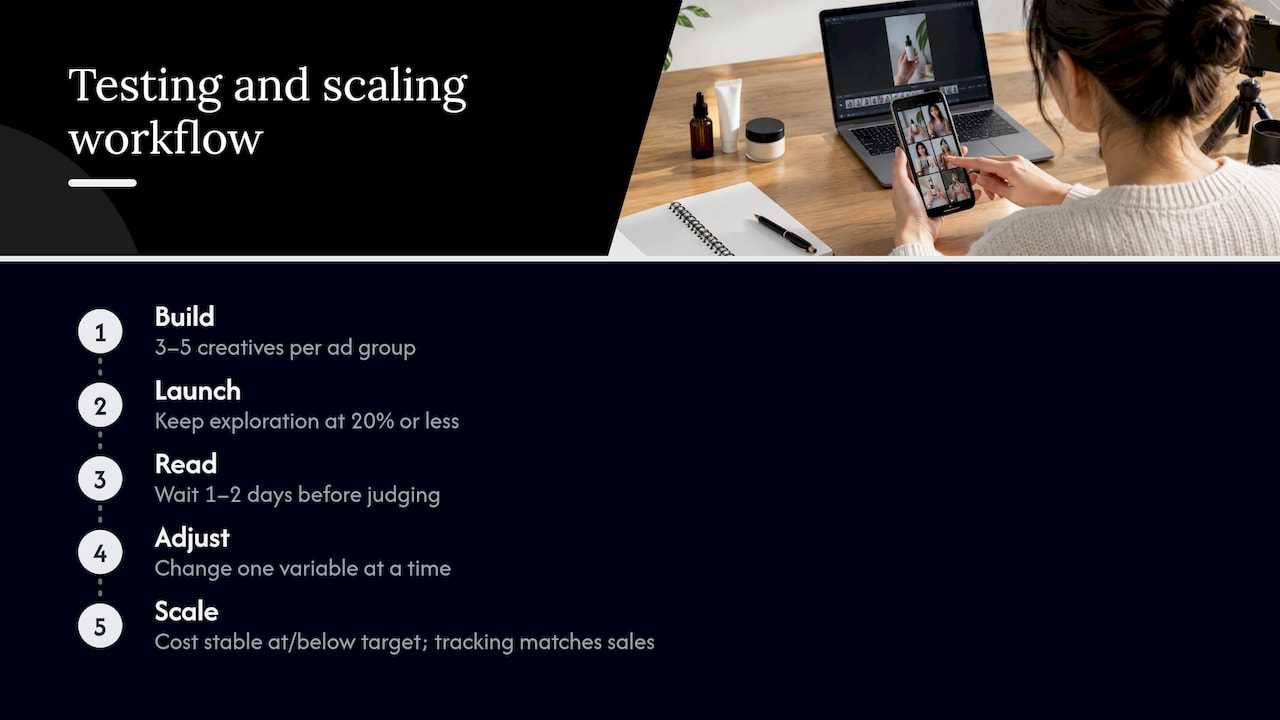
Start with allocation. Put most of your budget behind a core ad group and reserve a smaller slice for exploration. TikTok’s guidance suggests 20% or less of a campaign’s budget during learning, so you can try new angles without disrupting what is working.
Then set your creative count. Three to five creatives per ad group give the algorithm enough variety to find a winner without splitting delivery too thin. Name each file clearly, such as “hook-problem-v1,” so you can tell later which idea won.
Decide your reading window up front. Give each ad group one to two days before judging, and use a longer window if your budget is small and conversions come slowly. Aim for about 50 conversions per ad group to leave the learning phase when feasible, but treat that as a goal, not a requirement for every test.
When should you scale? Scale when cost per result has stayed at or below your target across several days, when the best creative still holds its engagement, and when your tracking agrees with your sales records. Increase the budget gradually, and add one new variable at a time. If results break, step back to the last stable budget and refresh the creative.
Keep a simple log with the date, change made and result. Over time, that log becomes a valuable asset, because it shows what your customers respond to.
What we recommend for U.S. small businesses
We advise TikTok when your product or service is easy to show on video, your margins can support testing, and you have someone who can produce simple content each week. When the offer is hard to explain visually, or your customers search for you intent-first, we usually put search and local marketing ahead of TikTok and add it later.
Our starter process is short. We audit your offer, site and tracking, then run a test with Pixel and offline events in place. We review the results against your margin and write a scale plan. During the test, we watch performance in real time and report in plain language, so you know what is working, what we changed and why.
— TONY
How we can help you launch your first TikTok test
If you would rather hand the setup and testing to a team, we can help. Here is what a starter engagement from Ibrand covers:
- Social media advertising: Campaign structure, budgets and bidding for your first test.
- Creative production: Native, vertical video built around a strong hook.
- Pixel and offline tracking: Clean measurement from the first click to the closed sale.
- Real-time reporting: Plain updates on cost per result and what we are changing next.
We run an audit, a managed test, a results review and a scale plan. Contact us through our homepage to discuss a test campaign for your business.
FAQ
Is TikTok a good way to advertise your business?
It can be, if your product suits short video and you track results properly. Start with a small in-feed or Spark Ads test, measure cost per purchase or lead against your margin, and expand only if the numbers hold.
How much do you need to spend on TikTok ads?
Plan around the platform’s minimums, which include a $20 daily minimum for ad groups. Actual costs depend on format, targeting, seasonality, competition and how well viewers respond to your ad.
Which TikTok ad formats should small businesses try first?
In-feed ads and Spark Ads are the best starting points because they look like organic content and cost less than premium placements. TopView and Brand Takeover are better saved for later, once you know what sells.
How do I get started on TikTok ads?
Switch to a TikTok for Business account, create an Ads Manager account on a desktop, and install the TikTok Pixel. Then launch a small test with three to five vertical video creatives and a trackable promo code or UTM link.
Sources
- How to build the perfect TikTok ad campaign, according to TikTok
- The only TikTok advertising guide you’ll ever need
- TikTok advertising: A comprehensive guide
- TikTok Ads Guide: How They Work + Cost and Review Process + Examples
Recent Comments