
Most sites see early technical signals within days to weeks, measurable momentum for easier keywords in 3 to 6 months, and significant, stable ROI in 6 to 12 months or longer. Highly competitive targets often take a year or more of consistent work, as top rankings tend to compound over time rather than arrive on a fixed schedule. The caveats matter more than the headline number: your starting point, niche, and execution speed all shift these windows.
TL;DR:
- Achieving stable rankings for competitive keywords typically requires a year or more of consistent effort due to the time it takes for Google to re-evaluate signals.
- Initial momentum, including indexing and impressions, generally appears within three to six months, but steady lead generation often lags by several months.
- Site health issues like crawl errors and slow server response can delay results, making technical fixes a priority early in the process.
- Backlink velocity and content relevance are critical; high-quality backlinks from relevant sites accelerate rankings more than rapid link-building.
- Expect significant, measurable ROI to develop after six months, with ongoing improvements driven by content, links, and site optimization.
Table of Contents
- 1. The month-by-month SEO timeline from launch to year two
- 2. What factors speed up or slow down your results
- 3. Which metrics tell you SEO is actually working
- 4. What the research says about ranking speed and timing
- 5. Quick wins that produce visible movement fastest
- 6. What documented SEO work actually looks like over time
- 7. Why vendor promises about speed deserve skepticism
- 8. How we help you move through this timeline faster
- FAQ
- Sources
1. The month-by-month SEO timeline from launch to year two
The work you do in the first two weeks sets the pace for everything after it, and skipping steps here is the single biggest reason timelines stretch longer than they need to.
- Week 1 to 2: run a technical audit, check how many pages Google has indexed, fix crawl blockers, submit or refresh your sitemap, and use the URL Inspection tool to request a recrawl on pages you have changed.
- Month 1: implement the fixes the audit surfaced, prioritize the handful of pages closest to ranking, and get Google Search Console and GA4 connected and verified before you publish anything new.
- Months 2 to 3: settle into a content publishing cadence, build internal links between related pages, and start outreach for the first backlinks; expect early movement on low-difficulty, long-tail keywords during this window.
- Months 4 to 6: traffic growth becomes noticeable for medium-difficulty terms, and the backlinks built in months 2 and 3 start influencing rankings as Google re-evaluates authority signals.
- Months 6 to 12: rankings stabilize, and many small business campaigns see a steadier, more predictable flow of leads rather than isolated spikes.
- Year 2 and beyond: compounding takes over. Content built in year one keeps earning links and traffic, and the cost of ranking for new terms drops because your domain already carries topical weight.
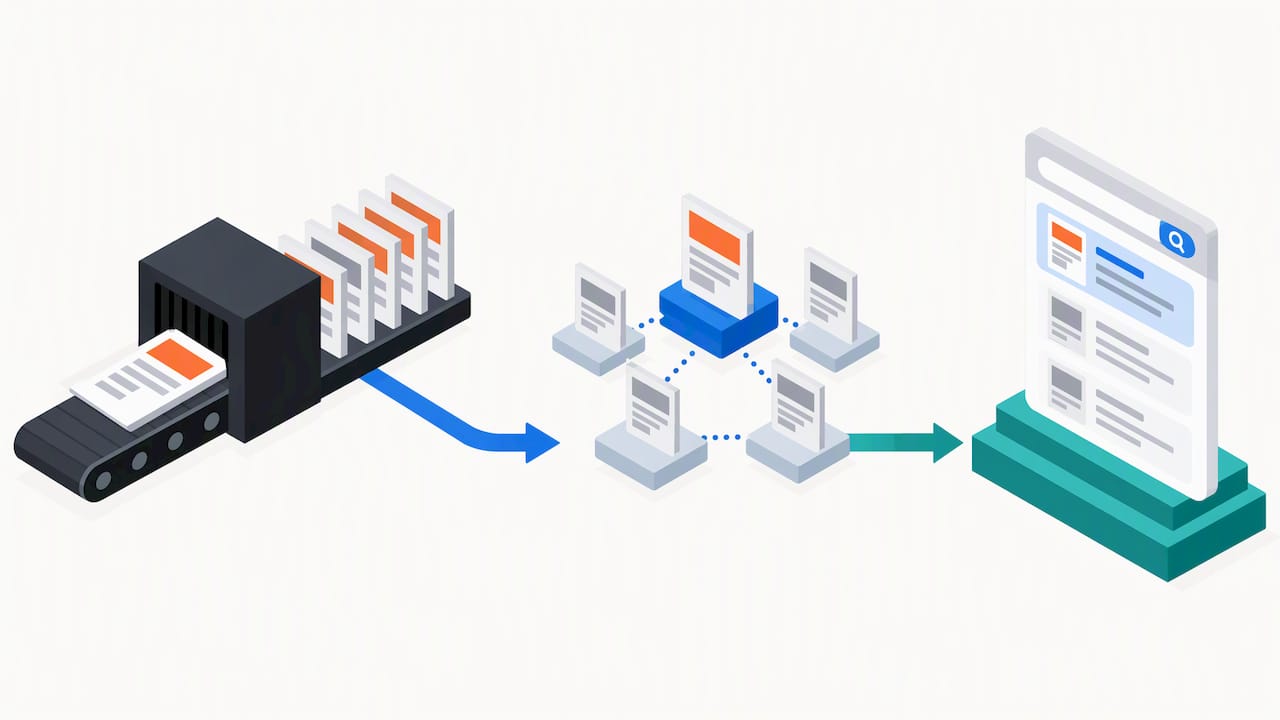
Crawling itself moves faster than most people expect. According to Search Engine Land, SEO runs on multiple independent clocks at once: crawling and indexing can happen quickly, but ranking stabilization for competitive terms usually takes months, and lead generation often lags behind traffic by several more months. Reporting on all three separately keeps expectations honest. Google’s own developer documentation confirms crawling after site changes typically takes a few days to a few weeks, with indexing and ranking processed as Google continues to re-evaluate signals over time.
The 3 to 6 month figure you see everywhere deserves a specific definition. It is best understood as the time to reach measurable momentum, meaning indexed content plus rising impressions, not the time to reach peak rankings. Many businesses mistakenly pull the plug around month three, right when the foundation work is finally starting to compound.
For a deeper walk-through of the costs and deliverables tied to each phase, our 90-180-360 day SEO timeline breaks down what a structured implementation plan looks like in practice.
2. What factors speed up or slow down your results
Two businesses can run the same SEO plan and see very different timelines, because the starting conditions matter as much as the work itself.
- Domain authority and age: established domains with existing trust signals tend to gain traction faster than brand-new sites because Google already has a track record to evaluate.
- Keyword competition and intent match: targeting low-competition, specific queries produces movement faster than chasing broad, high-volume terms from day one.
- Content quality and depth: one thorough page that fully answers a query consistently outperforms five thin pages that each cover a sliver of the topic.
- Technical site health: crawlability problems, heavy JavaScript rendering, and slow server response times can quietly stall everything else you do.
- Backlink velocity and quality: a steady trickle of earned links from relevant sites moves the needle more than a burst of low-quality ones.
- Internal turnaround time: how fast your team or developer can ship approved fixes directly affects how quickly signals show up.
Backlinks deserve a specific caution here. An Ahrefs analysis of one million newly published pages found that only 1.74% reached Google’s top 10 within their first year, and the study notes that backlink velocity accelerates results more than almost any other factor, but only when it is paired with content that actually matches what searchers want. Links pointed at a page that misses search intent tend to compound the wrong signal rather than the right one.
When a page shows no movement after roughly six months, the usual culprits are intent mismatch, thin content, or a lack of backlinks, not simply “not enough time” (per The Stacc). Diagnosing which of those three is holding a page back is more productive than waiting it out.
Pro Tip: Before adding more content, check whether your underperforming pages actually match what the searcher is trying to accomplish. Thin, well-targeted pages often outrank long, mismatched ones.
3. Which metrics tell you SEO is actually working
Watching the wrong metric at the wrong time is the fastest way to abandon a campaign that was quietly working. Different signals mature at different speeds, and reading them in sequence prevents false alarms.
| Timeframe | Metrics to watch | What they tell you |
|---|---|---|
| Early (weeks 1 to 6) | Indexed pages, crawl frequency, URL Inspection status, technical error counts | Whether Google can find and process your content |
| Mid (months 2 to 6) | Impressions, click-through rate, ranking position for target clusters, organic keyword count | Whether visibility is building for the right terms |
| Late (months 6 to 12+) | Organic leads, conversion rate stability, revenue attribution | Whether visibility is turning into business results |
The lag between rising traffic and rising leads catches a lot of business owners off guard. For many small business websites, that gap runs 3 to 6 months, largely because new visitors need to repeat exposure and trust-building content before they convert, and because conversion tracking itself often needs a full sales cycle to produce a clean signal.
Practitioners who track this closely tend to check Search Console data daily rather than waiting for a monthly report, since daily monitoring catches early spikes or sudden drops before they become a trend worth worrying about. Google’s own explanation of how Search works notes that indexing involves canonical selection and clustering, which is part of why a page can be indexed but still not served prominently right away.
4. What the research says about ranking speed and timing
Published data gives a clearer picture than guesswork, and it is less optimistic than most pitches suggest.
A very small percentage of newly published pages reach Google’s top 10 within their first year, according to Ahrefs’ study of one million URLs. That figure alone explains why a realistic timeline measures progress in stages rather than expecting a quick jump to page one.
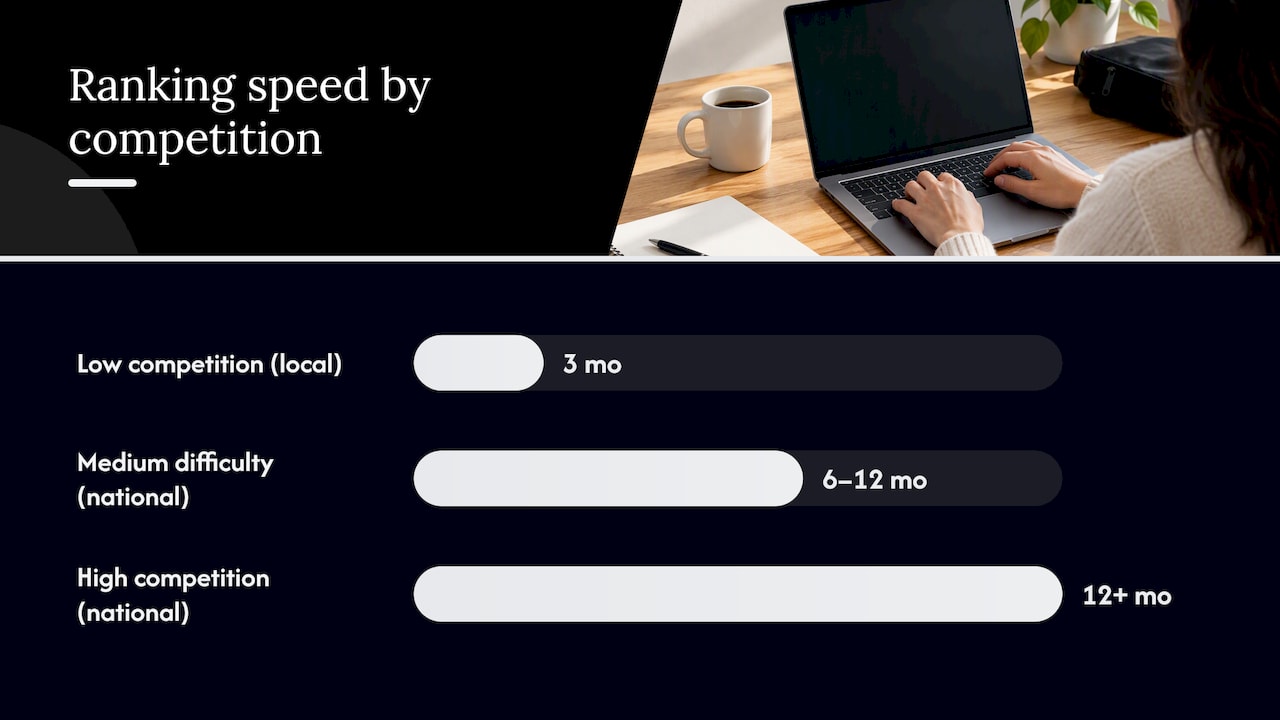
Realistic ranges vary sharply by difficulty and geography:
- Low-competition, local queries often move fastest, since fewer sites compete for the same map-pack or neighborhood terms.
- Medium-difficulty national keywords typically take longer to show stable movement, often falling into the 6 to 12 month window described above.
- High-competition national terms, especially in crowded industries, frequently take a year or more of sustained content and link-building work before they crack the top results.
Consider an anonymized pattern common among small service businesses: a local plumbing company starts with a handful of indexed pages, no structured content, and weak internal linking. Over the first 90 days, a focused technical cleanup and a dozen new location and service pages produce rising impressions for long-tail terms. By month 6, several of those terms reach page one, and by month 10, those rankings have translated into a steady trickle of form submissions. None of that happened in month one, and none of it would have happened at all without the groundwork laid there.
5. Quick wins that produce visible movement fastest
Some fixes show up in Search Console within days, which makes them worth tackling before anything else.
- Fix crawl errors flagged in Search Console, correct robots.txt mistakes, and resolve duplicate or conflicting canonical tags.
- Improve server response time and page speed, since slow-loading pages can suppress crawl frequency as well as rankings.
- Rewrite thin or outdated title tags and meta descriptions on pages that already rank but underperform on click-through rate.
- Add or correct schema markup and compress oversized images that are dragging download times.
- Claim and fully optimize your Google Business Profile, since local map-pack visibility often improves faster than organic rankings.
- Solicit a handful of recent customer reviews and correct inconsistent name, address, and phone details across directories.
- Verify analytics and goal tracking, connect GSC and GA4, and set up UTM parameters so every later result can actually be measured.
A reliable technical foundation underpins all of this. 540 Interactive’s guide on signs your website needs an update covers the kind of structural red flags, like slow load times and outdated mobile layouts, that quietly cap how fast any of these quick wins can work.
Pro Tip: Tackle technical fixes before content fixes. A fast, crawlable site makes every other improvement more visible, sooner.
6. What documented SEO work actually looks like over time
We structure engagements around checkpoints that match how these timelines actually unfold, not around vague promises.
- A 30-day checkpoint covering the technical audit, tracking setup, and quick-win fixes completed in that window.
- A 90-day checkpoint showing early keyword movement, published content, and initial outreach results.
- A 180-day checkpoint reviewing traffic trends, keyword cluster growth, and early lead data.
- Reporting built on Search Console and GA4 access, so clients can see the same data we are reading.
This cadence gives business owners a way to judge progress against real milestones instead of a single end date.
7. Why vendor promises about speed deserve skepticism
Any agency guaranteeing page-one rankings within 30 days is either misunderstanding how indexing and ranking work or hoping you will not check back. Crawling can happen fast, but ranking stabilization for anything competitive takes months, not weeks, and no one controls Google’s evaluation timeline.
In the early months, pairing paid search or social ads with SEO work is often the smarter move. Paid channels buy visibility while organic signals build underneath them, so the business does not go quiet while the slower clock ticks. Judge early progress by indexed pages, impressions, and crawl health, not by promises about where you will rank next month.
— TONY
8. How we help you move through this timeline faster
A clear 30-day audit cuts most of the guesswork out of an SEO timeline, and that is where engagements typically start. It is common to combine technical SEO, content production, backlink outreach, and local SEO management so the fixes that move fastest, like crawl errors and Google Business Profile optimization, happen in parallel with the slower-building work like content and links.

A typical path with us looks like this:
- First 30 days: full technical audit, tracking setup, and the quick-win fixes covered above.
- Days 30 to 90: content production begins, paired with outreach for the first backlinks.
- Days 90 to 180: reporting shows which keyword clusters are gaining traction, with adjustments made based on real data rather than guesswork.
Pricing is built around a custom plan for each client rather than a one-size package, and every engagement includes the real-time performance tracking that lets you see the same numbers we do. If you want a clear picture of where your site stands before committing to anything, start with a consultation and we will walk you through exactly what a realistic timeline looks like for your situation.
FAQ
How long does SEO take to show results?
Early technical signals, like indexing and crawl fixes, can show up within days to weeks, while most small business targets see measurable momentum in 3 to 6 months. Significant, stable ROI and competitive keyword rankings typically take 6 to 12 months or longer, based on Search Engine Land’s analysis of SEO’s multiple timelines.
What is the 80/20 rule in SEO?
The 80/20 rule generally refers to the idea that a small share of pages, keywords, or fixes tends to drive most of the measurable results, so prioritizing the highest-impact technical and content issues first produces faster movement than spreading effort evenly. Definitions vary by source, but the practical takeaway is the same: fix what matters most before chasing smaller gains.
Is an SEO score of 92 good?
SEO scores come from third-party tools with their own scoring methods, so a high score is generally a strong signal of solid technical health, but it does not guarantee rankings or traffic. Rankings depend on far more than a single tool’s score, including content quality, backlinks, and competition for your specific keywords.
Is SEO dead now with AI?
SEO is not dead, but it is evolving as AI-generated answers change how some searches get served. Google still relies on crawling, indexing, and serving to surface content, and sites with strong technical health and genuinely useful content remain positioned to appear in both traditional results and AI-driven ones.
Sources
- How long does it take to rank in Google? And how old are top ranking pages? — Ahrefs
- Ask Google to recrawl your URLs — Google Developers
- Google crawling, indexing and recovery timing ranges — Search Engine Journal
- How long does SEO take to work? — Search Engine Land
Recent Comments