
Most U.S. small businesses pay between $500 and $5,000 a month for SEO, with local service businesses landing on the lower end and competitive or ecommerce brands pushing past $10,000. The smartest starting move is not the biggest package you can afford. Build a narrow local foundation first, a solid Google Business Profile, clean technical setup, a handful of strong service pages, working conversion tracking, and getting everything in writing before you spend a dollar on anything broader.
TL;DR:
- Small businesses should prioritize building a local foundation with a well-maintained Google Business Profile and core service pages before expanding their SEO budget.
- Entry-level local SEO typically costs $500 to $1,500 per month, while more competitive or ecommerce campaigns can exceed $10,000.
- The most common SEO pricing model is a monthly retainer, which should be accompanied by clear deliverables, ownership, and transparent reporting.
- Costs increase with site size, competition, geographic scope, technical issues, and content needs, so assessing these factors is crucial before scaling.
- Starting with technical cleanup and local optimization offers the best return on investment for small businesses with limited budgets.
Table of Contents
- How Much Does SEO Cost for a Small Business?
- What Pricing Models Do SEO Providers Use?
- What Factors Drive SEO Costs Up or Down?
- What Should You Budget by Business Type?
- What Should a Credible SEO Package Include?
- How Do You Set a Budget and Measure ROI?
- What Questions Should You Ask an SEO Provider?
- Ibrand’s Approach to Budget-Conscious SEO
- The Playbook Most Small Businesses Get Backward
- Get a Budget-Fit SEO Plan Built for Your Business
- Sources
- FAQ
How Much Does SEO Cost for a Small Business?
Quotes vary wildly because the work itself varies wildly, but three tiers show up again and again across the market.
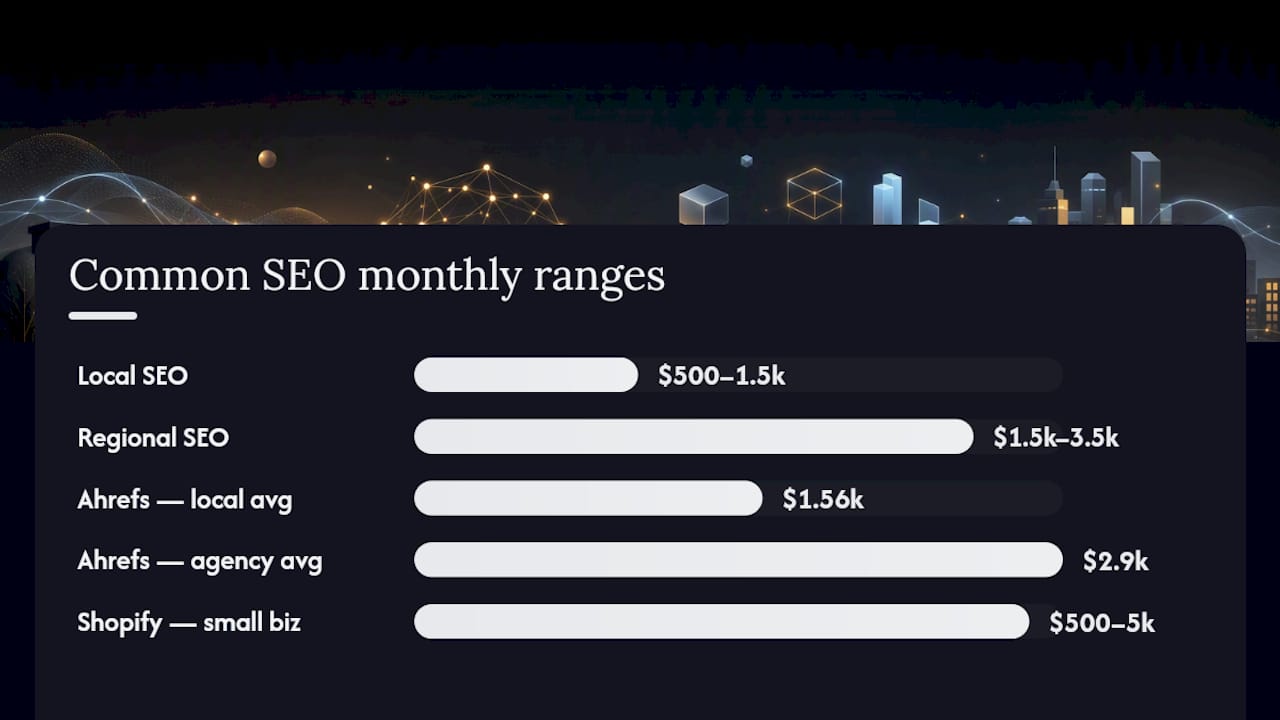
Entry-level or single-location local SEO typically runs $500 to $1,500 per month. This tier covers Google Business Profile management, a set of core service pages, basic technical fixes, and a slow, steady push on local rankings. It fits a plumber, a dentist, a boutique gym, or any business competing in one city or metro area.
Growth-stage or regional SEO sits at $1,500 to $3,500 per month. You’re now looking at ongoing content production, more aggressive technical work, and sometimes a light link-building component. This tier suits a business serving multiple neighborhoods or a few nearby cities, or one facing real competition for its main keywords.
Competitive, national, or ecommerce SEO typically involves significant monthly expenses due to larger scale and complexity. An Ahrefs survey puts average agency pricing near $2,900 a month across the industry, with local SEO averaging closer to $1,557 a month among the agencies it polled. Shopify’s pricing research lands in a similar range, noting many small-business packages fall between $500 and $5,000 monthly, while broader campaigns can exceed $10,000.
One-time projects follow a different math. A technical audit alone typically runs $1,000 to $5,000, depending on site size and how deep the crawl needs to go. A full website migration audit (moving platforms, replatforming, or consolidating domains) often lands between $3,000 and $10,000 because of the QA work involved. Large content projects, say, rewriting 20 to 30 service pages, tend to fall in the $2,000 to $8,000 range depending on research depth and word count.
Hourly consulting rates for small businesses usually fall within a range suitable for specialized advice and guidance. A single-location plumber might hire a consultant for 10 hours a month to review technical issues and guide an in-house employee, spending roughly $1,000 to $2,500 monthly without a full retainer. A small ecommerce shop with 200 product pages, by contrast, usually needs more hands-on execution than hourly consulting can realistically deliver, which is why most shift to a retainer once past the startup phase.
Quick reference for common scenarios:
- Single-location service business (HVAC, salon, law office): $500 to $1,500/month
- Multi-location or regional business: $1,500 to $3,500/month
- Competitive niche or small ecommerce: $3,500 to $10,000/month
- One-time technical audit: $1,000 to $5,000
- Hourly consulting: $100 to $250/hour
What Pricing Models Do SEO Providers Use?
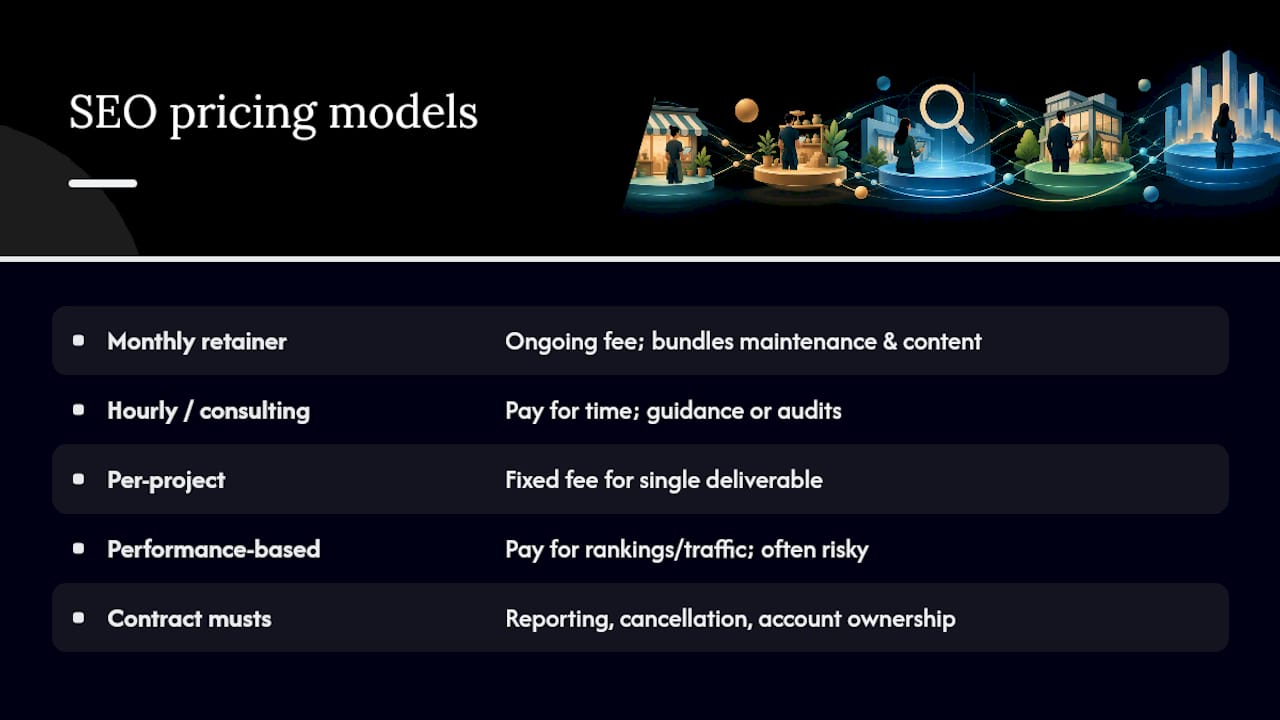
Most SEO providers charge one of four ways, and each one shifts risk and responsibility differently between you and the agency.
Monthly retainer. This is by far the most common structure. Roughly 70 to 80 percent of providers price this way, according to Ahrefs’ survey data, because SEO is ongoing work, not a one-time fix. A retainer typically bundles technical maintenance, content production, reporting, and Google Business Profile management into one predictable monthly fee. The upside is budget predictability. The downside is that two agencies charging the same $2,000 a month can deliver wildly different amounts of actual work, so the retainer price alone tells you almost nothing without a specific list of deliverables attached to it.
Hourly or consulting. You pay for time, usually to guide an internal team or audit specific problems rather than execute ongoing work. This model fits businesses with in-house staff who need direction, not a full outsourced program. It’s flexible but offers no guarantee of consistent output month to month.
Per-project. You pay a fixed fee for a defined deliverable: an audit, a migration, a content batch. This works well for a one-time need but leaves ongoing optimization, the part that actually compounds over time, unaddressed.
Performance-based. Payment ties to rankings or traffic milestones. This sounds appealing on paper, but it’s rare among reputable providers because Google itself warns that no one can guarantee rankings. Providers offering performance pricing sometimes chase easy, low-value keywords just to hit contract metrics, which can waste your budget on traffic that never converts.
Whatever model you choose, lock down three things in the contract: reporting cadence (monthly, at minimum), cancellation terms (30-day notice is standard; anything requiring a year-long lock-in deserves scrutiny), and account ownership. You should own your Google Business Profile, Search Console, and analytics accounts outright, not access them through the agency’s login.
What Factors Drive SEO Costs Up or Down?
Vendors quote wildly different numbers for what sounds like the same job, and the gap usually comes down to a handful of specific variables.
- Site size and complexity. A five-page service site costs far less to optimize than a 500-product ecommerce catalog. More pages mean more technical issues to fix and more content to write.
- Competition level. Ranking a bakery in a small town costs less than ranking a personal injury law firm in a major metro, where dozens of well-funded competitors are already targeting the same keywords.
- Geographic scope. One location is cheaper than ten. Each additional location typically needs its own Google Business Profile optimization, localized content, and review management.
- Technical health. A site built on an outdated CMS with broken redirects and slow load times needs remediation work before content or links can move the needle. That remediation often surprises business owners because it’s invisible until an audit surfaces it.
- Content needs. Starting from zero blog content or thin service pages costs more upfront than refining an already-substantial site.
- Provider experience. Agencies with a track record in your specific vertical often charge more, but they also tend to skip the learning curve a generalist would need.
- Timeline pressure. Wanting results faster generally means paying for more resources running in parallel, not a shortcut to faster rankings.
The dependency that catches small businesses off guard most often is implementation. Forbes Advisor’s cost breakdown points out that an audit identifies problems, it doesn’t fix them. Developer time, CMS limitations, stock photography or custom graphics, and approval workflows are frequently billed separately from the audit itself. Ask upfront whether your quote includes implementation or just recommendations.
Pro Tip: If your budget is tight, spend it on technical cleanup and Google Business Profile accuracy before content volume. A broken checkout flow or an unclaimed listing will undercut even great content, and both are usually cheaper to fix than a 20-article content campaign.
What Should You Budget by Business Type?
Budget targets shift a lot depending on what kind of business you run and how many locations you’re managing.
Single-location service business. Plumbers, electricians, dentists, salons, and similar operations should budget $500 to $1,500 a month to start. This covers Google Business Profile optimization, five to ten core service pages, basic technical health, and review generation. Increase spend once you’re consistently ranking in the local map pack and want to expand into nearby service areas.
Multi-location SMB. A regional chain with three to eight locations should plan for $1,500 to $4,000 a month, scaling with location count. Each additional location adds its own listing management and localized content needs, so budget roughly $150 to $300 per location per month on top of a core program.
Small ecommerce. Product-based businesses typically need $2,000 to $6,000 a month, since product page optimization, category structure, and technical SEO for larger catalogs take more hands-on work than a service site.
Startups. New businesses with no organic history should start conservative, around $1,000 to $2,000 a month, and prioritize foundational work (indexing, core pages, tracking) over aggressive content or link campaigns until there’s evidence of product demand.
For a solo operator or very early-stage business, a hybrid approach often makes more sense than a full agency retainer: handle basic execution in-house, guided by a service area business SEO playbook, and bring in a consultant a few hours a month for technical review. Once revenue supports it, or once you’re managing more than two locations, a full retainer usually pays for itself in time saved and consistency of output.
What Should a Credible SEO Package Include?
A vague monthly invoice with no specifics attached is the single biggest red flag in this industry. A legitimate package spells out exactly what you’re getting.
- Named deliverables. How many pages will be optimized or created each month? What’s the target word count for new content? Which technical issues will be fixed, and on what timeline?
- Local coverage. If you operate physically, the package should explicitly include Google Business Profile management, citation cleanup, and review response, not just “local optimization” as a vague line item.
- Link approach. Ask whether link building is included, and if so, what kind. Vague promises of “high authority backlinks” without naming a strategy are worth questioning.
- Conversion tracking. Your provider should set up or verify call tracking, form tracking, and goal tracking in analytics, not just report on traffic.
Beyond the task list, the contract itself needs safeguards:
- You retain full ownership of your Google Business Profile, Search Console, Analytics, and CMS access.
- Cancellation terms are clear, with reasonable notice periods rather than long lock-ins.
- Scope changes (adding locations, expanding content volume) come with transparent, agreed-upon pricing adjustments, not surprise invoices.
Reporting should arrive monthly at minimum, and Ahrefs recommends asking to see a sample report before signing anything, so you know exactly what data and detail level to expect. The KPIs that matter most for a small business are qualified leads, phone calls, and revenue attribution, not just raw traffic or keyword rankings, which can look great on paper while doing nothing for your bottom line.
How Do You Set a Budget and Measure ROI?
Start by capturing baseline numbers before you spend a single dollar on SEO. Pull your current organic clicks and impressions from Google Search Console, and if you don’t have call or lead tracking set up yet, that’s the first thing to fix, even before hiring anyone.
From there, the ROI math is straightforward. Take your average job value or customer lifetime value, then calculate how many new leads or sales you’d need from organic search to justify the monthly spend. A $1,500-a-month retainer for a business with a $2,000 average job value only needs to generate one additional closed sale a month to break even, with everything beyond that as margin.
Baseline metrics to capture before starting:
- Current organic clicks and impressions (Search Console)
- Current call and form lead volume
- Average revenue per job or per customer
- Current keyword rankings for your top 10 to 15 target terms
Timeline expectations matter as much as the math. Google itself notes that some changes appear within hours while others take months to show up in Search, and recommends waiting several weeks before judging any change. For small business budgeting purposes, treat the first 3 months as a foundation-building phase with limited visible movement. By 6 months, you should see measurable traffic and lead growth on your target terms. By 12 months, a well-executed local program should show clear revenue attribution, assuming your tracking was solid from day one.
Don’t panic if month two looks flat. That’s normal, not a sign the provider is failing.
What Questions Should You Ask an SEO Provider?
Before signing anything, get a written scope of work that names specific pages, deliverables, and estimated hours, not just a monthly dollar figure.
Ask these directly:
- What exactly will you deliver each month, and can I see a sample report from an existing client?
- Who does the actual work, an in-house team or subcontractors?
- What’s your process for content approval and technical changes on my site?
- Will I own my Google Business Profile, Search Console, and analytics accounts?
- What happens if I want to cancel, and what’s the notice period?
Watch for these red flags without exception:
- Guaranteed rankings or a promise of “page one in 30 days.” Google explicitly warns that no legitimate SEO can guarantee placement, since it doesn’t accept payment for ranking.
- Claims of a “special relationship” with Google. No such relationship exists for any agency.
- Vague deliverables like “ongoing optimization” with no specifics attached.
- Aggressive link-buying promises, which risk manual penalties down the line.
Pro Tip: Ask for a client reference in your own industry, then actually call them and ask what changed in their reporting dashboard month over month, not just whether they’re happy overall.
Ibrand’s Approach to Budget-Conscious SEO
Ibrand.media works specifically with small and local businesses that need SEO optimization built around a realistic budget, not a one-size-fits-all package. The approach starts narrow: Google Business Profile accuracy, core service pages, technical cleanup, and working conversion tracking, then expands once that foundation shows measurable demand. Real-time performance tracking means clients see exactly what’s happening with their traffic and leads each month, rather than waiting for a quarterly report to find out whether the spend is working. Every plan is scoped individually around the business’s specific location count, competition level, and starting technical condition, which is the same prioritization logic that governs any credible small-business SEO budget.
The Playbook Most Small Businesses Get Backward
Most SEO advice pushes small businesses toward broad, expensive campaigns before they’ve proven anyone wants what they’re selling in the first place. That’s backward. The research is consistent on this point: Google’s own guidance frames SEO as an ongoing process tied to business outcomes, not a rankings purchase, and the smartest small-business move is funding a narrow local foundation before spending on anything broader.
Here’s what gets overlooked constantly: two providers charging the identical $2,000 monthly retainer can deliver completely different amounts of real work. The dollar figure on a proposal tells you nothing on its own. What matters is the deliverables list behind it, page counts, content volume, named technical fixes, and who’s actually doing the work.
If you take one thing from this, it’s to resist the urge to buy scale before you’ve bought certainty. Nail your Google Business Profile, your core service pages, and your tracking setup first. Only then does expanding the budget make sense, because at that point you can actually measure what the extra spend buys you.
— TONY
Get a Budget-Fit SEO Plan Built for Your Business
Ibrand is the alternative to guessing at a retainer size or overpaying for a generic package built for a different kind of business. Every plan starts with a scoping conversation around your specific location count, competition, and current technical state, then builds a narrow local foundation first: Google Business Profile, core service pages, tracking, before recommending a dollar higher than what your situation actually calls for.

An initial engagement typically includes a discovery review of your current site and rankings, a scoped plan covering the local foundation work outlined above, and monthly reporting tied to leads and calls, not just traffic. If you’re ready to see what a realistic, custom-scoped budget looks like for your business, start a conversation with Ibrand and get a plan built around your numbers instead of a generic package tier.
Sources
- Do you need an SEO? Tips for hiring an SEO | Google Search Central
- How Much Does SEO Cost in 2026? Pricing Guide – Shopify
- SEO Pricing: How Much Does SEO Cost? (Ahrefs survey)
FAQ
How much do SEO services cost in the USA?
Most U.S. small businesses pay between $500 and $5,000 a month, with Ahrefs’ survey data putting the industry average near $2,900 monthly. One-time audits typically run $1,000 to $5,000, and hourly consulting falls between $100 and $250 an hour.
Is SEO still worth it in 2026?
Yes, for businesses willing to measure it correctly and give it time. Google’s own guidance notes that changes can take weeks or months to show measurable impact, so ROI comes from qualified leads and revenue over a 6 to 12 month window, not overnight rankings.
How much should SEO cost for a small business?
A single-location service business should budget $500 to $1,500 a month starting out, while multi-location or ecommerce businesses typically need $1,500 to $6,000 depending on scope and location count. Ibrand scopes each plan individually around a business’s specific competition level and starting technical condition, available through its SEO optimization services.
What is the 80/20 rule in SEO?
There’s no single official definition, but practitioners commonly use it to mean roughly 80 percent of your organic results come from about 20 percent of your effort, usually a handful of high-value pages or fixes. In practice, that often means prioritizing your Google Business Profile and core service pages before spending heavily on broader content campaigns.
Recent Comments