
Content marketing for plumbers is a local, emergency-first publishing system that turns urgent homeowner searches into booked jobs. It works because plumbing demand is almost always immediate and location-specific: someone’s basement is flooding at 11 PM, and they search “emergency plumber near me” before they search anything else. The plumber who shows up in that search, with a credible page and a clear phone number, gets the call.
Here is your starter playbook:
This week:
- Claim and fully complete your Google Business Profile (GBP) if you have not already
- Add a click-to-call button above the fold on your homepage
- Publish one emergency-intent page (example: “Burst pipe repair in [Your City]”)
This month:
- Apply for Google Local Services Ads (LSA) and complete the Google Guaranteed verification
- Set up call tracking so you know which pages and ads produce actual calls
- Collect five new Google reviews using a post-job SMS prompt
First quarter:
- Build three to five hyperlocal service pages targeting your top job types and neighborhoods
- Launch a simple email sequence: welcome, post-job follow-up, and a six-month maintenance reminder
- Publish two FAQ-rich blog posts targeting questions your customers actually ask (“How much does a water heater replacement cost in [City]?”)
That sequence, done in order, is the foundation. Everything else in this guide layers on top of it.
Key Takeaways
The most effective content marketing strategy for plumbers combines emergency-intent local pages, a fully optimized Google Business Profile, and Local Services Ads, measured from day one with call tracking tied to booked jobs.
| Point | Details |
|---|---|
| LSA first, then PPC | LSA averaged $57 per lead with a 44.5% book rate, versus $183 per lead for non-branded Google Ads. |
| Emergency and hyperlocal content | Publishing 1–2 high-intent, hyperlocal posts per month outperforms many generic explainers in conversions. |
| GBP and reviews are the organic foundation | Google ranks local results on relevance, distance, and prominence; GBP and review volume directly feed all three. |
| FAQ schema boosts AI visibility | Pages with FAQPage structured data get cited at a significantly higher rate in AI Overviews. |
| Ibrand for full-stack execution | Ibrand provides GBP optimization, LSA setup, schema-ready service pages, and call tracking for plumbing businesses. |
Table of Contents
- What content formats actually work for plumbing businesses?
- How do you set up local SEO and Google Business Profile for a plumbing business?
- Which paid channels should plumbers prioritize?
- How do reviews and testimonials fit into your content strategy?
- How do email and CRM automation create repeat plumbing business?
- How do you track leads and measure content marketing ROI?
- Where should you promote plumbing content, and when do lead marketplaces make sense?
- How do you build a content calendar on a small budget?
- How do you build a service page that actually converts?
- What mistakes do plumbers most often make with content marketing?
- Why LSA and E-E-A-T content outperform generic blog strategies
- What the first 90 days of a plumbing content setup actually look like
- Ibrand makes it easier to get this done without hiring a full team
- Sources
- FAQ
- What the first-person agency view misses (and why it matters)
What content formats actually work for plumbing businesses?
Not all content is equal for a plumbing business. Generic “how to unclog a drain” posts attract readers who want to DIY the fix, not pay someone. The formats that convert are the ones that meet a homeowner at the moment they have already decided to call a plumber.
Publishing 1–2 high-intent, hyperlocal posts per month consistently outperforms producing many generic explainers. That single data point should reshape your entire editorial calendar.
The formats worth your time
Emergency-intent pages are the highest-converting format. These are short, answer-first pages targeting searches like “slab leak repair [City]” or “no hot water [Neighborhood].” Lead with the answer, include your phone number twice, and keep the page under 600 words. Speed matters more than length here.
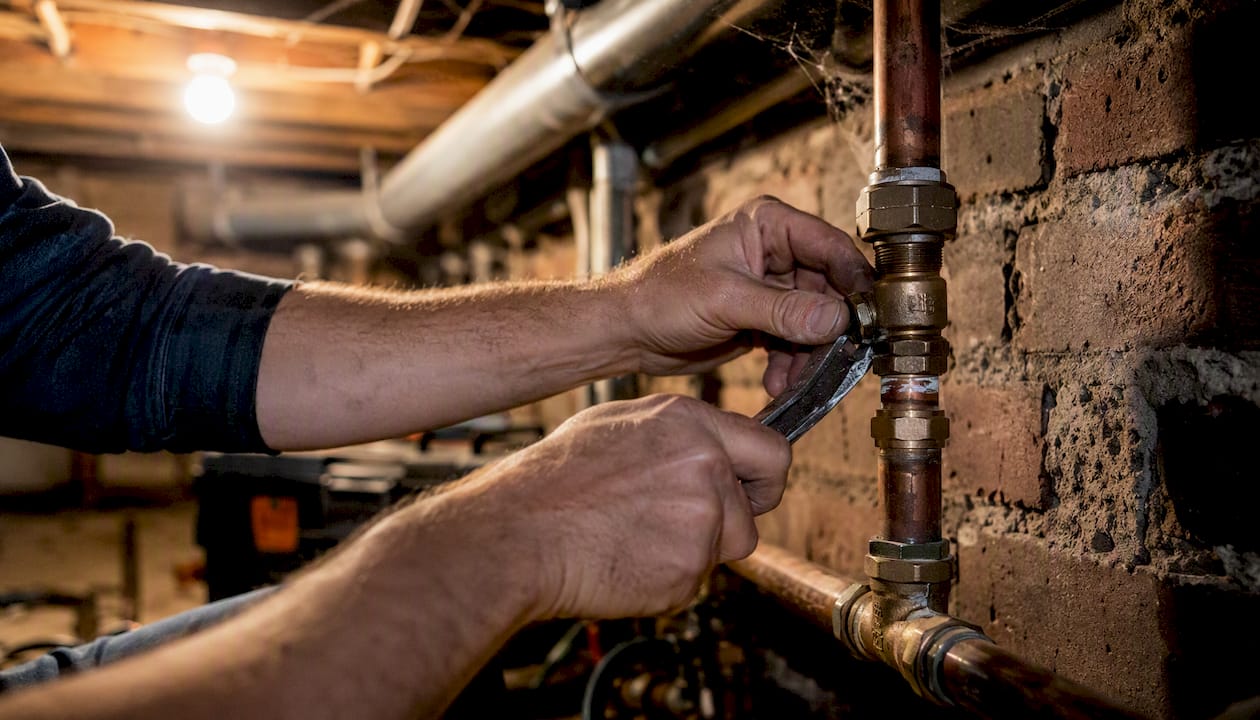
Hyperlocal service pages go one level deeper than a generic “drain cleaning” page. A page titled “Drain Cleaning in Oak Park, IL” that mentions local pipe ages, common issues in older homes, and your licensed technician’s name will outrank a generic page and convert better because it reads like it was written by someone who actually works in that area.
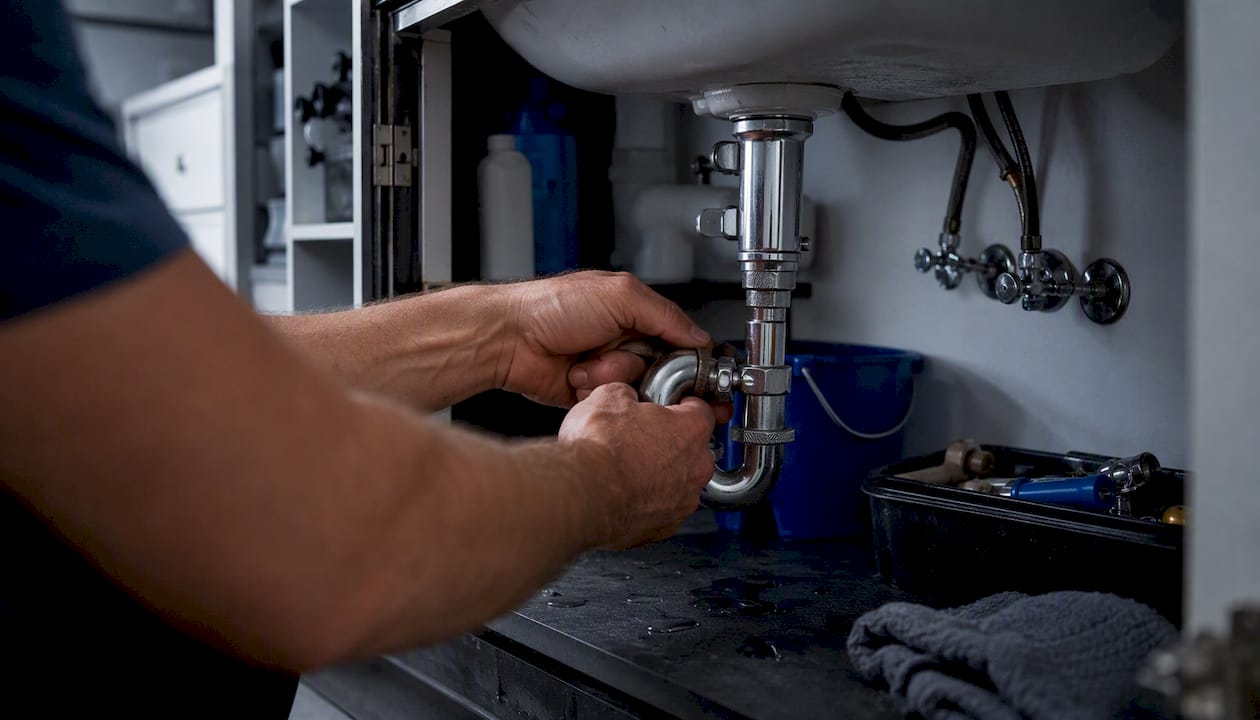
FAQ schema pages are increasingly critical. Pages with structured FAQPage markup get cited at a significantly higher rate in AI Overviews, which means your content can appear in AI-generated answers at the top of Google results. Target questions like “How long does a water heater last?” or “What causes low water pressure in a house?”
Short diagnostic YouTube videos (2–4 minutes) work well when paired with a clear description link and a call to action. A video titled “Why Is My Water Heater Making a Popping Noise?” that ends with “Call us at [number] if you’re in [City]” captures viewers who are already in problem-solving mode. Repurpose these clips for Instagram Reels and TikTok to extend reach without extra production cost.
Before/after case studies are underused. A photo pair showing a corroded pipe replaced with copper, plus two sentences about the job, the neighborhood, and the outcome, builds more trust than any marketing copy you could write. Add these to your service pages and GBP photo section.
Sample headings you can use directly:
- “Emergency Water Heater Repair in [City]: Same-Day Service”
- “Slab Leak Detection in [Neighborhood]: What It Costs and How Long It Takes”
- “Why Is My Toilet Running? A [City] Plumber Explains”
- “Drain Cleaning in [City]: Prices, Process, and What to Expect”
How do you set up local SEO and Google Business Profile for a plumbing business?
A well-optimized Google Business Profile, combined with a steady review flow, is the single highest-impact organic lever available to a local plumber. Google ranks local results on three signals: relevance, distance, and prominence. Your GBP directly influences all three.
GBP setup checklist (complete this in one hour)
- Claim your profile at business.google.com and verify ownership
- Set your primary category to “Plumber” (not “Contractor” or “Home Services”)
- Add every service you offer using GBP’s built-in services list, with descriptions
- Set an accurate service area by city or ZIP code, not just your business address
- Upload at least 10 photos: your truck, your team, job photos, and your office or shop
- Add your business hours, including emergency/after-hours availability
- Enable the booking link if you use an online scheduling tool
- Write a 250-word business description that includes your city, top services, and license number
- Publish your first GBP post (a seasonal tip, a recent job, or a current promotion)
Ongoing GBP maintenance (monthly):
- Post one update per week (a completed job, a tip, or a seasonal reminder)
- Respond to every review within 48 hours
- Add new job photos regularly
- Check that your phone number, hours, and service area are current
On your website, mobile optimization and page speed are the technical fixes that matter most. A plumbing site that loads slowly on a phone loses the call before it starts. Every service page needs a phone number in the header, a click-to-call button, and a location-aware title tag (example: “Water Heater Repair in Denver, CO | [Business Name]”).
On-site local SEO priorities:
- One dedicated page per service per city (not one page listing all services)
- LocalBusiness and Service schema on every service page
- FAQPage schema on any page with a Q&A section
- Your NAP (name, address, phone) consistent across every page and every directory listing
Which paid channels should plumbers prioritize?
Google’s ad ecosystem, specifically LSA and Search, consistently ranks as the highest-ROI paid channel for emergency plumbing demand. The reason is simple: both formats intercept someone who has already decided they need a plumber. You are not convincing them to want your service; you are just being the first credible option they see.
LSA vs. standard Google Ads
Local Services Ads sit above everything else in Google search results, including standard PPC ads. They show your business name, star rating, years in business, and the Google Guaranteed badge. That badge matters because Google requires license and insurance verification before awarding it, which signals to homeowners that you are a vetted professional.
The economics are compelling. LSA averaged about $57 per lead for plumbing with a roughly 44.5% book rate in a February 2026 benchmark, while non-branded Google Ads averaged about $183 per lead. At those numbers, LSA produces booked jobs at a fraction of the cost of standard PPC.
Budget guidance by business stage:
- Solo technician or one truck: Start with LSA only. Set a weekly budget of $150–$300 and pause it when you are booked out. Do not run standard PPC until LSA is converting.
- Two to three trucks: Run LSA as the primary channel and add branded Google Ads to capture anyone searching your business name. A $500–$800 monthly PPC budget is a reasonable starting point.
- Scaling up (four-plus trucks): Layer in non-branded Google Ads targeting high-value services (water heater replacement, sewer line repair). Use separate campaigns per service with dedicated landing pages.
Pro Tip: Set your LSA budget to pause automatically when you hit your weekly lead cap. Paying for leads you cannot answer is the fastest way to hurt your LSA ranking, since Google factors response rate into how often your ad shows.
For ad landing pages, keep it simple: headline with the service and city, a phone number above the fold, three to five trust signals (license number, years in business, Google rating), and a short form. Nextdoor and connected TV (CTV) can work for brand awareness in specific neighborhoods, but they belong later in the strategy, after LSA and GBP are producing consistent leads.
How do reviews and testimonials fit into your content strategy?
Reviews are content. A Google Business Profile with 80 five-star reviews and recent photos outperforms a competitor with 12 reviews and a stale profile, even if the competitor has a better website. GBP relevance, distance, and prominence are the ranking signals Google names directly, and review volume and recency feed directly into prominence.
Building a steady review engine:
- Send a review request via SMS within two hours of job completion, when the customer’s satisfaction is highest. A simple message works: “Hi [Name], thanks for having us out today. If you have a minute, a Google review helps our small business a lot: [link].”
- Follow up once by email three days later if no review was left
- Train every technician to mention the review request verbally before leaving the job site
- Never incentivize reviews with discounts or gifts; Google’s policies prohibit it
Displaying social proof in your content:
- Embed your Google star rating in the header of every service page using a review widget or a static badge
- Pull two or three specific review quotes onto each service page, matched to that service (a water heater review on the water heater page, not a generic one)
- Add a testimonial video clip to your homepage, even a 30-second phone recording from a happy customer
- Include your review count and average rating in your GBP posts
Responding to negative reviews: Reply within 24 hours, acknowledge the issue without admitting fault, and offer to resolve it offline. A professional response to a one-star review often impresses prospective customers more than the review itself would have hurt you. Keep the response under 100 words and include your direct phone number.
How do email and CRM automation create repeat plumbing business?
A single plumbing job is worth far more than the invoice if you stay in contact. Water heaters need flushing. Sump pumps need annual checks. Customers who hear from you twice a year book again; customers who never hear from you call whoever shows up first in Google next time.
The key is tying your email triggers to job type in your CRM. Tools like Jobber, ServiceTitan, and Workiz all support custom fields and automated follow-up sequences. Here is a simple sequence that works for most shops:
- Welcome (day 0, sent after first job): “Thanks for trusting us with your home. Here is what to expect from us and how to reach us in an emergency.” Include your license number, service area, and emergency line.
- Post-job follow-up + review request (day 2): Short message, direct link to Google review, and a one-line reminder of what was done.
- Six-month maintenance reminder (month 6): Triggered by job type. A water heater job triggers a “time to flush your tank” reminder. A drain cleaning job triggers a “keep your drains clear” tip with a booking link.
- Annual check-in (month 12): “It’s been a year since we serviced your [system]. Ready for a quick inspection?” Include a seasonal angle if relevant (pre-winter pipe check, spring sump pump test).
Segmentation that matters:
- Separate high-ticket customers (sewer line, water heater replacement) from routine maintenance customers; the former get more personalized outreach
- Tag customers by job type so every automated message is relevant to what you actually did for them
- Flag customers who have not booked in 18 months for a re-engagement campaign with a small incentive
Clear, specific communication builds the kind of trust that turns a one-time emergency call into a household that calls you every time. For more on how to present technical information in a way homeowners actually understand, the guidance on customer communication skills for plumbers is worth reading.
How do you track leads and measure content marketing ROI?
You cannot improve what you do not measure. The minimum tracking stack for a plumbing business is four things: call tracking, UTM parameters, a source field in your CRM, and conversion labels in Google Analytics or your ad platform.
| Tool / Method | What It Tracks | Why It Matters |
|---|---|---|
| Call tracking (e.g., CallRail) | Which page or ad generated each call | Connects content to actual phone leads |
| UTM parameters | Which campaign, channel, and content drove website visits | Lets you compare LSA vs. organic vs. email |
| CRM source field | Where each booked job originated | Maps call to job to revenue |
| GA4 conversion events | Form fills, click-to-call taps, booking completions | Shows which pages convert, not just which get traffic |
Minimum measurement checklist:
- Set up a unique tracking phone number for each major channel (LSA, GBP, website, email)
- Tag every paid ad URL with UTMs before it goes live
- Add a “How did you hear about us?” field to your booking form and train your dispatcher to ask it on every inbound call
- Label “call” and “form fill” as conversions in Google Ads and GA4
- Review your source report monthly: which channel produced the most booked jobs, not just the most clicks?
The single KPI to watch first is booked jobs per channel, not leads or clicks. A channel that sends 50 clicks and books 3 jobs beats one that sends 200 clicks and books 2. Once you have 60 days of data, you will know exactly where to put more budget and where to cut.
For a deeper look at tracking campaign performance for measurable growth, Ibrand’s guide walks through the attribution setup step by step.
Where should you promote plumbing content, and when do lead marketplaces make sense?
Distribution is what separates content that gets read from content that sits unread. Publishing a great service page and waiting for Google to find it can take months. Promoting it across the right channels accelerates that timeline.
Distribution checklist:
- Post every new page or blog to your GBP as a GBP update with a link
- Upload a short YouTube video version of any how-to or FAQ content, with the service page URL in the description
- Share job photos and tips in local Facebook community groups (not as ads; as a neighbor)
- Post on Nextdoor as a local business, especially after completing jobs in a specific neighborhood
- Send new content to your email list with a one-paragraph summary and a link
Lead marketplaces: when they help and when they hurt
Platforms like Angi, HomeAdvisor, and Thumbtack can fill your calendar quickly when you are starting out or entering a new service area. The tradeoff is real: you are renting leads rather than owning them, and the same lead is often sold to multiple contractors.
| Factor | Lead Marketplaces (Angi, Thumbtack) | Owned Channels (GBP, LSA, organic) |
|---|---|---|
| Speed to first lead | Fast (days) | Slower (weeks to months) |
| Cost per lead | Variable, often $30–$80+ | LSA ~$57; organic near zero |
| Lead exclusivity | Shared with competitors | Exclusive |
| Long-term value | None (stops when you stop paying) | Compounds over time |
| Control over messaging | Limited | Full |
Use marketplaces as a stopgap while your GBP and LSA are ramping up. Once LSA is producing consistent leads at around $57 each, the math usually favors shifting budget away from shared-lead platforms. Route every marketplace lead into your CRM and email sequence immediately so you capture the customer relationship regardless of where the lead originated.
How do you build a content calendar on a small budget?
Consistency beats volume. One well-researched, hyperlocal page published every two to three weeks outperforms a burst of ten generic posts followed by three months of silence. Workiz’s four-pillar framework for plumbing marketing, which includes content authority as a core pillar alongside GBP, paid ads, and automation, reflects the same priority: build steadily, not in bursts.
30-60-90 day content calendar:
- Month 1: Publish your top three emergency-intent service pages (burst pipe, no hot water, clogged drain). Set up GBP posts to promote each one. These pages should be live and indexed before anything else.
- Month 2: Add two hyperlocal city pages for your top service areas. Publish one FAQ blog post targeting a question your dispatcher hears weekly. Record one short YouTube video from a recent job.
- Month 3: Add a before/after case study page. Publish a seasonal content piece (pre-winter pipe protection, spring sump pump check). Start a monthly GBP post schedule.
Content brief template (use for every piece):
- Target keyword and local modifier (example: “water heater repair Denver CO”)
- Primary question the page answers in the first two sentences
- Local data point: average repair cost in your market, common pipe material in homes built before 1970, local water hardness
- Named technician or author with license number (E-E-A-T signal)
- FAQ section with three to five questions and short answers
- CTA: phone number, booking link, or both
Production workflow for a two-person shop:
- Owner or office manager identifies the topic and local angle (30 minutes)
- Technician or owner records a 2-minute phone video on the job (10 minutes)
- Writer or VA drafts the page using the brief (2–3 hours)
- Owner reviews for accuracy and adds license/credential info (20 minutes)
- Published and promoted via GBP post and email the same week
How do you build a service page that actually converts?
A high-performing plumbing service page is not a brochure. It is a direct answer to a specific question, written for someone who is stressed and needs a plumber now. Here is the template, using water heater repair as the example.
Step-by-step build:
- Meta title: “Water Heater Repair in [City], [State] | Same-Day Service | [Business Name]” (under 60 characters)
- Meta description: “Burst tank or no hot water? [Business Name] fixes water heaters same day in [City]. Licensed, insured. Call [number] now.” (under 160 characters)
- H1: “Water Heater Repair in [City]: Same-Day Service by Licensed Plumbers”
- Opening paragraph (answer first): State the service, your city, your phone number, and your response time in the first two sentences. Do not start with a history of water heaters.
- H2 sections as questions: “How much does water heater repair cost in [City]?” / “How long does a water heater repair take?” / “Do I need a repair or a full replacement?”
- Author/credential block: “This page was written by [Technician Name], a licensed plumber (License #[XXXXX]) serving [City] and surrounding areas since [year].”
- FAQ schema block: Three to five Q&A pairs marked up with FAQPage structured data. Pages with FAQ schema markup get cited at a significantly higher rate in AI Overviews.
- Trust signals: Star rating, review count, Google Guaranteed badge, years in business, service area map or list
- CTA: Phone number as a tap-to-call link, plus a short booking form
Schema placement: Add LocalBusiness schema in the site-wide header. Add Service schema to each service page. Add FAQPage schema to any page with a Q&A section. Place all structured data in the <head> or as a JSON-LD block just before the closing </body> tag.
Bullet checklist before publishing:
- Phone number appears at least twice (header and within body)
- Page loads in under 3 seconds on mobile
- Title tag includes city and service
- At least one real photo from an actual job
- License number visible on the page
- FAQPage schema validated in Google’s Rich Results Test
What mistakes do plumbers most often make with content marketing?
Most plumbing content marketing fails for the same handful of reasons. Knowing them in advance saves months of wasted effort.
- Generic AI-generated blog farms: Publishing 20 posts about “how to fix a leaky faucet” that read identically to every other plumbing blog does not build local authority. Google’s systems increasingly reward specificity and real trade experience. Fix: write one hyperlocal emergency page instead of five generic ones.
- Ignoring LSA: Many plumbers run standard Google Ads and skip LSA entirely, paying three times more per lead. Fix: apply for LSA this week; the verification process takes one to two weeks.
- Thin local pages: A page that says “We serve Denver” with two sentences of text does not rank. Fix: add local data points, a named technician, a FAQ section, and at least 400 words of specific, useful content.
- No click-to-call button above the fold: A homeowner with a burst pipe will not scroll to find your number. Fix: add a sticky header with a tap-to-call button on every page. This is a mobile optimization basic that directly affects conversion rate.
- No tracking: Running ads or publishing content without call tracking means you have no idea what is working. Fix: set up CallRail or a similar tool and assign a unique number to each channel before spending another dollar on ads.
- Inconsistent NAP: Your business name, address, and phone number appearing differently across Google, Yelp, and your website confuses Google’s local ranking algorithm. Fix: audit every directory listing and make them identical.
For a full breakdown of the most common plumbing marketing mistakes and their fixes, Ibrand’s dedicated guide covers each one with specific corrective steps.
Why LSA and E-E-A-T content outperform generic blog strategies
The evidence for prioritizing LSA and experience-driven content over generic blogging is now strong enough to treat as settled strategy rather than opinion.
On the paid side, the numbers are stark. LSA averaged $57 per lead with a 44.5% book rate versus $183 per lead for non-branded Google Ads in a February 2026 benchmark across 230 contractors. That is not a marginal difference; it is a structural cost advantage that compounds over a full year of ad spend.
On the content side, Google’s E-E-A-T framework (Experience, Expertise, Authoritativeness, Trustworthiness) has shifted what ranks. In 2026, a page written by a named, licensed plumber with a real license number, a local service area, and a before/after photo from an actual job outperforms an anonymous 1,500-word blog post on the same topic, even if the anonymous post has more backlinks.
Pages with FAQPage structured data markup get cited at a significantly higher rate in AI Overviews, meaning your content can appear in AI-generated answers at the top of Google results — without a click needed from the user. For a plumbing business, that visibility during an emergency search is the equivalent of a billboard at the exact moment someone needs you.
Three E-E-A-T actions to take this week:
- Add a named author block with a license number to every service page
- Add FAQPage schema to your top three pages and validate with Google’s Rich Results Test
- Publish one before/after case study with the technician’s name, the neighborhood, and the specific problem solved
Jobber’s practitioner guide consistently recommends starting with website and GBP fundamentals before layering paid channels, which aligns with the E-E-A-T priority: build a credible foundation first, then amplify it with paid traffic.
What the first 90 days of a plumbing content setup actually look like
Most plumbing businesses that struggle with content marketing are not doing the wrong things. They are doing the right things in the wrong order, or they are trying to do everything at once and doing none of it well.
When setting up a plumbing client for content success, the first 90 days follow a fixed sequence:
Days 1–30 (foundation):
- GBP audit: verify ownership, fix category, add all services, upload 10 photos, check NAP consistency across directories
- Publish the top three emergency-intent pages with proper schema and a named author block
- Apply for LSA and complete Google Guaranteed verification
- Install call tracking with unique numbers for GBP, LSA, and the website
Days 31–60 (amplification):
- Launch the post-job SMS review request sequence
- Publish two hyperlocal city pages
- Set up the welcome and post-job email sequences in your CRM (Jobber, ServiceTitan, or Workiz all support this natively)
- Record and upload the first YouTube video
Days 61–90 (measurement and iteration):
- Pull your first source report: which channel produced the most booked jobs?
- Identify the one or two pages driving the most calls and build similar pages for adjacent services
- Add FAQ schema to any page that does not have it yet
- Review LSA lead quality and adjust your service area or budget if needed
What to expect on the timeline: GBP improvements and LSA leads typically show up within the first 30 days. Organic content rankings take 60–90 days minimum for new pages. Email sequences start producing repeat bookings around month three. The businesses that stay consistent through that ramp period are the ones that build a compounding lead engine rather than a one-time traffic spike.
A quick onboarding checklist for a new plumbing client:
- GBP fully completed and verified
- LSA application submitted
- Call tracking live on all channels
- Three emergency pages published with schema
- Review request sequence active
- CRM source field capturing every lead origin
Ibrand makes it easier to get this done without hiring a full team
Running a plumbing business and building a content marketing system at the same time is genuinely hard. The playbook in this guide works, but it requires consistent execution across GBP, LSA, content production, schema markup, call tracking, and email automation simultaneously.
Ibrand handles the full stack for plumbing businesses: local SEO and GBP optimization, LSA setup and management, service page builds with schema, call tracking configuration, and ongoing content production. The difference from a traditional agency is the cost structure. Ibrand works with small and mid-size shops on transparent, affordable plans without long-term retainer lock-in, so you can start with the highest-ROI pieces (GBP and LSA) and add content production as your pipeline grows.
If you want a team that already knows the plumbing marketing sequence and can execute it without a six-month onboarding process, get a local SEO plan built for your market or start with a website optimization audit to see exactly what is holding your current site back from converting traffic into calls.
Sources
- Plumbing Marketing 2026: Strategies & Tools – Workiz
- Plumbing Content Marketing in 2026
- 13 Plumbing Marketing Ideas to Get More Business | Jobber Academy
- Mobile optimization – Moz
FAQ
How do I advertise myself as a plumber?
Start with Google Local Services Ads and a fully optimized Google Business Profile. LSA puts your business above standard search results with a Google Guaranteed badge, and GBP drives map-pack visibility at no cost per click.
How do I market my plumbing business with content?
Publish emergency-intent and hyperlocal service pages targeting searches like “burst pipe repair in [City],” add FAQPage schema, and promote each page via GBP posts and email. One well-built page per month compounds faster than a dozen generic blog posts.
How do I find customers as a plumber?
LSA and GBP are the fastest paths to inbound calls. For longer-term growth, organic service pages and a steady review engine build a pipeline that does not stop when you pause ad spend.
Where should a plumber advertise?
Google Local Services Ads and Google Business Profile are the highest-ROI starting points for most plumbing businesses. Lead marketplaces like Angi and Thumbtack can fill gaps early on, but owned channels produce better economics once LSA and GBP are established.
What the first-person agency view misses (and why it matters)
Most agency guides on content marketing for plumbers focus on what to build. Fewer address the sequencing problem: plumbing business owners who try to launch a blog, run Google Ads, optimize GBP, and set up email automation in the same month end up doing all of it poorly.
The counterintuitive truth is that doing two things well beats doing eight things adequately. If you have limited time this month, claim and complete your GBP and apply for LSA. Those two actions alone, done correctly, will produce more booked jobs than a blog with ten posts and no call tracking. Content compounds over time; LSA produces leads in days.
The other thing most guides understate is the value of specificity over volume. A single service page that mentions your city’s water hardness, the common pipe materials in homes built before 1960 in your area, and a real technician’s name will outrank five pages of generic plumbing advice. Homeowners trust specificity. So does Google. So do AI Overviews.
Build the foundation first. Then add content. Then measure. Then scale what the data tells you is working.
Recent Comments