
Reputation management for HVAC businesses is the ongoing process of monitoring, shaping, and improving how your company appears online so that potential customers choose you over the competitor down the street. It covers everything from generating fresh Google reviews and responding to complaints, to keeping your Google Business Profile accurate and showing up in the local map pack when someone searches “AC repair near me” at 2 PM on a July afternoon. HVAC reputation management involves core activities: review generation, review response, monitoring, crisis handling, and search visibility across platforms including Google, Yelp, Angi, and Facebook.
Why does this matter more than your ad spend? Because customers bypass paid ads entirely when a competitor has a stronger star rating. Your Google Local Services Ads badge means less when the business below you has 200 reviews averaging 4.9 stars and you have 40 averaging 3.8. Reputation is the filter customers apply before they ever click.
- Review generation: Consistently acquiring new reviews from real customers
- Review response: Engaging with every review, positive or negative, within 24 hours
- Listing accuracy: Keeping name, address, and phone consistent across all platforms
- Monitoring: Tracking what customers say across Google, Yelp, Angi, and social media
- Crisis handling: Addressing negative feedback before it compounds
- Search visibility: Using reputation signals to rank higher in local search results
Table of Contents
- How to generate and automate quality HVAC customer reviews
- How to respond to HVAC reviews in a way that builds trust
- Managing your HVAC business listings and consolidating review monitoring
- How your HVAC website and online profiles work together for reputation
- Using email, direct mail, and Google Local Services Ads to amplify your reputation
- Why exceptional customer service is the foundation of HVAC reputation
- Advanced expert insights on HVAC reputation management
- How tracking reviews by technician makes your team accountable
- How reputation management affects your local search rankings
- Legal and ethical considerations in HVAC reputation management
- Ibrand helps HVAC businesses build the reputation their work deserves
- FAQ
- Key Takeaways
How to generate and automate quality HVAC customer reviews
The single biggest mistake HVAC owners make with reviews is treating them as a passive outcome. Reviews are a system you build, not a reward you wait for.

Review velocity matters more to Google’s local ranking algorithm than your total review count. A business adding 3–5 reviews per month consistently outranks one that collected 80 reviews two years ago and stopped. Google reads steady acquisition as a signal of an active, healthy business.
The highest-converting request method is the technician asking in person, right after the job, while the customer is still feeling the relief of a fixed system. That moment of satisfaction is the peak of their willingness to help. Technician-driven requests followed immediately by a one-tap SMS link consistently outperform email or delayed follow-up by a wide margin.
- Ask in person at job completion, then send a direct SMS link within minutes
- Keep the SMS short: “Thanks for having us out today. A quick review would mean a lot.” with a one-click link
- Automate the SMS trigger from your field service software when a job is marked complete
- Never ask for a review before the work is done or the customer has confirmed satisfaction
- Rotate which technicians make the ask so no single person carries the burden
Pro Tip: Set up your field management software (ServiceTitan, Housecall Pro, or similar) to fire a review request SMS automatically when a job status changes to “completed.” That removes the human memory variable entirely and keeps your review velocity steady without extra effort.
How to respond to HVAC reviews in a way that builds trust
Responding to reviews is not a courtesy. It is a local SEO signal and a public demonstration of how you treat customers. Every response is read by the next potential customer, not just the person who left the review.
Responding within 24 hours to negative reviews limits reputational damage and signals to Google that your business is engaged. For positive reviews, a response within a day or two is fine, but never let a negative one sit over a weekend without acknowledgment.
- Negative reviews: Acknowledge the experience, apologize without admitting fault where appropriate, and offer to resolve it offline with a direct contact
- Positive reviews: Thank the customer by name, mention the specific service, and reinforce your brand values in one sentence
- Never argue publicly: Even when the customer is factually wrong, a defensive response looks worse than the original complaint
- Use keywords naturally: Mentioning your city and service type in responses (“We’re glad we could help with your AC repair in Phoenix”) adds local SEO value
Pro Tip: Write a response template library with 8–10 variations for common scenarios: great service, minor complaint resolved, unfair review, no-show dispute. Rotate them so responses don’t read as copy-paste. Assign one person to own review responses so tone stays consistent.
Managing your HVAC business listings and consolidating review monitoring
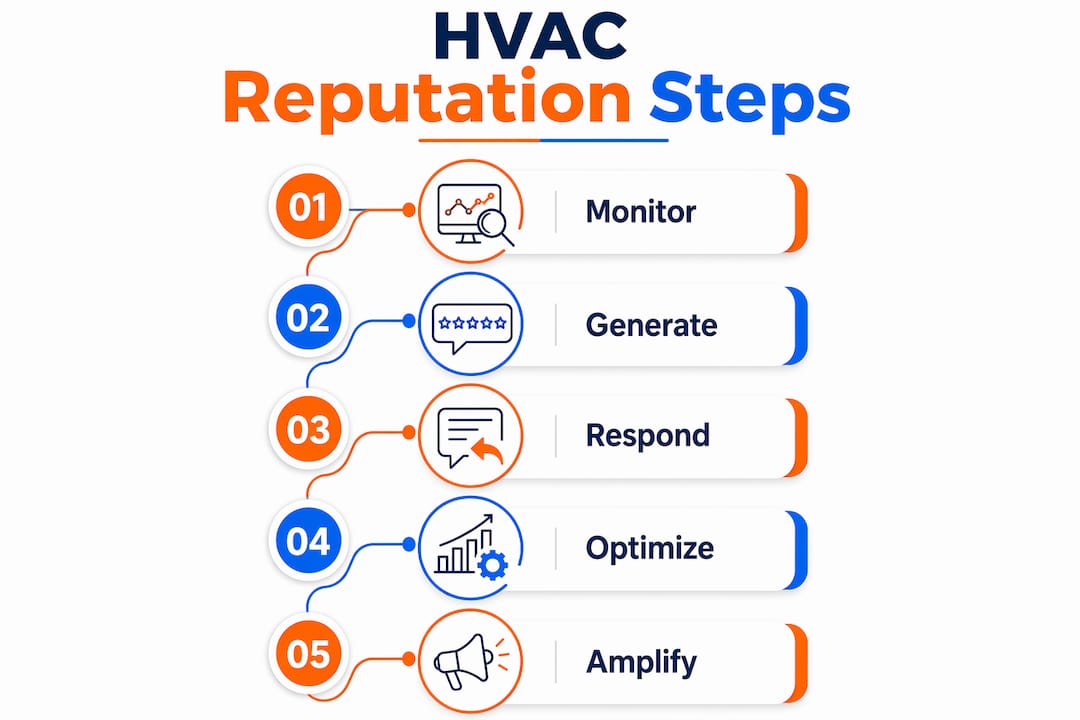
Inconsistent business information across platforms is one of the quietest reputation killers in the HVAC industry. If your address shows one zip code on Google and a different one on Yelp, search engines lose confidence in your listing and customers get confused.

Maintaining accurate listings across every platform improves both discoverability and consumer trust. The platforms that matter most for HVAC businesses in the United States are Google Business Profile, Yelp, Angi, Facebook, and the Better Business Bureau. Each one captures a different customer segment at a different moment in the buying decision.
| Approach | Best for | Manual effort | Review coverage |
|---|---|---|---|
| Platform-by-platform manual | Solo operators, under 20 reviews/month | High | Limited |
| Centralized dashboard (e.g., BirdEye, Podium) | Growing businesses, 5+ techs | Low | Google, Yelp, Facebook, more |
| Full-service reputation software | Multi-location HVAC companies | Very low | All major platforms + alerts |
- NAP consistency: Name, address, and phone must be character-for-character identical on every platform
- Claim every listing: Unclaimed profiles can be edited by anyone, including competitors
- Set up review alerts: Email or SMS notifications for new reviews so you never miss one
- Handle fake reviews: Flag them through the platform’s reporting tool; document the dispute in case you need to escalate
- Avoid review fatigue: Don’t ask the same customer to review you on three platforms. Pick one per job.
How your HVAC website and online profiles work together for reputation
Your website is not separate from your reputation. It is the destination customers land on after reading your reviews, and it either confirms or contradicts what those reviews promised.
Optimized HVAC websites with integrated review widgets and regularly updated content improve both search visibility and customer confidence. A site that shows your Google rating, features recent technician photos, and loads in under three seconds on mobile tells the same story your reviews do. A slow, outdated site with no social proof undermines even a strong review profile.
- Embed a Google review widget on your homepage and service pages
- Add local schema markup so search engines understand your service area and business type
- Publish short content regularly: seasonal maintenance tips, technician spotlights, before-and-after photos
- Link your Google Business Profile, Facebook, and Yelp pages from your website footer
- Make sure your site is mobile-first. Most HVAC searches happen on a phone during a system emergency.
For HVAC owners new to local SEO basics, the connection between website structure and review visibility is often the first thing that clicks once you see it in action.
Pro Tip: Add a “Leave Us a Review” page on your website that links directly to your Google, Yelp, and Angi profiles. Send that URL in your post-job SMS instead of a platform-specific link. It gives customers a choice and increases completion rates.
Customers who read your reviews and then land on a professional, fast, review-rich website convert at a significantly higher rate than those who land on a generic or outdated one.
Using email, direct mail, and Google Local Services Ads to amplify your reputation
Reputation management does not live in a silo. The businesses that grow fastest treat it as one layer of a coordinated marketing strategy, not a standalone task.
Email campaigns and direct mail reinforce brand visibility between service calls and create natural opportunities to request reviews or referrals. A seasonal tune-up reminder postcard does double duty: it drives a booking and puts your name in front of the customer right before you’d ask them to review you.
- Send a post-job email sequence: thank-you at 24 hours, review request at 48 hours, maintenance reminder at 90 days
- Use HVAC email marketing to segment customers by equipment age, service history, or last contact date
- Direct mail works especially well for seasonal campaigns in zip codes where you want to build density
- Google Local Services Ads display your star rating and review count directly in the ad unit, so a strong reputation makes your ad spend more efficient
- Coordinate campaign timing: run ads in the same weeks you’re actively collecting reviews to maximize the compound effect
Google Local Services Ads are worth calling out specifically. Unlike standard Google Ads, they show your business name, rating, and number of reviews in the ad itself. A business with a strong star rating and many reviews running Local Services Ads will almost always outperform a competitor with a lower rating running the same budget.
Why exceptional customer service is the foundation of HVAC reputation
No reputation management tool fixes a bad service experience. You can automate review requests, respond to every complaint, and maintain perfect listings. But if your technicians show up late, leave a mess, or can’t explain what they fixed, the reviews will reflect that eventually.
Professionalism on the job and congruency with your online brand are inseparable. As ACHR News put it in their coverage of HVAC reputation building:
That means your Google Business Profile photos, your website copy, and your technicians’ uniforms are all part of the same message. When they align, customers trust you before you arrive. When they don’t, even a great service call leaves a nagging doubt.
- Train every technician on the review request process and why it matters to the business
- Set clear standards for punctuality, communication, and job-site cleanliness
- Brief technicians on what to say when a customer asks about pricing or next steps
- Debrief after negative reviews to identify whether the issue was a service failure or a communication gap
- Recognize technicians publicly when their work generates strong reviews. It reinforces the behavior.
Advanced expert insights on HVAC reputation management
The businesses that build a durable reputation advantage go beyond collecting reviews. They treat reputation as a measurable system with defined metrics and feedback loops.
Automated workflows with sentiment filters are one of the more underused tactics in the HVAC space. The concept is straightforward: after a job, send a brief satisfaction check. If the customer responds positively, route them to the review link. If they signal dissatisfaction, route them to your service manager instead. You resolve the issue privately before it becomes a one-star review.
Beyond star ratings, the metrics that actually predict long-term reputation health are:
- Review velocity: How many new reviews you’re adding per month
- Response rate: What percentage of reviews receive a response from you
- Sentiment trend: Whether the language in reviews is improving or declining over time
- Review-to-booking conversion: How often a new review leads to a new inquiry
Pro Tip: Build your reputation as a competitive moat, not just a marketing metric. A business with a large number of reviews and an excellent star rating is nearly impossible for a new competitor to displace quickly, regardless of their ad budget. Every review you collect today is a barrier to entry for tomorrow.
How tracking reviews by technician makes your team accountable
Most HVAC businesses track reviews at the company level. The ones that grow fastest track them at the technician level.
When a customer mentions a technician by name in a review, that data tells you something specific: which team members are generating trust and which ones are creating friction. Field service platforms like ServiceTitan and Housecall Pro allow you to tag completed jobs to individual technicians, then cross-reference those jobs with reviews received in the same period.
This creates a feedback loop that is far more useful than a company-wide star rating. A technician with a pattern of 3-star reviews mentioning “didn’t explain the problem” needs coaching on communication, not technical skills. A technician who consistently generates 5-star reviews by name is a model worth studying and replicating across the team. Linking reviews to jobs also helps you identify whether negative feedback clusters around specific service types, neighborhoods, or times of day, which points to operational issues rather than individual performance.
How reputation management affects your local search rankings
Google’s local ranking algorithm weighs three factors: relevance, distance, and prominence. Reputation management directly influences prominence, which is the factor you have the most control over.
A business with consistent review velocity, high response rates, and accurate listings across platforms signals to Google that it is active, trusted, and worth surfacing in the local map pack. The map pack, those three businesses that appear above organic results on a local search, captures the majority of clicks for high-intent queries like “furnace repair near me.”
Star ratings also affect click-through rates from search results. A listing with 4.7 stars and 180 reviews will draw more clicks than a listing with 4.2 stars and 30 reviews, even at the same position. More clicks signal relevance to Google, which reinforces the ranking. It compounds. Businesses that treat reputation management as an SEO strategy, not just a customer service task, understand this loop and build systems around it. The connection between online reputation and local search performance is one of the clearest cause-and-effect relationships in digital marketing for service businesses.
Legal and ethical considerations in HVAC reputation management
The rules around review solicitation are clearer than most business owners realize, and the penalties for breaking them are real.
The Federal Trade Commission requires that any incentivized review be disclosed. Offering a discount, gift card, or free service in exchange for a review without disclosure violates FTC guidelines and can result in fines. Google’s own policies prohibit incentivized reviews outright, and platforms like Yelp actively filter reviews they suspect were solicited through incentives.
Buying fake reviews is a separate and more serious issue. Google has pursued legal action against review brokers, and businesses caught with fake reviews face profile suspension. The reputational damage from a public suspension far outweighs any short-term rating boost.
Ethically, the standard is simple: ask real customers for honest reviews, respond to all feedback professionally, and never manipulate the record. Reputation management built on authentic reviews is also more durable. Fake reviews tend to cluster in patterns that platforms detect, and a sudden spike of generic five-star reviews often triggers a filter that removes them in bulk, sometimes taking legitimate reviews with them.
One area that trips up HVAC businesses is responding to negative reviews in a way that reveals customer information. Keep responses general. Never reference a customer’s address, specific equipment details, or payment history in a public reply, even when defending a disputed claim.
Ibrand helps HVAC businesses build the reputation their work deserves
Most HVAC companies do excellent work and still lose customers to competitors with a stronger online presence. The gap is rarely service quality. It is visibility, consistency, and the systems that keep reputation growing month after month.

Ibrand works with small and medium-sized HVAC businesses across the United States to close that gap without the overhead of a large agency. The focus is practical: local SEO that moves your map pack ranking, website structure that converts review readers into booked appointments, and marketing coordination that ties your reputation signals into your ad spend. If you have been putting off local search optimization because it felt too technical or too expensive, Ibrand’s approach is built specifically for businesses at your scale. Get a custom plan at ibrand.media and see exactly where your reputation stands and what it would take to improve it.
FAQ
What is reputation management for HVAC businesses?
Reputation management for HVAC is the ongoing process of monitoring, generating, and responding to customer reviews while maintaining accurate business listings across platforms like Google, Yelp, and Angi to build trust and attract more bookings.
What is the purpose of reputation management?
The purpose is to shape how potential customers perceive your business online before they ever contact you. A strong reputation reduces the friction between a search and a booked appointment.
What is an example of reputation management in HVAC?
A practical example is automating a post-job SMS review request through field service software, then responding to every new review within 24 hours and tracking which technicians generate the most positive feedback by name.
How much does reputation management cost for an HVAC company?
Costs vary widely. Basic tools like Google Business Profile are free; dedicated reputation platforms range in cost depending on features and business size. Full-service agency management runs higher and typically includes SEO and listing management.
What are the four elements of reputation management?
The four core elements are monitoring (tracking what customers say), generation (acquiring new reviews consistently), response (engaging with all feedback promptly), and recovery (addressing negative experiences before they compound into lasting damage).
Key Takeaways
Reputation management for HVAC is a measurable system built on review velocity, accurate listings, prompt responses, and operational consistency that directly drives local search rankings and booked appointments.
| Point | Details |
|---|---|
| Review velocity beats total count | Consistently adding new reviews each month outranks businesses with more total reviews but no recent activity. |
| Technician requests convert best | In-person asks at job completion, followed immediately by a one-tap SMS link, produce the highest review conversion rates. |
| Respond within 24 hours | Responding to negative reviews within 24 hours limits damage and signals engagement to Google’s local ranking algorithm. |
| NAP consistency matters | Name, address, and phone must be identical across Google, Yelp, Angi, Facebook, and BBB to protect search visibility. |
| Ibrand for HVAC reputation growth | Ibrand helps HVAC businesses build local SEO, listing consistency, and review systems without large-agency overhead. |
Recent Comments