
Why branding matters for med spas: the bottom line
Your med spa’s brand is the first thing a prospective client judges, often before they ever read a single service description. Stanford University’s Web Credibility Research found that 46.1% of people form their credibility opinion based on visual design alone. That is not a soft metric. It means nearly half your potential clients are deciding whether to trust you before they see your prices, your credentials, or your before-and-after photos.
Here is what strong branding actually does for a med spa:
- Builds patient trust immediately. A professional, consistent visual identity signals that your practice is credible and competent, not just another discount injector.
- Removes you from price wars. When clients understand your unique value, they stop comparing you on cost and start comparing you on outcomes and experience.
- Aligns every touchpoint. From your Instagram grid to your consultation room, consistent branding creates a patient journey that feels deliberate and trustworthy.
- Converts interest into bookings. Prospects who recognize and trust your brand convert at higher rates than those encountering a fragmented or generic identity.
- Protects long-term growth. Inconsistent branding erodes patient perception quietly, making retention harder even when your clinical results are excellent.
The med spa industry has grown fast enough that services like Botox and laser treatments risk becoming commodities. Branding is how you stop that from happening to your practice.
What brand strategy actually means for your med spa
Brand strategy is not a logo or a color palette. It is the operational and narrative plan that defines who you are, who you serve, and how every part of your practice communicates that consistently. Think of it as the blueprint that guides your marketing copy, your staff scripts, your intake forms, and your social media captions, all at once.
A med spa without a defined brand strategy tends to drift. Messaging shifts depending on who wrote the post that week. The website says one thing, the front desk says another, and the consultation room feels like a third business entirely. That fragmentation quietly kills conversion, because patients sense the disconnect even when they cannot name it.
Pro Tip: Write your brand strategy as a one-page document your entire team can reference. Include your mission, your client persona, your voice guidelines, and three words that describe how every patient interaction should feel. Laminate it. Put it in the break room.
A well-built brand strategy does four things:
- Defines your mission and values so every decision has a filter
- Establishes your unique value proposition (UVP) so clients know exactly why you over anyone else
- Identifies your client persona so messaging speaks to real motivations, not demographics
- Sets your voice and tone so communication feels consistent whether it is a text reminder or a treatment brochure
When those four elements are aligned, the patient journey becomes predictable. Predictable journeys build trust. Trust drives bookings and referrals.
The key components of a med spa brand strategy
Getting brand strategy right means going deeper than a mission statement on your website. Each component shapes how clients experience your practice before, during, and after treatment.

Mission and values are your foundation. They answer why your med spa exists beyond revenue, and they filter every operational decision. A practice built around clinical precision makes different hiring choices than one built around luxury and pampering. Neither is wrong; the key is consistency.
Unique value proposition is where most med spas underinvest. Your UVP is not “we offer personalized care” (every competitor says that). It is the specific combination of expertise, experience, and outcomes that no one else in your market delivers the same way. Nail this, and your marketing writes itself.
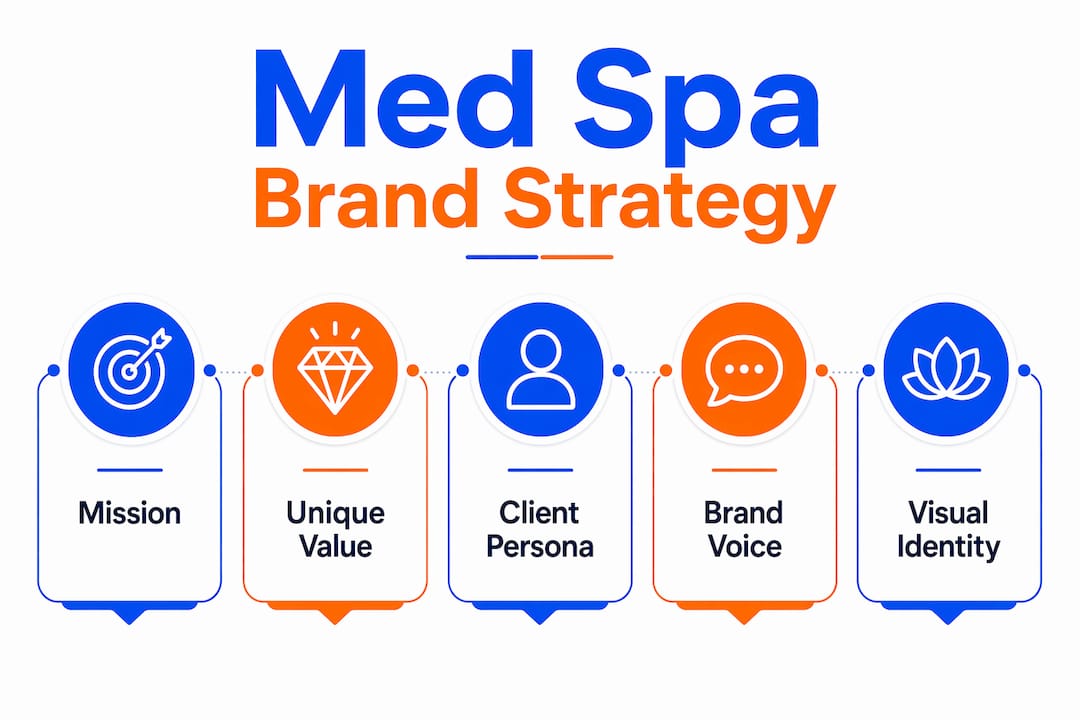
Client persona shapes everything downstream. Med spa clients invest in personal transformation, and effective branding taps into psychological motivations like confidence and self-care rather than clinical jargon. Knowing whether your ideal client is a 38-year-old professional seeking subtle anti-aging results or a 52-year-old retiree ready for a full skin reset changes your copy, your imagery, and your channel choices entirely.
Brand voice and tone determine how you sound across every medium. A luxury-positioned spa speaks differently than a results-focused clinical practice, even when describing the same treatment. Decide on your voice, document it, and train your team to use it.
Compliance and clinical messaging deserve their own place in your framework. Integrating compliance and clinical accuracy into brand communications enhances credibility rather than limiting it. Clients trust practices that communicate transparently about what treatments can and cannot do.
Common pitfalls to avoid:
- Copying a competitor’s aesthetic without defining your own values first
- Writing a UVP that describes your category, not your practice
- Using clinical language with clients who came for confidence, not a medical lecture
- Letting individual staff members improvise brand voice in client communications
How to build a visual identity that captures your med spa’s essence
Visual identity is the face of your brand strategy. Done well, it communicates professionalism and aspiration in the same glance. Done poorly, it undercuts everything your clinical team works to build.

Logo design is your signature. It should be clean, scalable, and meaningful without being literal. A logo that tries to show syringes, leaves, and a face simultaneously usually succeeds at none of them. Simplicity signals confidence.
Color palette carries more weight than most owners realize. Med spas must balance clinical credibility with luxury aesthetics, and color is the fastest way to strike that balance. Soft neutrals like warm whites, blush tones, and sage greens convey calm and cleanliness. A single accent color, deep navy or muted gold, adds the aspirational edge without tipping into garish.
Pro Tip: Before finalizing your color palette, test it on both your website and printed materials under different lighting. Colors that look elegant on a monitor can read cold or clinical under fluorescent light in a treatment room.
Typography should prioritize readability and elegance. A serif font for headings paired with a clean sans-serif for body text is a combination that reads as both authoritative and approachable. Avoid decorative scripts for anything beyond a logo accent; they are hard to read and rarely age well.
Tagline is your brand promise compressed into a phrase. It should be specific enough to mean something and short enough to remember. “Feel like yourself, only better” is more useful than “Excellence in aesthetic medicine.”
Key visual identity principles:
- Apply your palette, fonts, and logo consistently across every channel, print, digital, and physical space
- Avoid stock photography that looks generic; clients recognize it immediately and it signals low investment
- Ensure your visual identity reflects your actual client demographic, not an aspirational one that alienates your real audience
- Treat your treatment room design as part of your visual brand, not a separate operational concern
Building a website and social media presence that works for your brand
Your website is the single most important brand asset you control. Educational content and before-and-after galleries build patient trust and position your practice as an authority, but only when the site itself looks credible enough to earn that trust first.
Must-have website elements for med spas:
- Detailed, plain-language treatment pages that explain what clients can expect
- Authentic before-and-after galleries with real patient results
- Clear calls to action for booking consultations, not just browsing
- A mobile-optimized layout, since most prospective clients find you on a phone
Consistent NAP information (Name, Address, Phone) across your website, Google Business Profile, and directories strengthens local search visibility and reinforces brand presence. It is a small detail that compounds over time.
Social media extends your brand story between appointments. Instagram and TikTok work particularly well for med spas because the results are visual and the transformation narrative is inherently compelling. The mistake most practices make is treating social as a promotional channel rather than a trust-building one. Educational posts, behind-the-scenes content, and practitioner spotlights build the relationship that eventually converts a follower into a booked client.
Measure what matters: track digital marketing performance through engagement rates, website traffic from social channels, and consultation booking rates. Those three metrics tell you whether your brand presence is actually working or just generating likes.
When and how to refresh your med spa brand
A brand refresh is not an admission of failure. It is a recognition that your practice has grown, your market has shifted, or your original identity no longer reflects who you are.
Triggers that signal it is time to revisit your brand:
- Your visuals look dated compared to practices opening in your market
- You have repositioned your services or added a new specialty
- Client feedback consistently misaligns with how you intend to be perceived
- Your messaging feels inconsistent across channels and no one can explain why
A med spa brand is continuously evolving, and the right time to refresh depends on what a brand audit reveals. Start there. Audit your visual identity, your messaging, your online presence, and your in-practice experience as a single system. Where do they diverge? That gap is where clients lose confidence.
Incremental refreshes work well when the core identity is sound but execution has drifted. Update the color palette, modernize the typography, tighten the copy. A comprehensive rebrand makes sense when the positioning itself needs to change, not just the aesthetics.
One rule applies to both approaches: preserve your core values through the transition. Clients who already trust you are trusting something specific. Change the look, sharpen the message, but do not abandon the substance that earned their loyalty.
When you are ready to introduce changes, communicate proactively. A brief email to existing clients explaining the refresh, framed as growth rather than overhaul, turns a potential moment of confusion into a touchpoint that reinforces the relationship.
Bringing it all together: from visuals to patient experience
Branding fails most often not in the design phase but in the delivery phase. Many med spa founders treat branding as a creative task instead of an operational integration, which produces beautiful marketing materials and an inconsistent patient experience underneath them.
Patient loyalty and conversion increase when workflows and messaging align with the brand promise. That means consultation scripts, intake documentation, post-treatment communication, and even how your front desk answers the phone all need to reflect the same identity your website projects.
Practical steps for operational brand integration:
- Write consultation scripts that use your brand voice, not generic clinical language
- Train staff on the three words that define how every patient interaction should feel
- Audit your intake forms and post-treatment emails for tone consistency
- Review your physical space against your visual brand at least once a year
To measure whether branding is working, track online reputation signals like review sentiment and star ratings alongside booking conversion rates and client retention. A brand that is working shows up in all three, not just in follower counts.
Building online credibility takes time, but the compounding effect is real. Practices that align their visual identity, messaging, and patient experience consistently outperform those that treat each element as a separate project.
Key Takeaways
Strong med spa branding combines visual identity, operational consistency, and patient experience alignment to convert prospects into loyal clients and protect long-term growth.
| Point | Details |
|---|---|
| Design drives first impressions | 46.1% of prospective patients form credibility opinions based on visual design alone, per Stanford Web Credibility Research. |
| Brand strategy is operational | Branding must align marketing, staff behavior, and patient workflows, not just aesthetics, to convert and retain clients. |
| UVP separates you from the market | A specific unique value proposition stops price comparisons and positions your practice on outcomes and experience. |
| Refresh when the brand drifts | Conduct a brand audit when visuals, messaging, or patient experience diverge; preserve core values through any update. |
| Measure what matters | Track review sentiment, booking conversion rates, and client retention to gauge whether branding is producing real results. |
FAQ
Why does branding matter more for med spas than other businesses?
Med spa clients are making trust-based decisions about their appearance and health. A credible, consistent brand signals clinical competence and reduces the anxiety that prevents prospective clients from booking.
What is the most important element of a med spa brand strategy?
The unique value proposition is the most critical element. It defines what makes your practice different in a market where services are often identical, shifting the client’s decision from price to value and trust.
How often should a med spa refresh its brand?
There is no fixed schedule. Conduct a brand audit whenever your visuals feel dated, your market positioning shifts, or client feedback consistently misaligns with your intended identity.
How does branding affect patient retention?
Consistent patient experience aligned with brand promise reduces drop-off between consultation and treatment and builds the emotional connection that brings clients back. Retention is a branding outcome, not just a service quality one.
Can a small med spa compete on branding against larger practices?
Absolutely. Clarity and consistency beat budget. A small practice with a sharp UVP, a defined voice, and a coherent visual identity will outperform a larger competitor with generic, scattered messaging every time.
Recent Comments