
TL;DR:
- Consistent local citations improve your business’s visibility in search results and AI responses. Maintaining accurate NAP data across authoritative directories builds trust signals that enhance rankings and customer confidence. Regular citation management ensures ongoing SEO benefits and better local search presence.
Local citations are mentions of your business’s name, address, and phone number on external websites, and they are one of the most direct ways to improve your ranking in local search results. Known in the SEO industry as NAP citations, these listings appear on directories like Yelp, Yellow Pages, local chambers of commerce sites, and industry-specific portals. Understanding why local citations are important gives you a concrete advantage over competitors who treat them as an afterthought. Consistency of NAP details across trusted directories acts as a digital fingerprint that proves your business’s legitimacy to both search engines and consumers. Get this right, and you show up where your customers are looking.
Why local citations are important for search rankings
Local citations work as trust signals inside Google’s local ranking algorithm. Every time your business name, address, and phone number appear consistently on a credible site, Google gains more confidence that your business is real, active, and located where you say it is. That confidence translates directly into higher placement in the local pack, the three-business block that appears at the top of Google’s local search results.

The impact extends beyond traditional search. AI-generated local search responses primarily pull business data from multiple consistent, high-authority local citations rather than relying only on Google Business Profile. An analysis of 6.9 million AI local search citations confirms this pattern. That means your citation health now determines whether you appear in ChatGPT recommendations, Perplexity answers, and voice search results, not just Google Maps.
Citations also reinforce your relevance for specific search queries. A plumber listed on HomeAdvisor, Angi, and the local chamber of commerce website sends a clear category signal to search engines. That signal helps Google match your business to “plumber near me” searches with greater confidence.
Here is what citations directly affect in local SEO:
- Local pack placement: More consistent citations increase your prominence score in Google’s algorithm.
- Organic local rankings: Citations support your website’s authority in geo-targeted searches.
- AI assistant answers: Voice and chat AI tools rely on citation ecosystems to verify business data.
- Consumer trust: Accurate listings reduce friction when customers try to contact or visit you.
Pro Tip: Link your Google Business Profile to the same NAP details you use across every directory. Any variation, even “St.” versus “Street,” can confuse Google’s verification process.
What makes a local citation effective and trustworthy?
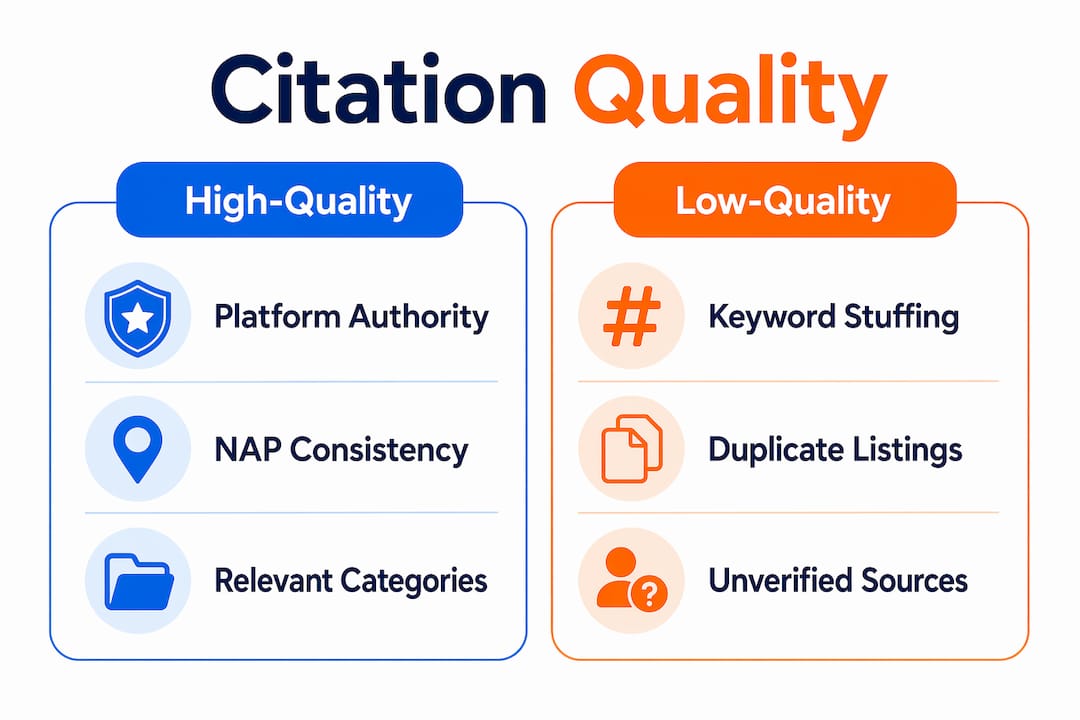
NAP consistency is the foundation of every effective citation. Your business name, address, and phone number must appear identically across every platform where you are listed. Inconsistent citation data can cause Google and AI systems to treat your business as multiple entities, which fragments your trust signals and damages visibility. A single digit wrong in your phone number or an abbreviated street name on one platform is enough to create that problem.
Beyond NAP, the quality of a citation depends on several supporting elements. Business category selection matters because it tells search engines exactly what service you provide. Accurate hours prevent customer frustration and signal that your listing is actively maintained. Photos, website URLs, and business descriptions add depth that authoritative directories reward with better placement.
BrightLocal research shows that 80% of consumers lose trust in a business due to inconsistent contact details, and 93% express frustration with incorrect listings. Those numbers reflect real lost customers, not abstract SEO metrics.
The difference between a high-quality citation and a low-quality one comes down to the authority of the platform and the completeness of the listing.
| Citation element | High-quality citation | Low-quality citation |
|---|---|---|
| Platform authority | Established directory or industry portal | Generic, low-traffic link farm |
| NAP accuracy | Exact match across all fields | Partial or mismatched details |
| Supporting data | Category, hours, photos, URL | Name and phone only |
| Maintenance | Regularly updated | Created once, never reviewed |
Common errors to avoid include keyword stuffing your business name (listing “Best Pizza Chicago Joe’s” instead of “Joe’s Pizzeria”), using a tracking phone number that differs from your main number, and listing a P.O. box as your primary address on directories that require a physical location.
Pro Tip: Before submitting to any new directory, search for existing listings of your business there. Duplicate listings with conflicting details are harder to fix than starting clean.
How many citations do businesses need and where should they appear?
Quality beats quantity every time when it comes to local citations. 10 to 15 high-quality, complete local citations outperform 200 low-quality generic listings in ranking stability and local visibility. Chasing volume on low-authority directories wastes time and can introduce inconsistencies that hurt more than they help.
The right platforms depend on your business type and location. Start with the highest-authority general directories, then move to category-specific and local sources. A well-rounded citation profile typically includes:
- Core directories: Google Business Profile, Yelp, Bing Places, Apple Maps, and Facebook Business.
- Industry-specific portals: Angi and HomeAdvisor for home services, Healthgrades for medical practices, Avvo for legal professionals, TripAdvisor for hospitality.
- Local sources: Your city’s chamber of commerce, local business associations, and regional news sites that maintain business directories.
- Data aggregators: Neustar Localeze, Data Axle, and Foursquare feed business data to dozens of secondary directories automatically.
Service-area businesses face a specific challenge. Service-area businesses benefit from citations to build local trust even without a physical storefront, and major directories including Google Business Profile support this setup with a “hide address” option. If you run a mobile dog grooming service or a home cleaning company, you still need a strong citation profile. Focus on directories that allow service-area designations rather than forcing a physical address you do not have.
Prioritize platforms where your customers actually search. A restaurant owner gets more value from a complete Yelp and TripAdvisor listing than from 50 obscure directory submissions. Understanding how local listings drive visibility helps you focus your effort on the platforms that move the needle.
How to maintain and update local citations for ongoing SEO benefit
Citation management is not a one-time task. Ongoing citation hygiene is necessary for sustaining visibility in evolving search environments. Businesses move, phone numbers change, and hours shift seasonally. Every update you fail to make across your listings creates a new inconsistency that chips away at your trust signals.
A practical maintenance routine looks like this:
- Audit your existing citations quarterly. Search your business name on Google and check the top 20 results for any listings with outdated or incorrect information. Free tools like Google Search and paid platforms designed for citation tracking both work for this step.
- Correct duplicates immediately. Duplicate listings split your authority and confuse search engines. Claim and merge or delete any duplicate profiles you find on major directories.
- Update all platforms simultaneously when details change. If you move locations or change your phone number, update Google Business Profile first, then work through your full directory list within the same week.
- Monitor new citations passively. Set a Google Alert for your business name to catch any new mentions or listings created without your input.
- Integrate citation updates with your Google Business Profile. Google Business Profile is the anchor of your local SEO presence. Keep it current and treat it as the master record that all other listings should match.
Local listings optimization goes beyond just fixing errors. Adding new photos, responding to reviews, and updating seasonal hours all signal to Google that your listing is actively managed. Active management correlates with stronger local pack placement over time.
Google’s local ranking factors value both the quantity and quality of citations, with consistent data leading to prominence and trust in results algorithms. Treat citation maintenance the same way you treat paying your utility bills. It is not exciting, but letting it lapse has real consequences.
Key Takeaways
Local citations are the digital foundation of local SEO, and consistent, accurate NAP data across authoritative directories directly determines your visibility in Google’s local pack, organic results, and AI-generated search answers.
| Point | Details |
|---|---|
| NAP consistency is non-negotiable | Identical name, address, and phone across every listing builds search engine trust. |
| Quality outranks quantity | 10–15 authoritative citations deliver more ranking stability than hundreds of generic ones. |
| AI search relies on citations | ChatGPT and voice assistants pull from citation ecosystems, not just Google Business Profile. |
| Consumer trust is at stake | 80% of consumers lose trust in a business with inconsistent contact details. |
| Maintenance sustains results | Quarterly audits, duplicate removal, and real-time updates keep citation signals strong. |
Citations are your business’s digital fingerprint
I have worked with dozens of small business owners who spent months on content and paid ads while their citation profiles were a mess. A bakery in one city had five different phone numbers listed across major directories because the owner had changed numbers twice and never updated the old listings. Their Google Business Profile showed one address; Yelp showed another. They were invisible in the local pack despite having a great website.
The fix took less than two weeks. We corrected the NAP across 12 key directories, merged the duplicate Google listings, and updated the business category. Within six weeks, they appeared in the local pack for three high-value search terms. No new content. No ad spend. Just clean citations.
What most business owners miss is that AI search has raised the stakes significantly. AI-powered search engines rely on the same citation ecosystem as traditional search, making citation health more critical than ever for appearing in voice and chat AI results. When someone asks their phone “best bakery near me,” the AI pulls from a network of consistent citations to decide who to recommend. If your data is fragmented, you simply do not appear.
Realistic expectations matter here. Citation corrections typically take four to twelve weeks to propagate fully across the web and influence rankings. Do not expect overnight results, but do expect steady, compounding gains. The businesses I see struggle most are the ones who fix citations once and then ignore them for two years. Treat it as a living part of your local SEO strategy, not a checkbox you tick once.
— TONY
How Ibrand helps small businesses get citations right
Getting citations right requires knowing which directories matter, how to fix inconsistencies at scale, and how to keep everything current as your business evolves.

Ibrand works with small businesses to build and maintain citation profiles that actually move rankings. The team audits your existing listings, corrects NAP inconsistencies, and places your business on the directories that carry the most weight in your industry and location. Every citation effort connects to a broader local SEO plan built around your specific goals. If you want to show up in the local pack and in AI-generated search results, clean citations are where that work starts. Ibrand makes that process straightforward and measurable from day one.
FAQ
What are local citations in SEO?
Local citations are online mentions of your business’s name, address, and phone number on external websites, directories, and platforms. They serve as trust signals that help search engines verify your business’s legitimacy and location.
How do local citations improve local search rankings?
Citations signal to Google that your business is real and consistently located where you claim. Consistent NAP data across authoritative directories increases your prominence score, which directly affects local pack and organic local rankings.
How many local citations does a small business need?
Quality matters more than volume. Ten to fifteen complete, accurate citations on high-authority directories outperform hundreds of low-quality generic listings in ranking stability and local visibility.
Can incorrect citations hurt my business?
Inconsistent citation data can cause Google to treat your business as multiple entities, fragmenting your trust signals and reducing visibility. Research shows 80% of consumers also lose trust in businesses with inconsistent contact details.
Do service-area businesses need local citations?
Service-area businesses benefit from citations even without a physical storefront. Major directories including Google Business Profile support a hidden-address setup, so mobile and home-based businesses can still build a strong citation profile.
Recommended
- How Smart Search Backlink Strategies Help Small Businesses Outrank Big Competitors | Ibrandmedia
- Understanding the Benefits of Local SEO for Small Businesses | Ibrandmedia
- Improving Local Search Rankings for Small Businesses Easily | Ibrandmedia
- Local SEO Strategies for Small Business Success | Ibrandmedia
Recent Comments