
TL;DR:
- Customer engagement focuses on building ongoing, meaningful relationships that increase loyalty, satisfaction, and revenue. Businesses that prioritize engagement see higher customer spending, repeat purchases, and lower churn rates. Maintaining continuous, personalized communication and effective feedback loops strengthens customer trust and long-term value.
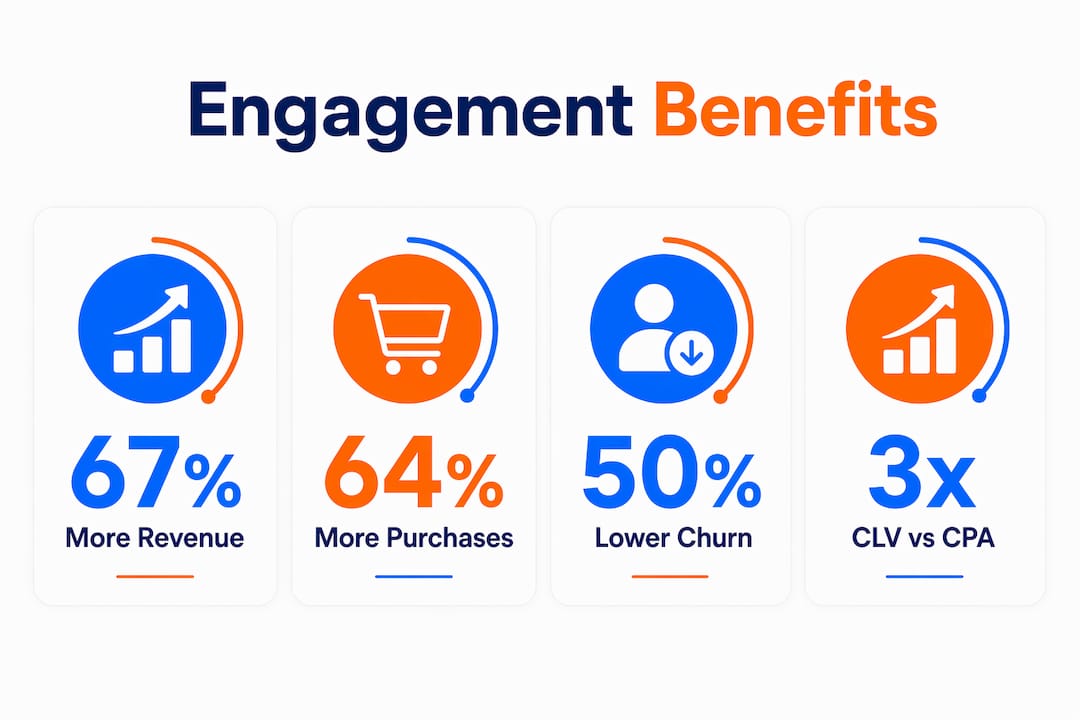
Customer engagement is defined as the ongoing practice of building meaningful, two-way relationships between a business and its customers to drive loyalty, satisfaction, and sustainable revenue growth. Why customer engagement matters becomes clear when you look at the numbers: current customers spend 67% more on average than new ones, and engaged customers are 64% more likely to purchase more frequently. These figures are not coincidences. They reflect a fundamental shift in how successful businesses compete. The industry term for this discipline is “customer engagement management,” and it covers every touchpoint from first contact to post-purchase advocacy. Businesses that treat engagement as a core function, not a marketing add-on, consistently outperform those that focus only on acquisition.
What measurable benefits does customer engagement provide?
The financial case for engaging customers is direct and well-documented. Loyal, engaged customers generate more revenue per transaction, buy more often, and cost far less to retain than new customers cost to acquire. Customer acquisition costs have risen sharply, making it a strategic imperative to maximize value from the customers you already have.
The benefits of engaging customers fall into four clear categories:
- Higher spending per customer. Current customers spend 67% more than new ones. That gap widens as the relationship deepens over time.
- Greater purchase frequency. Engaged customers are 64% more likely to buy again. Repeat purchases build predictable revenue without additional ad spend.
- Lower churn rates. 73% of customers switch to competitors after multiple bad experiences, and over 50% leave after just one unsatisfactory interaction. Consistent engagement reduces those friction points before they become exits.
- Organic advocacy. Engaged customers provide valuable feedback, advocate for your brand without being asked, and reduce your dependence on paid acquisition channels.
The impact of customer engagement on lifetime value is the most underappreciated metric in small business marketing. Most business leaders track cost per acquisition but rarely calculate what a retained, engaged customer is actually worth over three to five years. That number almost always dwarfs the cost of the engagement program itself.
| Benefit | Business impact |
|---|---|
| Higher average spend | 67% more revenue per existing customer vs. new |
| Increased purchase frequency | 64% higher likelihood of repeat buying |
| Reduced churn | Fewer exits after negative experiences |
| Lower acquisition dependence | Organic referrals replace paid channels |
| Stronger forecasting | Predictable revenue from loyal customer base |

Pro Tip: Track Customer Lifetime Value (CLV) alongside your cost per acquisition. If your CLV is not at least three times your acquisition cost, your engagement program needs more attention than your ad budget does.
How does engagement shape buying behavior and customer experience?
Customer experience and product quality are now equally weighted in the minds of buyers. 80% of customers value the experience from an organization as much as its actual products or services. That single data point reframes the entire competitive picture. You can have the best product in your category and still lose customers to a competitor who communicates better.
Engagement creates emotional connections that influence decisions before a customer ever reaches a checkout page. When a business listens, responds, and personalizes its communication, customers develop trust. Trust shortens sales cycles, reduces price sensitivity, and increases the likelihood of referrals. Trust built through engagement also improves sales cycle speed, forecasting accuracy, and negotiation openness.
The mechanism behind this is a two-way information loop. Effective engagement requires actively listening and tailoring personalized responses, not just broadcasting promotional messages. Automated email blasts and social posts without replies are one-way communication. They inform but do not engage. Real engagement means a customer feels heard, and that feeling changes their buying behavior in measurable ways.
Businesses that build this loop into their customer experience strategy also gain a competitive intelligence advantage. Every piece of feedback, every support ticket, and every social comment is data about what customers actually want. Brands that capture and act on that data differentiate themselves in markets where products are increasingly similar.
Pro Tip: Set up a simple monthly review of customer feedback across all channels, including email replies, social comments, and support tickets. Patterns in that data will tell you more about buying behavior than most paid research tools.
What challenges do businesses face with engagement strategies?
The most common mistake in customer engagement is confusing it with a loyalty points program. Many businesses rely on point or discount schemes that attract price-sensitive shoppers who leave the moment a competitor offers a better deal. Discounts create transactions. Engagement creates relationships. These are not the same outcome.
Several other pitfalls consistently undermine engagement efforts:
- One-way communication. Sending newsletters, promotions, and announcements without creating space for replies trains customers to tune you out.
- Inconsistent interactions. A customer who receives excellent service in one channel and poor service in another loses trust in the brand, not just the channel.
- Impersonal messaging. Generic “Dear Customer” emails signal that you do not know your audience. Personalization is now a baseline expectation, not a premium feature.
- Privacy missteps. Collecting customer data without clear value exchange or transparent policies erodes the trust that engagement depends on.
The deeper problem is that many businesses treat engagement as a campaign rather than a continuous process. A campaign has a start date and an end date. Engagement must be treated as a continuous lifecycle process, building trust across multiple interactions over time. Businesses that run an engagement campaign and then go quiet see their metrics spike and then fall back to baseline. Sustained engagement requires consistent investment in communication, feedback, and personalization.
Pro Tip: Audit your current customer communications and count how many invite a response versus how many just deliver information. If fewer than 30% invite a reply, your engagement strategy is still one-directional.
Which strategies actually improve customer engagement?
Improving customer engagement starts with treating it as a lifecycle activity, not a single touchpoint. Successful businesses approach engagement as an ongoing process that cultivates trust and creates more cost-effective upsell opportunities over time. The practical strategies that deliver consistent results share three traits: they are personalized, they are multi-channel, and they use data to improve over time.
Personalized, multi-channel communication
Segment your customer base by behavior, purchase history, and stated preferences. Send different messages to first-time buyers, repeat customers, and lapsed customers. Each group has different needs, and a single message serves none of them well. Platforms like Salesforce, HubSpot, and Klaviyo make behavioral segmentation accessible even for small teams.
Customer data and CRM use
A CRM platform is the operational backbone of any engagement strategy. It centralizes customer history, tracks interactions, and surfaces patterns that inform better communication. Without a CRM, engagement efforts are reactive. With one, they become proactive. Pair your CRM with real-time analytics to see which engagement touchpoints actually drive conversions.
Proactive feedback mechanisms
Ask for feedback at structured points in the customer lifecycle: after purchase, after support interactions, and at regular intervals for subscription customers. Net Promoter Score (NPS) surveys, post-purchase emails, and community forums all generate the data needed to close the feedback loop. The key is acting on what you hear and communicating that action back to customers.
Lifecycle engagement tactics
| Stage | Engagement approach | Goal |
|---|---|---|
| Acquisition | Personalized onboarding emails | Set expectations, reduce early churn |
| Active use | Behavioral triggers and tips | Increase product adoption |
| At-risk | Re-engagement campaigns | Recover lapsing customers |
| Loyal | Exclusive offers and advocacy programs | Deepen loyalty, generate referrals |
Building customer loyalty online through these lifecycle stages is far more cost-effective than replacing churned customers with new acquisitions. The math consistently favors retention.
Key Takeaways
Customer engagement is the single most cost-effective lever for increasing revenue, reducing churn, and building a brand that customers actively recommend.
| Point | Details |
|---|---|
| Engagement drives higher revenue | Existing customers spend 67% more and buy 64% more frequently than new ones. |
| Experience equals product value | 80% of customers rate experience as important as the product itself. |
| Churn is preventable | Over 50% of customers leave after one bad experience; consistent engagement reduces that risk. |
| Avoid transactional tactics | Discount programs attract price-sensitive buyers; personalized dialogue builds lasting loyalty. |
| Treat engagement as a lifecycle | Sustained, multi-channel engagement across the customer journey outperforms one-off campaigns. |
The real cost of ignoring engagement
Most business leaders I work with understand engagement in theory. Where they struggle is in treating it as a financial priority rather than a soft marketing activity. The businesses I have seen stagnate most predictably are the ones that invest heavily in acquisition and almost nothing in the relationships they have already built.
The uncomfortable truth is that engagement is not a feel-good initiative. It is a revenue protection strategy. When acquisition costs keep rising and paid channels become less predictable, the businesses with strong engagement programs are the ones that weather those shifts. Their customers stay longer, spend more, and bring in referrals that cost nothing.
What I find most businesses get wrong is the timeline. They expect engagement to produce results in the same quarter they launch it. Real engagement compounds. A customer who has had six positive interactions with your brand over two years behaves completely differently from one who has had two. The trust that builds over time is what makes upselling feel natural rather than pushy, and what turns a satisfied customer into an advocate.
My advice is simple: start with the customers you already have. Map every touchpoint they experience. Find the gaps where communication goes silent or becomes generic. Fix those first. The revenue impact of closing those gaps almost always exceeds what a new campaign would deliver.
— TONY
How Ibrand helps businesses build stronger customer connections
Building real customer engagement requires the right digital infrastructure, and that is exactly where Ibrand works with small and medium-sized businesses every day.
Ibrand’s services in SEO optimization and social media management are built to increase your visibility and create the consistent, personalized touchpoints that drive engagement. From search-optimized content that attracts the right customers to social channels that keep conversations active, Ibrand builds the digital presence that turns one-time buyers into loyal advocates. Every plan is tailored to your business size, budget, and growth goals, with real-time performance tracking so you always know what is working. Contact Ibrand to build an engagement strategy that delivers measurable results.
FAQ
Why does customer engagement matter more than acquisition?
Customer engagement matters because existing customers spend 67% more and cost far less to retain than new customers cost to acquire. As acquisition costs rise, engagement becomes the more profitable growth lever.
What is the difference between customer engagement and a loyalty program?
A loyalty program rewards transactions with points or discounts. Customer engagement builds ongoing, two-way relationships through personalized communication, feedback, and consistent interaction across the customer lifecycle.
How does poor engagement lead to customer churn?
73% of customers switch to competitors after multiple bad experiences, and over 50% leave after a single unsatisfactory interaction. Inconsistent or impersonal communication accelerates that churn.
What is the most effective customer engagement strategy?
The most effective approach combines multi-channel personalized communication, a CRM platform for behavioral tracking, and proactive feedback loops that close the information gap between business and customer.
How do you measure the impact of customer engagement?
Track Customer Lifetime Value, repeat purchase rate, Net Promoter Score, and churn rate. These four metrics together give a clear picture of whether your engagement efforts are building or eroding customer relationships.
Recommended
- Why reviews matter: unlocking growth for small businesses – Ibrandmedia
- How to Engage Customers Online: Boost Your Business Success | Ibrandmedia
- Increasing Engagement on Social Media: Proven Tips for 2025 | Ibrandmedia
- Creating Engaging Social Content: A Guide for Small Businesses 2025 | Ibrandmedia
Recent Comments