
TL;DR:
- Small venues must prioritize local SEO to capture high-intent search traffic that leads to bookings, as AI recommendation use increases.
- Building a strong Google Business Profile, managing reviews, ensuring citation consistency, and creating dedicated service pages are key strategies, with results developing over 6 to 12 months.
Search engine optimization (SEO) is the single most cost-effective tool small venues have for attracting local customers who are ready to book. While paid ads stop the moment your budget runs out, SEO builds compounding visibility that keeps working for you. Understanding why small venues need SEO means recognizing that local search is where booking decisions begin, and AI usage for local recommendations jumped from 6% to 45% between 2025 and 2026 alone. Google Business Profile, review management, and content strategy are no longer optional extras. They are the foundation of every venue’s digital presence.
Why small venues need SEO: the core case
Local SEO is the practice of optimizing your online presence to appear in geographically relevant searches, and for small venues, it is the difference between a full calendar and an empty one. When someone searches “event space near me” or “wedding venue in Austin,” they are not browsing. They are ready to make a decision. Capturing that intent is exactly what local SEO delivers.

The mechanism works through several interconnected signals. Google evaluates your Google Business Profile (GBP), the consistency of your name, address, and phone number (NAP) across directories, the volume and quality of your reviews, and the relevance of your website content. Each of these signals tells Google whether your venue deserves to appear in the local map pack, the three-listing block that dominates local search results and drives the majority of clicks.
Reviews carry particular weight. Only 35% of SMBs have a claimed and active Google Business Profile, which means the majority of small venues are invisible in the very place customers look first. That gap is your opportunity. A fully optimized GBP with recent reviews, accurate hours, and venue photos outperforms a bare listing every single time.
SEO for venues is also a long-term investment. Expect 6 to 12 months before you see significant ranking improvements in competitive local searches. That timeline sounds daunting, but it reflects how compounding assets work. Every review you earn, every citation you fix, and every page you publish adds to a growing foundation that becomes harder for competitors to displace.
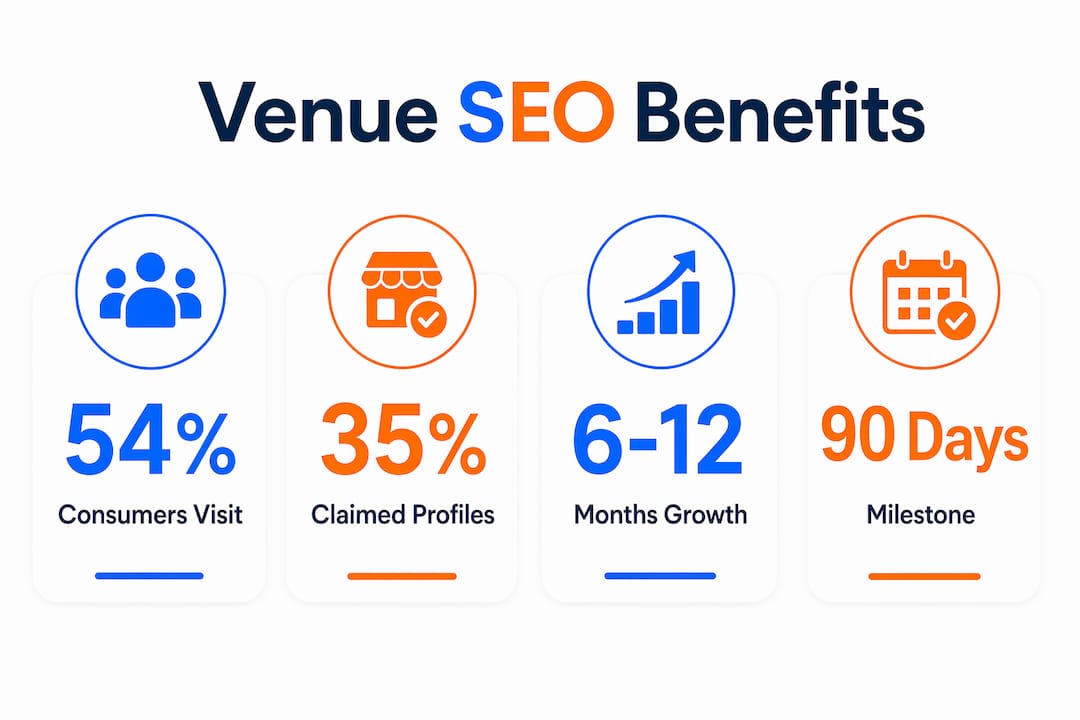
Pro Tip: Set a 90-day milestone to claim and fully optimize your GBP before measuring ranking changes. Rankings follow authority, and authority takes time to build.
What SEO strategies should small venues prioritize in 2026?
The most effective venue SEO strategy in 2026 combines Google Business Profile optimization, active review management, citation consistency, and targeted content creation. Here is how to execute each one.
-
Claim and fully build out your Google Business Profile. Add every relevant category (event venue, wedding venue, banquet hall), upload at least 20 high-quality photos, write a keyword-rich description, enable the booking link, and post weekly updates. A weak or unclaimed GBP limits your website’s SEO effectiveness because customers evaluate venues in the map UI before they ever reach your site.
-
Build a review acquisition system. Ask every client for a review within 48 hours of their event. Diversify across Google, Yelp, The Knot, and WeddingWire. AI systems parse review sentiment to generate local recommendations, so the themes in your reviews (spacious, easy parking, responsive staff) directly influence how AI surfaces your venue.
-
Respond to every review within 24 hours. Research shows 59% of consumers expect responses within that window, and 21% say how a business responds to reviews directly affects their confidence in booking. A thoughtful response to a negative review often converts skeptical prospects more effectively than five positive ones.
-
Audit and correct your NAP citations. Check your venue’s name, address, and phone number across Google, Yelp, Apple Maps, Bing Places, Facebook, and niche directories like Eventective and GigSalad. Inaccurate listings confuse AI models and reduce local trust signals, directly hurting your rankings.
-
Create dedicated service and location pages on your website. A single “Our Venue” page does not rank for “corporate event space in Denver” and “intimate wedding venue in Denver” simultaneously. Service-specific pages ranked first for local organic results and second for AI visibility in 2025 data. Build one page per event type and one per location if you operate multiple sites.
-
Add video content and customer-generated materials. A 60-second walkthrough video of your space, embedded on your website and posted to YouTube, signals relevance and keeps visitors on your page longer. Both factors improve your rankings over time.
Pro Tip: Use Google’s Q&A feature on your GBP proactively. Post and answer your own frequently asked questions about capacity, catering, and parking. This content feeds directly into AI-generated venue summaries.
How does venue SEO differ from general small business SEO?
Venue SEO and general small business SEO share the same technical foundation, but the priorities diverge significantly at the execution level. Understanding those differences helps you allocate your limited time and budget where it actually moves the needle.
| Factor | Venue SEO | General small business SEO |
|---|---|---|
| Search intent | Transactional and local (“book a venue near me”) | Mixed: informational, navigational, transactional |
| Visual content | Critical: photos and video drive booking decisions | Helpful but not decisive |
| Review impact | Directly tied to booking conversion | Builds trust but less immediate |
| Map pack priority | Primary traffic source | One of several traffic sources |
| Content focus | Event types, capacity, amenities, testimonials | Product/service descriptions, blog content |
| Citation directories | Niche platforms (The Knot, WeddingWire, Eventective) | General directories (Yelp, BBB, Bing Places) |
The transactional intent behind venue searches is the most important distinction. Someone searching for a plumber might compare options over days. Someone searching for a venue is often working against a deadline, a wedding date, a corporate retreat, a milestone birthday. That urgency means your GBP listing, your photos, your reviews, and your booking link must all be ready to convert at first glance.
54% of consumers visit a business website after reading positive reviews, up from 32% in 2019. For venues, that means your website must match the promise your reviews make. If reviews mention a beautiful outdoor terrace, your website needs photos of that terrace above the fold.
The reliance on niche directories also sets venue SEO apart. Platforms like The Knot and WeddingWire function as vertical search engines with their own ranking algorithms. Appearing prominently on those platforms, alongside a strong Google presence, creates multiple discovery paths that general small businesses simply do not need to manage.
What challenges do small venues face with SEO?
Small venues run into predictable obstacles when they start investing in local SEO. Knowing them in advance prevents the most common mistake: abandoning the strategy before it has time to work.
-
Slow results create false urgency. The 6 to 12 month timeline for meaningful ranking improvements is not a flaw in the strategy. It reflects how search engines build trust in a business over time. Venues that switch tactics at month three reset that clock entirely.
-
Review management requires consistency. Asking for reviews once after a big event is not a system. You need a repeatable process, whether that is a follow-up email template, a QR code at checkout, or a text message sent 48 hours post-event. Without consistency, your review recency drops and so does your ranking.
-
AI-driven search changes the rules. AI recommendation usage rose from 6% to 45% in a single year. Platforms like ChatGPT, Perplexity, and Google’s AI Overviews now surface venue recommendations based on review sentiment, citation accuracy, and structured data. A venue optimized only for traditional search is already behind.
-
Limited staff means limited bandwidth. Most small venues operate with lean teams. The solution is not to do everything at once. Prioritize GBP optimization and review acquisition first, then citation cleanup, then content. Those three activities deliver the highest return per hour invested.
-
“Set it and forget it” thinking kills momentum. SEO is not a one-time project. Google’s algorithm updates, competitor activity, and shifting consumer behavior all require ongoing attention. Venues that treat SEO as a launch task rather than an ongoing practice lose ground steadily without realizing it.
The good news is that local SEO success in 2026 centers on clarity and trust signals across every digital touchpoint. You do not need a massive budget. You need accurate information, genuine reviews, and consistent effort applied to the right platforms. For practical guidance on building that foundation, the local SEO strategies Ibrand has documented for small businesses offer a solid starting point.
Key takeaways
Small venues that invest in local SEO build a compounding digital asset that drives bookings, builds trust, and outperforms paid advertising over any 12-month horizon.
| Point | Details |
|---|---|
| GBP is your primary conversion surface | Claim, complete, and actively manage your Google Business Profile before any other SEO task. |
| Reviews drive AI visibility | AI recommendation usage hit 45% in 2026, making multi-platform review management non-negotiable. |
| NAP consistency builds trust | Inaccurate citations across directories confuse search engines and AI models, reducing your rankings. |
| Dedicated pages outrank generic ones | Create separate pages for each event type and location to capture specific local search queries. |
| SEO takes 6 to 12 months | Expect a long runway and measure progress through booking inquiries, not just keyword rankings. |
The compounding advantage most small venues are leaving on the table
I have worked with enough small venue owners to know the most common objection: “We get most of our bookings through word of mouth, so SEO can wait.” That logic made sense in 2015. It does not hold in 2026.
Word of mouth now starts online. When a friend recommends your venue, the first thing the recipient does is search for it. What they find, your GBP photos, your review score, your website, either confirms the recommendation or kills it. SEO is not replacing word of mouth. It is the infrastructure that makes word of mouth convert.
What I find most underappreciated is the competitive gap that opens up when you commit to SEO while your competitors do not. Most small venues are not doing this well. They have unclaimed GBP listings, outdated photos, and zero review response strategy. That is not a threat. That is an opening. The venues I have seen grow fastest are not the ones with the biggest budgets. They are the ones that showed up consistently for 12 months while everyone else waited for a shortcut.
The AI shift makes this more urgent, not less. When nearly half of consumers are now asking AI tools for venue recommendations, the venues with the strongest review profiles, the most accurate citations, and the clearest service pages are the ones getting recommended. That is not luck. That is the result of deliberate, sustained SEO work. The venue marketing strategies that compound over time are always the ones built on search visibility first.
— TONY
How Ibrand helps small venues fill their calendars with SEO
If you have read this far, you already understand the stakes. The next step is execution, and that is where most venue owners stall without support.
Ibrand specializes in venue SEO services that cover every layer of local search: Google Business Profile optimization, review acquisition systems, citation audits, and dedicated service page creation. Every plan is built around your specific venue type, location, and competitive market. If you want to see what a targeted SEO strategy looks like for your space, Ibrand’s team builds custom plans with transparent pricing designed for small venue budgets. You can also explore the website optimization guide to understand what your site needs before your first consultation.
FAQ
Why does SEO matter more for venues than other businesses?
Venue searches carry strong transactional intent, meaning searchers are ready to book, not just browse. Combined with the visual and review-driven nature of venue decisions, local SEO directly determines whether your space appears when it matters most.
How long does SEO take to work for a small venue?
Most venues see meaningful ranking improvements after 6 to 12 months of consistent effort, according to EverBridal’s 2026 venue SEO research. Measuring success through booking inquiries rather than rankings alone gives a more accurate picture of progress.
What is the most important SEO task for a small venue to start with?
Claiming and fully optimizing your Google Business Profile is the highest-impact first step. Only 35% of small businesses have an active GBP, which means most venues are invisible in the local map pack where booking decisions happen.
How does AI search affect venue SEO in 2026?
AI tools like ChatGPT and Google’s AI Overviews now surface venue recommendations based on review sentiment, citation accuracy, and structured data. With AI usage for local recommendations rising to 45% in 2026, venues need multi-platform review strategies and accurate listings to appear in AI-generated results.
Do small venues need to be on platforms beyond Google?
Yes. Niche directories like The Knot, WeddingWire, Yelp, and Eventective function as vertical search engines with their own algorithms. Appearing on multiple platforms creates redundant discovery paths and strengthens the citation signals that both Google and AI systems use to verify your venue’s credibility.
Recent Comments