
TL;DR:
- Effective digital lead generation for SMBs centers on quality and conversion, not just volume.
- Measuring ROI and sales alignment are more critical challenges than lead collection, shifting focus to value.
Most business owners think digital lead generation is about collecting as many email addresses as possible. Fill the top of the funnel, hope some convert, repeat. But that mindset is costing you real money. HubSpot’s 2026 State of Marketing survey found that measuring ROI (33%) and sales-marketing alignment (27.6%) rank as bigger challenges than lead generation itself (29.6%). That tells you something important: the game has shifted from chasing volume to proving value.
Table of Contents
- Defining digital lead generation for SMBs
- How digital lead generation works: The process and key tactics
- Measuring success: Metrics that matter most for SMBs
- What actually works: Lessons from real SMB case studies
- Perspective: Why measurement and alignment matter more than ever
- Take the next step with expert-led digital lead generation
- Frequently asked questions
Key Takeaways
| Point | Details |
|---|---|
| Quality beats quantity | Focusing on high-quality leads delivers better sales results than sheer lead numbers. |
| Track the right metrics | Measure lead quality, conversion, and ROI instead of just raw volume. |
| Multichannel matters | The best digital lead generation mixes tactics like SEO, ads, and remarketing for optimal results. |
| Sales and marketing alignment | Coordinating sales and marketing teams leads to more effective lead generation. |
| Continuous improvement | Regularly review strategies and benchmarks to keep your lead pipeline healthy and growing. |
Defining digital lead generation for SMBs
Now that you know lead generation is about more than raw numbers, let’s dig into how it’s defined in today’s SMB marketplace.
A digital lead is a prospective customer who shows some form of interest in your product or service through an online channel. That interest might look like filling out a contact form, clicking a paid ad, downloading a free resource, or starting a live chat session. The word “digital” simply means the interaction happened online rather than through a cold call or in-person visit.
Here’s where many small business owners get tripped up: there’s a major difference between lead volume (how many contacts you collect) and lead quality (how likely those contacts are to actually buy). SMBs measure effectiveness using both of those dimensions, but most early-stage businesses fixate only on volume. A list of 5,000 cold contacts beats a curated list of 200 warm prospects exactly zero times in the real world.
The most common digital channels for generating leads include:
- Websites and landing pages: Your core conversion engine where visitors decide to act or leave.
- Paid advertising: Google Ads, Meta Ads, and display networks that put your offer in front of targeted users.
- Social media: Organic posts and paid campaigns on platforms like Instagram, LinkedIn, and Facebook.
- Email marketing: Both outbound prospecting and inbound nurture sequences.
- Search engine optimization (SEO): Attracting visitors who are already searching for what you offer.
- Live chat and chatbots: Capturing leads in real time while visitors are still actively engaged.
Before you can learn to generate leads online at scale, you need to understand lead qualification. Qualification is the process of filtering your contacts to identify which ones are worth pursuing. A qualified lead meets specific criteria, such as budget, decision-making authority, and timeline to purchase. Skipping this step means your sales team (or you, if you wear both hats) wastes time on contacts who were never going to buy. For a deeper look at early-stage approaches, the basics of lead gen for startups apply equally well to established SMBs looking to tighten up their pipeline.
Pro Tip: Before you launch any campaign, write down exactly what a “qualified lead” looks like for your business. Define the job title, budget range, industry, or problem they’re trying to solve. This single step will save you hours of wasted follow-up.
How digital lead generation works: The process and key tactics
With foundational concepts clear, let’s map out exactly how digital lead generation works step by step for small businesses.
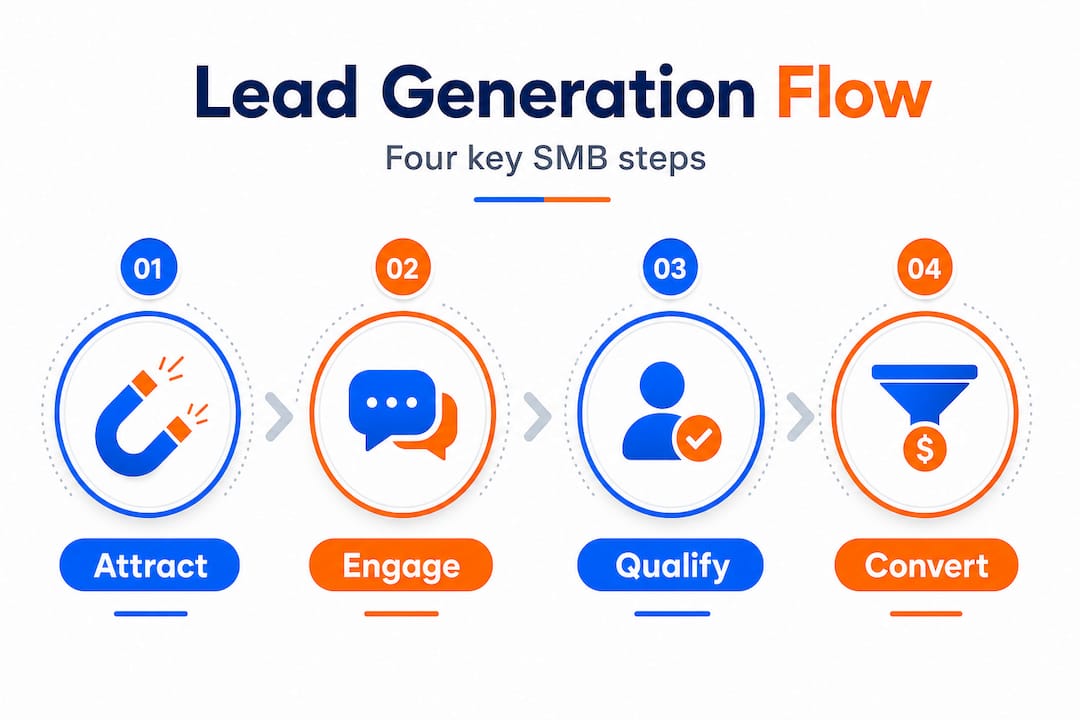
The process has four core stages. Every successful campaign, regardless of budget size, moves through all four:
- Attract: Draw targeted visitors to your web presence through paid ads, SEO content, social media posts, or video. The key word is targeted. A plumbing company running ads to people searching “emergency plumber near me” will always outperform one running general home improvement ads.
- Capture: Convert anonymous visitors into known contacts using forms, lead magnets, live chat, or phone click-to-call buttons. This is where your landing page design matters enormously. A cluttered, slow-loading page kills conversions before they start.
- Nurture: Stay in touch with leads who aren’t ready to buy yet through email sequences, retargeting ads, and follow-up calls. Most leads need between five and eight touchpoints before they make a decision.
- Convert: Turn nurtured leads into paying customers through a sales call, a booked appointment, or a completed online purchase.
| Stage | Top tactics | Pros for SMBs | Cons for SMBs |
|---|---|---|---|
| Attract | SEO, Google Ads, social media ads | Scalable, targeted reach | Requires budget or time investment |
| Capture | Landing pages, lead forms, live chat | Measurable, direct | Needs strong copy and design |
| Nurture | Email sequences, remarketing ads | Automated, cost-efficient | Takes time to build and test |
| Convert | Sales calls, online booking, webinars | High ROI when done right | Requires follow-up discipline |
Organic Growth Studio’s SMB case study frames success benchmarks around four pillars: audience and offer fit to the landing page, conversion tracking and optimization, lead nurturing and remarketing, and validating that leads actually convert to revenue. Notice that three of those four pillars happen after the lead is captured. Most SMBs invest everything in attraction and capture, then abandon the lead on the doorstep.
The right lead generation strategies for your business depend on your audience’s behavior. A B2B service firm will lean heavily on LinkedIn and email. A local restaurant will prioritize Google Business Profile and Instagram. The channel matters less than the message-to-audience fit. For a practical walkthrough of implementation, this step-by-step lead guide breaks down tactics by business type.
Pro Tip: Always set up conversion tracking before you spend a single dollar on ads. Without it, you’re flying blind and you’ll never know which campaigns are generating real customers versus just clicks.
Measuring success: Metrics that matter most for SMBs
After reviewing practical tactics, let’s look at how you know what’s really working (or not) in your lead generation efforts.
Vanity metrics are the enemy of growth. Getting 10,000 visitors to your website sounds impressive until you realize only three of them filled out a form. Real measurement focuses on the numbers that connect directly to revenue. Here’s what you actually need to track:
- Lead volume: Total contacts captured in a given period. Your baseline number.
- Qualified lead rate: The percentage of total leads that meet your ideal customer criteria. Healthy rates vary by industry but anything above 20% is worth building on.
- Conversion rate: The percentage of leads that become paying customers. Industry averages typically land between 2% and 5% for most digital channels.
- Cost per lead (CPL): Total ad or campaign spend divided by the number of leads generated. Lower is better, but only if quality stays high.
- Return on investment (ROI): Revenue generated from a campaign minus the cost, expressed as a percentage. This is your north star.
- Lead-to-customer ratio: How many leads does it take to close one sale? If you need 50 leads to close one deal, your funnel has a leak somewhere.
“93.8% of marketers say lead quality improved over the past year, signaling that better targeting tools and smarter campaigns are finally paying off for businesses willing to measure carefully.”
| Metric | Why it matters | Red flag |
|---|---|---|
| Lead volume | Shows reach and campaign activity | High volume with low quality |
| Qualified lead rate | Reveals targeting precision | Below 10% consistently |
| Conversion rate | Measures sales effectiveness | Dropping quarter over quarter |
| Cost per lead | Controls budget efficiency | Rising without revenue increase |
| ROI | Connects marketing to profit | Negative or unmeasured |
One of the most overlooked factors is sales-marketing alignment. In many SMBs, marketing generates leads and tosses them to sales with no context, no scoring, and no feedback loop. SMBs face persistent challenges around measuring ROI and achieving this alignment, which means the leads you’re already generating may be getting lost in handoff. Fixing the communication between your marketing efforts and your sales follow-up is often cheaper than generating more leads.

Understanding the specific lead generation challenges that SMBs face helps you prioritize where to fix your funnel first. And once you’ve identified the gaps, tracking lead results with a consistent dashboard keeps you honest about what’s actually improving.
What actually works: Lessons from real SMB case studies
Understanding the metrics is the first step. Let’s see how smart lead generation actually delivers growth for businesses like yours.
Real-world examples cut through the theory fast. Here are patterns that show up consistently across successful SMB campaigns:
Landing page optimization: A local HVAC company rewrote its service page headline, added a simple three-field form, and improved page load speed from 6 seconds to under 2 seconds. Qualified leads increased by 30% within 60 days without spending a dollar more on ads. The traffic was already there. The capture process was broken.
Remarketing that actually converts: A boutique law firm noticed that most visitors left their consultation page without booking. They ran a simple remarketing campaign on Meta targeting people who had visited that page in the last 14 days. The ad offered a free 15-minute call with a specific attorney. Booked consultations doubled within the first month. The key was timing and relevance, not a huge budget.
Email follow-up sequences: A B2B software reseller found that 70% of their inbound leads never received a follow-up email because their sales rep was too busy. They built a simple four-email drip sequence that went out automatically over 10 days. Revenue from inbound leads increased by 40% in one quarter, with zero additional ad spend.
Organic Growth Studio’s empirical benchmarks consistently point to audience-offer fit, conversion tracking, nurturing, and quality validation as the four pillars of repeatable success. Not one of these cases succeeded by finding a new trendy platform. All of them won by fixing the basics.
Best practices that emerge from every successful case:
- Match your ad message to your landing page exactly. Disconnect between the two kills conversions instantly.
- Follow up within 5 minutes of a lead submission. Response speed is one of the strongest predictors of conversion.
- Segment your email list so nurture content matches where the lead is in their decision process.
- Track every stage of the funnel, not just the top. Knowing where leads drop off tells you exactly where to fix things.
- Validate quality regularly by reviewing closed deals and tracing them back to their original source.
“Remarketing works best when it’s timely and personal. A generic ‘we miss you’ ad sent 45 days later rarely converts. A specific, relevant offer sent within 7-14 days of the initial visit is a different story entirely.”
If you want to boost local online sales using these same principles, the playbook is the same whether you’re a single-location retailer or a regional service provider. And if you’re not using remarketing strategies yet, you’re leaving warm leads on the table every single day.
Pro Tip: Set a remarketing window of 7 to 14 days for most service businesses. After two weeks, the prospect has likely moved on or found a competitor. Strike while the interest is still warm.
Perspective: Why measurement and alignment matter more than ever
Now, having seen what works in the real world, here’s a perspective you won’t find in most guides.
The digital marketing industry loves a new tactic. Every year there’s a new platform, a new ad format, a new AI tool promising to flood your pipeline overnight. And every year, SMBs burn budget chasing those promises while ignoring the fundamentals that actually drive growth.
Here’s the uncomfortable truth: most small businesses don’t have a lead generation problem. They have a measurement problem. They’re generating leads, but they can’t tell you which ones converted, which channel produced the best ROI, or why their sales rate is dropping. Governance and measurement matter as much as channel selection, even when overall lead generation is improving across the board. That nuance gets lost in every “10 best tactics” article.
Quality beats quantity. It always has. But the pressure to show activity (impressions, clicks, followers) makes it easy to default to volume metrics because they look good in a report. The business owners who win long-term are the ones who get comfortable asking harder questions: What was my actual revenue from last quarter’s campaigns? How many leads turned into repeat customers? What did it cost me to acquire each of them?
Sales-marketing alignment is probably the most underappreciated driver of lead gen success. When your marketing team (or your marketing agency) and your sales process operate in separate silos, the leads you worked hard to generate get mishandled, misqualified, or simply forgotten. Building a feedback loop where sales tells marketing what a good lead actually looks like is worth more than doubling your ad budget. You can explore how growth-focused lead strategies incorporate this alignment into every campaign stage.
The contrarian lesson we keep coming back to: obsess over iterative improvement and tracking, not campaign volume. Run fewer campaigns better. Measure everything. Fix one variable at a time. That boring, disciplined approach consistently outperforms the business owner who launches five new tactics every month and wonders why nothing sticks.
Take the next step with expert-led digital lead generation
When you’re ready to take action, expert support is your fastest route from learning to sustained growth.
Reading about lead generation tactics is useful. Actually implementing them consistently, while running a business, is a different challenge entirely. At ibrand.media, we build tailored lead generation plans designed specifically for small and mid-sized businesses. That means no generic templates and no guesswork about which tactics fit your market.
Our approach starts with website search optimization for SMBs so your business gets found by people already looking for what you offer. We layer in social media management benefits to keep your brand visible and engaging across the platforms your customers actually use. And for businesses that rely on local customers, our local online marketing services make sure you show up where it counts. Every plan includes real-time performance tracking so you always know exactly what’s working.
Frequently asked questions
What’s the difference between a digital lead and a qualified lead?
A digital lead is any online contact who’s shown interest in your business. A qualified lead goes further by meeting specific criteria, such as budget, need, or authority, that make them likely to purchase.
What’s the number one challenge SMBs face with digital lead generation?
Measuring ROI and aligning sales with marketing rank as the top challenges. SMBs consistently struggle to connect their marketing activity to actual revenue, which makes it hard to know what to improve.
Do most SMBs see improvement in their lead generation results?
Yes. 55.7% of marketers say it’s easier to generate leads now than a decade ago, and 24.5% report lead volume has significantly increased, signaling that digital tools and better targeting are making real progress possible for most businesses.
Which digital tactics get the best results for SMB lead generation?
Tactics built around audience and offer fit, combined with conversion tracking, lead nurturing, and quality validation, consistently outperform campaigns that focus only on reach or click volume.
Recent Comments