
If customers already search for what you sell, start with Google Ads. If your product needs to be discovered or sells on how it looks, start with Facebook or Instagram Ads through Meta. Once either channel is profitable, run both, because they solve different problems at different stages of the buying decision.
That’s the whole decision in one sentence, but the “why” matters because it changes how you set budgets and judge success. Meta creates demand by putting your product in front of people who weren’t looking for it, while Google captures people who are already looking. Benchmarks back this up: Meta’s average cost per click tends to run lower, often in the $0.62 to $1.72 range, while Google Search clicks typically cost more but convert at a higher rate because the visitor arrives with intent already formed.
- Search demand exists? Start with Google Ads.
- No one is searching, but the product is visual or new? Start with Meta.
- Both signals present? Split a small test budget and let 30 to 60 days of data decide.
Before spending a dollar, check Google’s Keyword Planner or Google Trends for your product category. If people are typing it into a search bar, that’s demand you can capture today.
Key Takeaways
Google Ads wins when search demand already exists, Facebook and Instagram Ads win when a product needs visual discovery, and most SMBs eventually benefit from running both once one proves profitable.
| Point | Details |
|---|---|
| Match platform to intent | Use Google Ads when Keyword Planner shows real search volume; use Meta when the product needs visual discovery. |
| Compare CPA, not CPC | Meta’s clicks often cost less, but Google Search frequently converts higher, so calculate CPA and ROAS before deciding. |
| Give campaigns real time | Wait two to four weeks on Google and three to four weeks on Meta before judging results or cutting a campaign. |
| Combine once profitable | Use Meta for prospecting and retargeting, then let Google Search capture the demand it creates. |
| Get expert campaign help | Ibrand builds custom Google and Meta campaign plans for SMBs with transparent pricing and real-time tracking. |
Table of Contents
- Google Ads vs Facebook Ads: The Core Difference That Decides Everything
- Why Google Ads Usually Wins for High-Intent and Local Searches
- Why Facebook and Instagram Ads Win for Visual and Brand-Building Goals
- Comparing Advertising Costs: Why CPC Is the Wrong Number to Watch
- Which Platform Should You Start With? A Decision Flow for Small Budgets
- The Campaign Setup Checklist That Protects Your Data
- Running Both Platforms Together Without Wasting Budget
- What Makes Ibrand a Credible Guide on This Decision
- Timelines, Learning Phases, and When Results Actually Mean Something
- Why Tracking Results Looks Different on Each Platform
- Fitting Ads Into Your Broader Marketing Stack
- Benchmarks and Reference Links Used in This Article
- What the Data Actually Tells SMB Owners to Do Next
- Get a Campaign Plan Built Around Your Actual Search Demand
- Sources
- FAQ
Google Ads vs Facebook Ads: The Core Difference That Decides Everything
Every argument about Google Ads versus Facebook Ads boils down to one distinction: demand capture versus demand creation. Google Ads captures demand that already exists. Someone types “emergency plumber near me” or “best noise canceling headphones under $200,” and you show up with an answer. Facebook and Instagram Ads, run through Meta, create demand by interrupting someone’s scroll with something they didn’t know they wanted until they saw it.
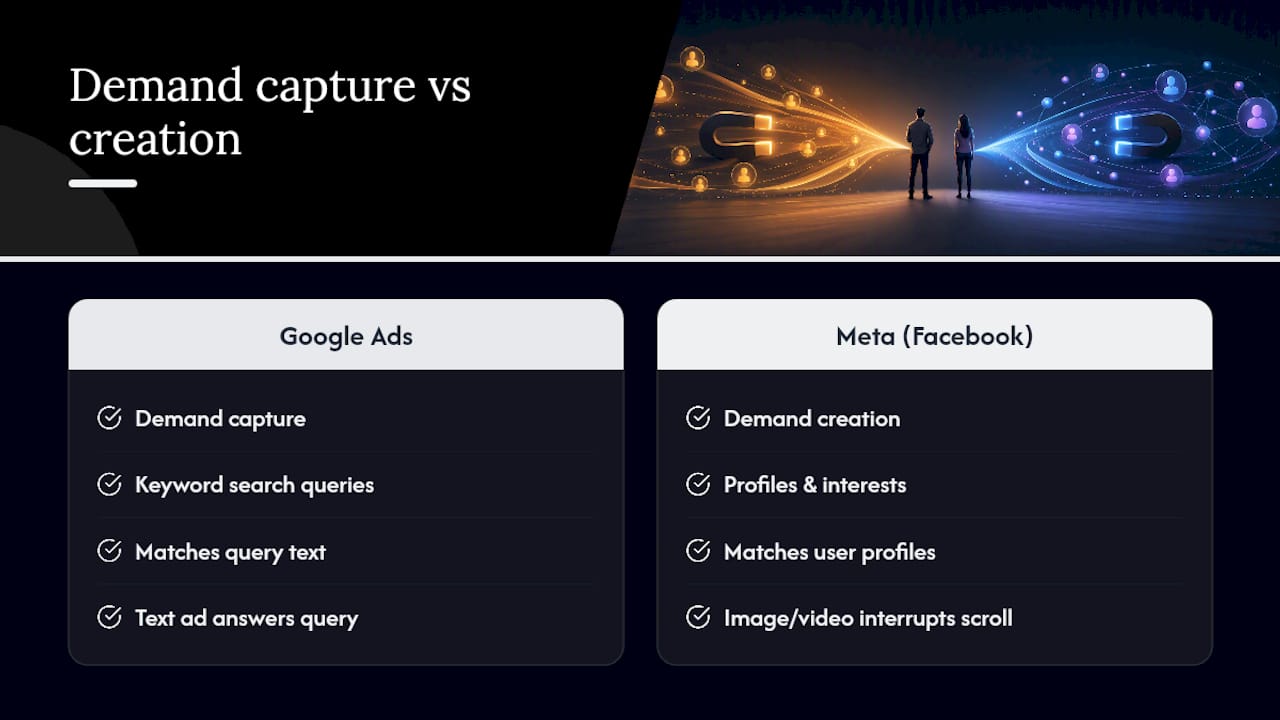
That difference changes everything downstream, starting with how each platform finds an audience. Google works backward from a keyword: it matches a search query to your ad based on words and phrases entered in real time. Meta works forward from a profile: it matches your ad to people based on interests, past behavior, demographics, and lookalike modeling built from your existing customers. Google Ads vs Facebook Ads or Meta Ads isn’t really a fight over which platform is better; it’s a fight over which kind of buyer intent you’re trying to reach.
The practical consequence shows up in creative and messaging. A Google Search ad succeeds by matching the exact language of the query and getting straight to the answer. A Meta ad succeeds by stopping a thumb mid-scroll, which means the image or video is doing most of the persuasive work before anyone reads a word of copy.
Pro Tip: Before writing a single ad, spend 15 minutes in Google’s Keyword Planner searching your product category. If monthly search volume is meaningful and the suggested cost per click looks survivable for your margins, you have a demand-capture opportunity sitting there unclaimed. If the volume is near zero, you have a demand-creation problem, and that’s Meta’s game to play.
This is also why “which is better, Google Ads or Facebook Ads” is the wrong question in isolation. A local HVAC company with strong search volume and a new subscription skincare brand with very low search recognition are not solving the same problem, and no single platform answer works for both.
Why Google Ads Usually Wins for High-Intent and Local Searches

Google Ads dominates when someone has already decided they need something and is actively looking for it. That’s the mechanism behind most of its wins for small businesses: Google processes billions of searches daily, and a meaningful share of those searches carry commercial or local intent, from “24 hour locksmith” to “commercial dishwasher replacement parts.”
Google Ads gives you four main levers for reaching that intent:
- Search ads — text ads matched to exact queries, best for high-intent, ready-to-buy searches.
- Shopping ads — product listings with images and prices, built for ecommerce comparison shopping.
- Display ads — banner-style ads across partner websites, useful for retargeting more than cold prospecting.
- YouTube ads — video placements that work well for demonstration-heavy products and services.
Quality Score is the piece most SMB advertisers underrate. Google scores your ads on expected click-through rate, ad relevance, and landing page experience, and a higher score literally lowers what you pay per click. A landing page that loads slowly or doesn’t match the ad’s promise will cost you more for the exact same position than a competitor with a tighter page, which is why landing page work isn’t optional polish. It’s a direct lever on cost.
Google Ads tends to be the stronger starting point for:
- Local service businesses (plumbers, electricians, dentists, lawyers) where customers search by need and location.
- Replacement parts, repairs, and anything with an established, specific product name.
- B2B companies where buyers research solutions by category or problem before ever seeing a social ad.
If your business fits any of these patterns and search volume shows up in Keyword Planner, Google Ads is where your first dollar should go.
Why Facebook and Instagram Ads Win for Visual and Brand-Building Goals

Meta’s advantage shows up wherever a product needs to be seen before it can be wanted. That’s true of most direct-to-consumer physical goods, subscription boxes, and anything that photographs or films well. Meta’s family of apps reaches a massive share of internet users worldwide, which gives advertisers enormous room to build and test audiences that don’t yet know your brand exists.
Placements and formats matter more here than on Google, because the ad itself has to do the work of stopping a scroll:
- Feed ads — the default placement, still solid for direct response.
- Stories and Reels — vertical, full-screen, video-first, and increasingly where the cheapest attention lives.
- Carousels — multiple images or products in one ad unit, strong for ecommerce catalogs.
Audience building is Meta’s other core strength. The Meta pixel tracks visitor behavior on your site, which lets you build custom audiences of people who viewed a product or abandoned a cart, then build lookalike audiences that resemble your best existing customers. That combination often produces cheaper prospecting than cold targeting alone, and it makes retargeting the highest-converting layer of a Meta campaign almost every time.
Meta tends to be the stronger starting point for:
- DTC lifestyle and physical product brands where the visual sells the item.
- New product launches with no existing search demand to capture.
- Awareness and consideration campaigns where the goal is building a customer list, not an immediate sale.
On Meta, creative quality is the single biggest performance lever you control; on Google, that role belongs to keyword selection and landing page experience. Knowing which lever you’re pulling determines where your time and budget should go first.
Comparing Advertising Costs: Why CPC Is the Wrong Number to Watch
Comparing raw cost per click between Google Ads and Facebook Ads is one of the most common mistakes SMB advertisers make, because a cheap click that never converts is worse than an expensive one that does.
The numbers behind the myth: Facebook and Instagram average clicks often land between $0.62 and $1.72, while Google Search clicks in competitive categories frequently run $2 to $5 or more. That gap looks like a clear win for Meta until you factor in conversion rate, where Search traffic typically converts at a noticeably higher percentage because the visitor already wants what you’re selling.
The metric that actually matters is cost per acquisition (CPA) or return on ad spend (ROAS), not CPC. Here’s the math that gets skipped: if Google Search costs $4 per click but converts at 5%, your CPA is $80. If Meta costs $1 per click but converts at 1%, your CPA is $100. The platform with the “cheaper” clicks just cost you more per sale.
Run the same exercise with your own numbers before deciding where to spend:
- Take your average CPC on each platform.
- Divide by your expected conversion rate to get CPA.
- Divide your average order value by CPA to estimate ROAS.
A $50 average order value with an $80 CPA is a losing campaign no matter how cheap the clicks felt going in. Comparisons across multiple benchmark studies consistently show the same pattern: Meta wins on raw click cost, Search often wins on conversion rate, and the only way to know which wins on profit is to calculate CPA and ROAS for your own product, your own price point, and your own margins.
Which Platform Should You Start With? A Decision Flow for Small Budgets
Run through this checklist before committing your first ad dollar:
- Check for search volume. Open Google’s Keyword Planner and search your product or service category. Meaningful monthly volume means demand-capture opportunity exists right now.
- Ask whether visuals sell the product. If a photo or short video would convince someone faster than a text description, that’s a signal favoring Meta.
- Check your margins. Thin margins with high Google CPCs in your category may make Meta’s lower entry cost the safer first test.
- Pick one platform and commit a real test budget. Real campaign data across large ad accounts shows SMBs generally do better concentrating budget on one channel first rather than splitting thin across both while still learning.
- Give it a real learning window. Both platforms need time before results mean anything. Google’s algorithm typically needs about 50 conversions in a rolling window to exit the learning phase efficiently, and Meta’s ad sets need roughly the same conversion volume before delivery stabilizes.
For a local service business with clear search volume, start with $20 to $30 a day on Google Search, aimed at your two or three highest-intent keyword themes. For a new visual product with no search history, start with $15 to $25 a day on Meta, running two to three creative variations against a broad interest audience.
Pro Tip: Don’t judge either platform inside the first 10 to 14 days. That window is mostly the algorithm learning who converts, and pulling the plug early throws away data you paid for without ever seeing what it was worth.
The Campaign Setup Checklist That Protects Your Data
Clean measurement is what makes the CPA comparison above actually trustworthy. Skip this setup and you’ll be comparing two sets of guesses instead of two real numbers.
- Set up conversion tracking before launch, not after. Define the exact action that counts as a conversion, whether that’s a purchase, a form fill, or a phone call.
- Connect the Meta pixel and map GA4 events consistently. Both platforms need to see the same conversion events to optimize toward them properly, and a clear conversion tracking setup prevents the two platforms from reporting different numbers for the same sale.
- Use one consistent UTM naming structure across every campaign. Inconsistent tagging is the single most common reason SMBs can’t tell which channel actually drove a sale months later.
Landing pages need different treatment depending on the traffic source. Search visitors want the fastest possible path to the answer they searched for; a page stuffed with brand storytelling will tank your Quality Score and your conversion rate together. Social visitors need more context, because they weren’t looking for you a minute ago, so a page that reintroduces the product and its benefit works better there.
- Test one creative variable at a time, whether that’s image, headline, or offer.
- Seed new audiences with your best-performing past creative rather than starting cold every time.
- Refresh Meta creative every two to three weeks; ad fatigue sets in faster on social than on Search.
Running Both Platforms Together Without Wasting Budget
Once either channel is profitable on its own, running both usually outperforms running one alone. Google and Meta are widely treated as complementary rather than competing channels, and the most common full-funnel workflow looks like this: Meta builds awareness and captures cold attention, retargeting nurtures the people who engaged but didn’t buy, and Google Search catches the same people once they start actively searching for your brand or product by name.
Budget splits vary meaningfully by business type:
- Local services: 70 to 80% Google Search, 20 to 30% Meta for retargeting and reputation-building.
- Established ecommerce: roughly even split, often 50/50, shifting toward whichever channel shows the stronger trailing 30 day ROAS.
- DTC product launches: 70 to 80% Meta early on to build awareness and a retargeting pool, shifting toward Google Shopping as branded search volume grows.
- B2B lead generation: 60 to 70% Google Search and Display, with Meta or LinkedIn-style targeting used mainly for top-of-funnel awareness among decision-makers.
Agency-level data across large managed ad spend shows this pattern holds industry by industry: companies with strong existing search demand consistently see Google outperform Meta by a wide margin, while visual and newly launched products often see the reverse.
The guardrail that keeps this from becoming guesswork: don’t shift budget based on a week of data. Sudden budget swings reset both platforms’ learning phases and can tank performance right when you’re trying to scale it.
What Makes Ibrand a Credible Guide on This Decision
Ibrand builds and manages Google Ads and Meta Ads campaigns for small and local businesses every day, alongside the SEO, local marketing, and web design work that makes those ad dollars convert once someone clicks. That combination matters because an ad campaign only works as well as the landing page behind it.
- Custom campaign plans built around whichever platform matches your actual search demand and product type.
- Transparent, published pricing instead of a quote you have to request and wait on.
- Real-time performance tracking so you see CPA and ROAS, not vanity metrics like impressions.
If you want a second opinion on which platform fits your budget and your industry before you commit spend, that’s a conversation Ibrand has with SMB owners regularly, and it starts with a straightforward consultation, not a sales pitch.
Timelines, Learning Phases, and When Results Actually Mean Something
Both platforms need a real runway before their algorithms optimize well, and judging performance too early is one of the most common ways SMBs waste ad budget.
Google Ads campaigns typically show early signal within the first week, since search intent is immediate. But Google’s own bidding algorithms perform best after accumulating a meaningful volume of conversions, generally landing on a stable cost per acquisition somewhere between two and four weeks in, depending on your daily budget and conversion volume.
Meta’s learning phase behaves differently because it’s matching your ad against interest and behavior data rather than an explicit query. New ad sets typically need to log a batch of conversions, commonly cited around 50 within a seven day window, before Meta’s delivery system exits the learning phase and starts optimizing efficiently. Ad sets that get edited repeatedly during this window, even small changes like swapping a headline, can reset that clock and extend the learning period further.
The practical rule: give Google Search two weeks minimum before making a bid or budget decision, and give Meta at least that long, ideally closer to three to four weeks, before killing an ad set that isn’t hitting target CPA. Pulling the plug at day five on either platform means judging a campaign before it ever had a fair chance to optimize.
Why Tracking Results Looks Different on Each Platform
Attribution works differently enough between these two platforms that comparing their reported numbers side by side without adjustment will mislead you.
Google Ads attribution is relatively straightforward because the click and the conversion usually happen close together in time, often within the same session. Google’s own conversion tracking, paired with Google Analytics 4, gives a fairly clean picture of what a search click actually produced.
Meta attribution is messier, largely because of privacy changes over the past few years. Apple’s App Tracking Transparency framework, introduced in iOS, restricted how much behavioral data apps can collect from iPhone users without explicit permission, and a large share of Meta’s ad audience browses on iOS devices. That shift reduced the precision of Meta’s pixel-based tracking and pushed many advertisers toward Meta’s Conversions API, which sends conversion data directly from a business’s server rather than relying solely on browser-based tracking.
The practical fix is running both platforms’ native tracking alongside GA4 and treating small discrepancies as normal rather than alarming. Expect Meta to report more conversions in its own dashboard than GA4 will credit to it, since Meta’s default attribution window is generous. When the two numbers diverge sharply, trust GA4 or your CRM’s actual sales data over either platform’s self-reported total.
Fitting Ads Into Your Broader Marketing Stack
Neither Google Ads nor Meta Ads works in a vacuum, and treating either as a standalone growth engine leaves real performance on the table.
Search and SEO connect directly to Google Ads, since paid search often surfaces keyword and conversion data that sharpens your organic search strategy too, and a business ranking well organically for its top keywords can often lower its paid CPC on the same terms through a stronger relevance signal. Email marketing pairs naturally with Meta, since custom audiences built from your email list are typically among the cheapest and highest-converting lookalike sources you can build.
CRM integration matters more as budgets grow, since knowing which channel produced a customer who actually stayed and spent, not just one who clicked, is the only way to judge true return over time. Businesses running social media management alongside paid Meta campaigns also tend to see lower cost per click, since an active organic presence improves ad relevance and audience trust before the paid ad even appears. For B2B companies layering in account-based tactics, a partner resource on B2B growth platforms is worth a look for how technical buyers move through longer research cycles before converting.
Benchmarks and Reference Links Used in This Article
- Google Ads vs Facebook Ads: Which Is Better? – Shopify
- Facebook Ads vs. Google Ads: Which Is Better? – WordStream
- Superscale
- $12M in Data Compared – PXL Peak
What the Data Actually Tells SMB Owners to Do Next
Most advice on Google Ads versus Facebook Ads treats this like a permanent brand loyalty decision, and that’s the part I think misses the point entirely. It isn’t. It’s a sequencing decision, and the sequence depends entirely on whether demand for your product already exists in a search bar somewhere.
The conventional wisdom I’d push back on hardest: the idea that a “balanced” 50/50 split is the safe way to start. It isn’t safe, it’s slow. Splitting a small test budget across two platforms while both are still in early learning phases means neither one gets enough data to tell you anything useful within a reasonable window. Concentrate the first real test on whichever platform your own Keyword Planner search and product type point to, and let it either work or fail clearly before adding the second channel.
What actually matters, based on everything in the benchmarks above, is the CPA math, not the CPC headline. A local service business chasing “cheap clicks” on Meta while ignoring a clear Google Search opportunity is optimizing for the wrong number. Run the calculation on your own numbers before either platform gets a dollar of your budget.
Get a Campaign Plan Built Around Your Actual Search Demand
Deciding between Google Ads and Facebook Ads shouldn’t require guessing your way through a few hundred dollars of wasted spend before you find out which one fits. Ibrand builds custom advertising plans for small and local businesses that start with the same question this article does: does search demand exist for what you sell, or does your product need visual discovery first? That answer determines the entire campaign structure, budget split, and creative approach we build for you.
Every plan comes with transparent, published pricing and real-time performance tracking, so you see your actual cost per acquisition instead of a vague monthly report. If you’re ready to put a real budget behind either platform, or both, Ibrand’s online advertising services are the next step, and you can also start by reviewing our guide to affordable advertising for small businesses to see what a realistic first month looks like. Request a custom plan and we’ll tell you honestly which platform fits your business before we ever ask you to spend a dollar.
Sources
- Google Ads vs Facebook Ads: Which Is Better? – Shopify
- Superscale
- Global social networks ranked by number of users – Statista
FAQ
Is Google Ads better than Facebook Ads?
Neither is universally better; Google Ads wins when your product already has search demand, while Facebook and Instagram Ads win when your product needs visual discovery or you’re building brand awareness from a low starting point.
Are Google Ads really worth it for a small business?
Google Ads is worth it when meaningful search volume exists for your product and your landing page converts, since you’re paying to reach people who are already looking for what you sell.
What are the disadvantages of Google Ads?
Google Ads can carry higher cost per click in competitive categories, requires ongoing keyword and Quality Score management, and delivers little value if no one is actively searching for your product yet.
Should I learn Facebook Ads or Google Ads first?
Learn whichever platform matches your product: if Keyword Planner shows real search volume for what you sell, start with Google Ads; if your product is visual with little existing search demand, start with Facebook and Instagram Ads through Meta.
How do Google Ads and Facebook Ads costs compare?
Facebook and Instagram Ads typically have lower average cost per click, often between $0.62 and $1.72, while Google Search clicks cost more but tend to convert at a higher rate, so comparing cost per acquisition matters more than comparing raw click cost.
Recent Comments