
TL;DR:
- Email segmentation involves grouping subscribers based on shared characteristics to deliver targeted, relevant messages that improve engagement. Focusing on behavioral and demographic data initially, businesses should build dynamic, AI-supported segments and regularly update them to maximize ROI. Most issues stem from poor data quality and over-segmentation, so starting with three to five core segments maintains effectiveness and scalability.
Email marketing segmentation is the practice of dividing your subscriber list into smaller groups based on shared characteristics so each group receives messages that match their specific interests, behaviors, or stage in the buying cycle. Segmented campaigns double click-through rates compared to unsegmented sends, making list segmentation the single highest-leverage tactic available to marketing professionals and small business owners. Platforms like Mailchimp and Klaviyo have built their core product value around this capability because the data is unambiguous: relevant messaging wins. This email marketing segmentation guide covers every layer, from foundational types to AI-powered automation, so you can build a system that compounds results over time.
What is email marketing segmentation and why does it matter?
Email marketing segmentation is the process of organizing your list into distinct groups, called segments, based on criteria like demographics, purchase history, geographic location, or engagement behavior. The goal is to replace one generic broadcast with multiple targeted messages, each written for a specific audience subset. Relevant messaging is the single biggest driver of email performance in 2026, outperforming send-time optimization and subject line testing combined.

The business case is straightforward. A subscriber who bought running shoes last month responds differently to a promotional email than someone who browsed your homepage once and never returned. Treating them identically wastes budget and trains your list to ignore you. Segmentation fixes that by matching message intent to subscriber readiness, which is why tools like HubSpot and Klaviyo position it as a prerequisite for any serious email program.
What are the core types of email segmentation?
Four foundational segmentation categories cover the majority of use cases for small businesses and marketing teams.
| Segmentation type | What it uses | Best for | Data source |
|---|---|---|---|
| Demographic | Age, gender, income, job title | Broad personalization, B2C and B2B | Sign-up forms, CRM fields |
| Geographic | City, region, country, time zone | Local offers, event invites, send-time optimization | IP data, billing address |
| Psychographic | Values, interests, lifestyle, motivations | Brand storytelling, premium positioning | Surveys, preference centers |
| Behavioral | Purchases, clicks, site visits, cart activity | Conversion campaigns, re-engagement | ESP tracking, ecommerce data |
Demographic segmentation is the easiest starting point because the data is collected at sign-up. Geographic segmentation adds a layer of relevance for businesses with physical locations or region-specific offers. Psychographic segmentation requires more effort to collect but produces the strongest brand affinity when done well. Behavioral segmentation is the most predictive of conversion because it reflects what subscribers actually do, not just who they say they are.
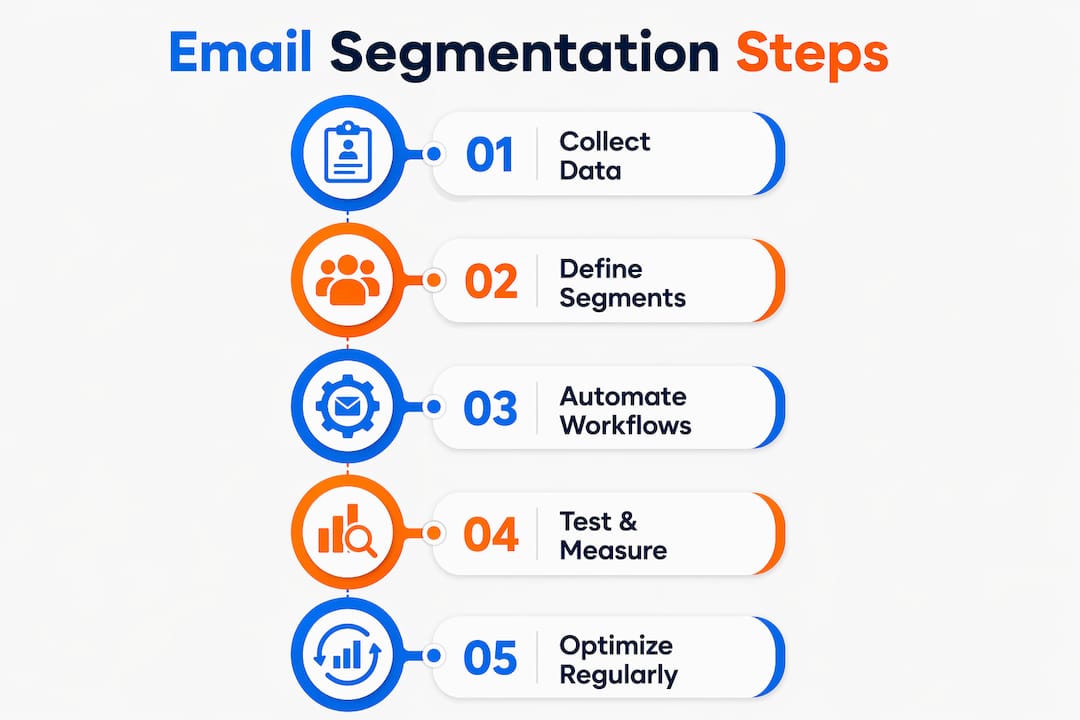
The practical takeaway: start with behavioral and demographic data because both are available in most email service providers (ESPs) without additional survey work. Layer in psychographic signals as your program matures and your data collection improves.
Which advanced email segmentation strategies produce the best ROI?
Once you have the basics running, these five advanced frameworks consistently produce the strongest returns.
- Lifecycle stage segmentation groups subscribers by where they sit in the customer journey: new subscriber, active buyer, lapsed customer, or loyal advocate. Each stage requires a different message. New subscribers need onboarding sequences. Lapsed customers need re-engagement offers. Loyal advocates respond to referral programs and early access.
- RFM scoring (Recency, Frequency, Monetary) ranks customers by how recently they purchased, how often they buy, and how much they spend. High RFM scores identify your best customers. Low recency scores flag churn risk. RFM is especially powerful for ecommerce brands using platforms like Shopify or WooCommerce because transaction data is already structured.
- Engagement-level segmentation separates highly engaged contacts from passive and dormant ones. Engagement segmentation improves list health by reducing unsubscribes and spam complaints, which directly protects your sender reputation.
- VIP and repeat customer segmentation isolates your top spenders for exclusive treatment: early product launches, loyalty rewards, or personalized outreach. These subscribers convert at higher rates and have lower acquisition costs than new leads.
- Firmographic segmentation applies to B2B lists and groups contacts by company size, industry, revenue, or tech stack. A SaaS company selling to enterprise IT teams needs entirely different messaging than one selling to solo consultants.
One pitfall that kills otherwise solid programs: over-segmentation. Starting with three to five core segments is optimal because too many small segments reduce statistical significance and make testing unreliable. Build depth in a few high-impact segments before multiplying them.
Pro Tip: For B2B lists, combine firmographic data with behavioral signals. A contact at a mid-size company who visited your pricing page three times in one week belongs in a high-intent conversion segment, not a generic nurture flow.
How can marketers collect and maintain quality segmentation data?
Good segmentation fails without good data. Here is a practical process for auditing and maintaining the inputs your segments depend on.
- Audit your ESP and CRM. Pull a full export and check for duplicates, missing field values, and inconsistent data formats. Regular audits for duplicates, inconsistent mappings, and missing values are the foundation of segmentation accuracy. A list with 30% incomplete records produces unreliable segments regardless of how sophisticated your logic is.
- Identify data gaps and fill them. If you lack purchase history, connect your ESP to your ecommerce platform. If you lack demographic data, add a single-question preference survey to your welcome sequence. Progressive profiling, asking one question per email over several sends, works better than long sign-up forms that reduce conversion.
- Manage consent and subscription status. Clean consent data is non-negotiable for deliverability and legal compliance under CAN-SPAM and GDPR. Suppress unsubscribes, hard bounces, and complaint records before every send. Never re-add contacts who opted out.
- Set a data refresh schedule. Refresh segmentation data at least quarterly, with monthly preferred for high-growth programs. Stale data produces stale segments. A customer who was “active” six months ago may now be dormant, and sending them conversion-focused emails instead of re-engagement content wastes spend.
- Use behavioral and transactional data as primary inputs. These update automatically through your ESP and ecommerce integrations, making them more reliable than manually entered demographic fields.
Pro Tip: Avoid free-text fields in sign-up forms for any data you plan to use in segmentation logic. “New York,” “new york,” “NY,” and “N.Y.” are four different values to a database. Use dropdowns or checkboxes instead.
How to automate email segmentation effectively with AI and workflows
Automation converts segmentation from a manual, periodic task into a real-time system that responds to subscriber behavior as it happens. Dynamic segments automatically update based on customer behavior, unlike static lists that become outdated the moment they are created. This distinction matters because a static “recent purchasers” list from last month is already wrong.
| Feature | Static segmentation | Dynamic segmentation |
|---|---|---|
| Update frequency | Manual, periodic | Real-time, automatic |
| Accuracy over time | Degrades quickly | Stays current |
| Workflow integration | Requires manual triggers | Triggers fire automatically |
| Best use case | One-time campaigns | Ongoing nurture and lifecycle flows |
| Setup complexity | Low | Moderate to high |
Building dynamic segments in platforms like Klaviyo or HubSpot requires defining clear enrollment criteria (what behavior adds someone to the segment) and exit criteria (what behavior removes them). Dynamic segment lists should be built with enrollment and exit criteria based on recent behavioral events and lifecycle stages to enable precise workflow triggering. Without exit criteria, segments bloat and workflows fire at the wrong time.
AI-enhanced tools assist in predictive segmentation by identifying hidden patterns in purchase sequences, browsing behavior, and engagement history that human analysts would miss. The critical caveat: AI recommendations require human validation to confirm they align with your brand tone and business goals. Automated personalization at scale works best when a marketer reviews segment logic monthly and adjusts criteria based on campaign performance.
Measure automation success with click-to-open rate (CTOR) and conversion rate per segment, not open rate alone. Use suppression lists and wait conditions inside workflows to prevent a single subscriber from receiving conflicting messages from overlapping segments.
Pro Tip: Set a segment overlap audit into your monthly calendar. If one subscriber qualifies for four active workflows simultaneously, they will receive too many emails and unsubscribe. Overlap rules or priority logic inside your ESP prevent this.
What metrics prove your email segmentation strategy works?
Measurement is where most segmentation programs break down. Marketers track the wrong numbers and draw the wrong conclusions.
Open rates are no longer a reliable primary metric. Apple Mail Privacy Protection and similar features inflate open rates artificially, making a 45% open rate and a 25% open rate nearly indistinguishable in terms of actual engagement. Open rates are unreliable post-privacy updates; prioritize click-to-open rate and conversion metrics per segment instead.
The metrics that actually tell you whether segmentation is working:
- Click-to-open rate (CTOR): Measures clicks as a percentage of opens, filtering out the privacy-inflated open count. CTOR above 20% indicates strong message-to-segment alignment.
- Conversion rate per segment: The percentage of recipients who completed the desired action. Compare this across segments to identify which groups respond to which offers.
- Revenue per recipient: Total revenue generated divided by emails sent to that segment. This is the clearest indicator of ROI at the segment level.
- Unsubscribe and complaint rates: Rising rates in a specific segment signal a mismatch between message content and subscriber expectations. Fix the content or the segment criteria before the next send.
Testing within segments requires discipline. Isolate a single variable per test, run it against a statistically significant sample, and compare results to a control group. Testing subject line and send time simultaneously in the same experiment produces data you cannot interpret.
Pro Tip: Set a “segment expiration” rule in your program. Any segment that has not been reviewed and validated in 90 days gets paused automatically. This prevents stale audience data from contaminating your results.
Key takeaways
Effective email segmentation requires behavioral data, dynamic automation, and disciplined measurement to produce compounding ROI improvements over time.
| Point | Details |
|---|---|
| Behavioral data wins | Behavioral signals predict conversion better than static demographics alone. |
| Start with 3 to 5 segments | Over-segmentation reduces sample sizes and makes testing statistically unreliable. |
| Dynamic beats static | Dynamic segments update in real-time and keep workflow triggers accurate. |
| CTOR over open rate | Click-to-open rate is the most reliable engagement metric post-privacy changes. |
| Refresh data monthly | Stale segmentation data degrades campaign performance; monthly audits maintain accuracy. |
Why most segmentation programs stall before they scale
After working with dozens of small business marketing programs, the pattern I see most often is not a lack of strategy. It is a lack of discipline around data quality and segment quantity. Teams build 15 segments in the first month, realize they cannot create 15 versions of every campaign, and quietly abandon the whole system. The segments sit in the ESP, unused, while the team goes back to broadcasting.
The fix is simpler than most people expect. Start with three segments that map directly to your revenue goals: high-intent buyers, active subscribers who have not purchased, and lapsed customers. Get those three working well, meaning you have content, triggers, and measurement in place, before adding anything else. Aligning message content with subscriber intent and readiness, not just demographic targeting, is what separates programs that scale from programs that stall.
I also see businesses underestimate consent hygiene until a deliverability problem forces the issue. Suppressing unsubscribes and managing bounce data is not optional maintenance. It is the foundation that keeps your sender reputation intact and your segments trustworthy. Combine that with data-driven segmentation supported by AI and human oversight, and you have a system that gets smarter every month without requiring a larger team to run it. That is the version of segmentation worth building.
— TONY
How Ibrand helps small businesses get segmentation right
Ibrand works with small and medium-sized businesses that want their digital marketing to produce measurable results, not just activity. If you are building out your email program and need support connecting segmentation strategy to your broader local search presence, the Ibrand team brings both the technical setup and the strategic direction.
From audience analysis and ESP configuration to campaign reporting and ongoing optimization, Ibrand’s approach starts with your business goals and builds backward to the tactics. Whether you are running your first segmented campaign or rebuilding a program that stopped performing, explore how personalized marketing can move the needle for your specific audience. Contact Ibrand to request a custom plan built around your list, your customers, and your revenue targets.
FAQ
What is email segmentation in simple terms?
Email segmentation means splitting your subscriber list into smaller groups so each group receives emails relevant to their behavior, interests, or stage in the buying process. The goal is to replace generic broadcasts with targeted messages that drive higher engagement and conversions.
How many segments should a small business start with?
Start with three to five core segments aligned to your primary business goals. Over-segmentation creates small sample sizes that make testing unreliable and content production unsustainable for small teams.
What data do I need to start segmenting my email list?
Most ESPs provide behavioral data like opens, clicks, and purchase history out of the box. Combine that with basic demographic fields from your sign-up form to build your first segments without additional data collection tools.
How often should I update my email segments?
Refresh segmentation data at least quarterly, with monthly updates preferred for active programs. Dynamic segments in platforms like Klaviyo or HubSpot update automatically, but the underlying criteria and logic still need periodic human review.
Why are my open rates not a reliable segmentation metric?
Apple Mail Privacy Protection and similar features pre-load email tracking pixels, inflating open rates regardless of whether a subscriber actually read the email. Use click-to-open rate and conversion rate per segment as your primary performance indicators instead.
Recent Comments