
Link building is the process of getting other websites to link to yours, and it works because each link tells search engines and AI systems that someone else vouches for your content. The single fastest first move for a beginner is a two-part action: find every unlinked mention of your brand or business already sitting on the web, then send a short, polite request asking the publisher to turn it into a real hyperlink. That one tactic alone tends to produce a high success rate with fast referral traffic because the publisher already knows who you are. They just forgot to link you.
Before you write a single outreach email, spend your first hour doing this:
- Search Google for
"your business name"(with quotes) and note every site that mentions you but doesn’t link to you. - Pull up Google Search Console (free) and check whether your homepage and top pages are indexed at all.
- List your three best pieces of content, the ones genuinely worth someone else linking to. If you don’t have three, that’s your real starting point.
Pro Tip: Don’t skip the indexing check. Sending outreach emails to promote a page Google hasn’t even crawled yet is like handing out business cards for a store that isn’t open.
Once you’ve got that list of unlinked mentions, run this quick checklist before you do anything else:
- Confirm the mention is on a live, active page (not an archived or dead one).
- Check whether the site has an editor, contact page, or author byline you can reach directly.
- Draft one short, specific request per mention, referencing the exact page and sentence where your name appears.
Key Takeaways
Link building for beginners works best when you prioritize relevant, editorially earned links over raw authority scores, starting with reclaimed mentions before investing in guest posts or digital PR.
| Point | Details |
|---|---|
| Audit before outreach | Confirm indexing and list every unlinked brand mention before sending a single pitch. |
| Reclaim mentions first | This tactic has the highest success rate for beginners since the publisher already knows you. |
| Relevance beats raw authority | A relevant link from a small niche site often outperforms a high-authority irrelevant one. |
| Track a few core metrics | Watch referring domains, referral traffic, and anchor text diversity weekly and monthly. |
| Consider guided help when ready | Ibrand offers a starter audit and campaign support once DIY tactics have proven the concept. |
Consistency beats intensity here. A beginner who reclaims five mentions and pitches three resource pages every month for six months will outpace someone who blasts two hundred emails once and gives up when the reply rate disappoints.
Table of Contents
- What Is Link Building and Why Does It Matter for SEO?
- Which Links Actually Move the Needle?
- Beginner Link Building Tactics Ranked by Effort
- How to Start: Your First 30 to 90 Days
- Which Tools and Metrics Actually Matter?
- Common Beginner Mistakes That Waste Time or Risk Penalties
- How Long Until You See Results?
- The Fastest Win: Reclaiming Mentions and Auditing Linkable Assets
- What Do Google’s Link Guidelines Actually Prohibit?
- How Do You Keep a Healthy Link Profile Long Term?
- What I’d Focus On If I Were Starting Today
- Ready for Hands-On Help With Your First Campaign?
- Sources
- FAQ
What Is Link Building and Why Does It Matter for SEO?
Link building means earning hyperlinks from other websites back to yours, and it matters because those links function as votes of confidence in the eyes of both search engines and the newer AI systems people now use to find answers. A link from another site is a signal you can’t fully manufacture on your own page. It has to come from somewhere else, which is exactly what makes it valuable.
Search engines have used links as a core ranking signal for decades, but the picture has expanded. Modern SEO treats link building as serving two audiences at once: traditional search rankings and the large language models now summarizing answers for users. According to Semrush’s 2026 link building framework, tactics split usefully into “link producers” (things that generate a steady volume of links) and “association producers” (placements that build brand association on higher-authority sites). Both categories feed into how visible you become, whether someone is scrolling a search results page or asking a chatbot for a recommendation.
Not every link carries equal weight, and this is where beginners often get confused by conflicting advice.
- A link from a small, niche blog that covers your exact industry, sitting inside a relevant paragraph, often does more for your visibility than a link buried in the footer of a massive but unrelated site.
- A mention on a well-trafficked forum thread where real people are discussing your product category tends to send warmer referral traffic than a directory listing nobody reads.
- A guest post on a site your actual customers visit beats a guest post on a site chosen purely because its metrics looked impressive.
Pro Tip: When you’re deciding between two link opportunities, ask “would a real customer of mine actually read this page?” If the answer is no, the link’s authority score matters a lot less than it looks like it should.
The bigger truth beginners need to internalize early: link building only compounds when it’s stacked on solid technical and on-page SEO. Moz’s beginner’s guide to link building makes this point directly. Links amplify good content; they don’t rescue thin or broken pages.
Which Links Actually Move the Needle?
Not all backlinks are created equal, and beginners waste enormous amounts of time chasing the wrong ones. Five factors determine whether a link genuinely helps you: authority, relevance, anchor text, placement, and link attributes.
Authority gets treated like the only metric that matters, but it’s really just one input. It measures how much trust a site has accumulated, usually shown as a score like Domain Rating (Ahrefs) or Domain Authority (Moz). A high number looks impressive on a spreadsheet, but a link from an authoritative site that has nothing to do with your industry carries a fraction of the value people assume.
Relevance is the factor beginners underrate the most. A link from a site that covers your actual topic, even a small one, tells search engines and AI systems something specific: real people in your niche find your content worth referencing. That topical signal often outweighs a raw authority score.
Anchor text, the clickable words in the link itself, gives context about what the linked page is about. A link with the anchor text “affordable local SEO tips” tells search engines more than a generic “click here.”
Placement on the page changes how much weight a link carries. A link embedded naturally in the body of an article, surrounded by relevant text, reads as an editorial endorsement. A link stuffed into a sidebar widget or site-wide footer reads as decoration, and search engines have gotten good at telling the difference.
Link attributes like dofollow, nofollow, and the newer sponsored and ugc tags tell search engines how much credit to pass through. A nofollow link from a hugely trafficked site can still drive real visitors and brand exposure. It just won’t pass the same ranking signal a dofollow link would.
Here’s the trade-off beginners face constantly: a relevant link from a smaller site versus a distant, high-authority link from somewhere unrelated to your industry.
- Picture a resource page on a local business association’s site, ranked linking to your services page in a curated list of vetted providers. That’s high relevance, decent placement, and a link readers actually click.
- Compare that to a link buried in a footer of a massive national news site, unrelated to your industry, added automatically through a widget. Higher raw authority, but readers never see it and search engines increasingly discount that kind of placement.
The pattern holds across most beginner link profiles studied by SEO practitioners: sites that prioritize relevance and authenticity over chasing the biggest possible authority number tend to build sturdier rankings over time, because their link profile mirrors how a real audience actually references them.
Beginner Link Building Tactics Ranked by Effort
The tactics below run from fastest and easiest to more time-intensive, so you know where to spend your limited hours first.
1. Reclaim unlinked mentions. Someone already wrote about you, quoted you, or referenced your business name without linking. You just have to ask them to fix it. This works because you’re not asking for a favor out of nowhere. You’re pointing out an oversight on a page they already control.

2. Resource page and directory outreach. Many sites maintain curated lists of tools, services, or local businesses. Getting added is often a matter of finding these pages and pitching your inclusion. Directory submissions deliver an early, low-cost link and useful referral signal, though they should be balanced with higher-effort tactics as your site matures.
3. Broken link building. Find a dead link on a relevant site (tools like Ahrefs or a free Chrome extension will spot these), then suggest your own working page as the replacement. Site owners generally appreciate the heads-up, since a broken link makes their page look neglected.
4. HARO and media requests. Journalists and bloggers regularly post requests for expert quotes through services like Connectively (formerly HARO) or Featured. Respond with a specific, useful answer and you often get a link in the published piece.
5. Guest posts. Pitch an article to a site your actual audience reads, not just any site that accepts guest content. Secure a link inside the article body rather than settling for an author-bio-only placement, and verify the site has real organic traffic and active editorial output before you invest hours writing for it.
6. Linkable assets and digital PR. Original research, a free calculator, an in-depth local guide. Content people cite because it’s genuinely useful. This takes the most upfront work but keeps earning links passively for years.
Semrush’s roundup of 10 working backlink tactics recommends mixing quick wins with at least one long-term investment, so you’re not just chasing fast links that plateau after a month.
Here’s a short outreach template for reclaiming a mention:
Subject: Quick fix for your [Article Title] piece
Hi [Name],
I came across your article on [topic] and noticed you mentioned [Your Business Name] in the section about [specific detail]. Thanks for including us!
Would you mind adding a link to our site where you reference us? It’d make it easier for your readers to find us directly. Here’s the link: [URL]
Happy to return the favor if there’s ever anything I can help promote on our end.
Thanks again,
[Your Name]
Rough effort-versus-impact guide for a beginner working solo:
- Reclaiming mentions: low effort, fast turnaround, high success rate.
- Resource pages and directories: low to medium effort, moderate impact.
- Broken link building: medium effort, moderate to high impact.
- HARO/media responses: medium effort, variable impact (depends on the outlet).
- Guest posts: high effort, high impact when placed on a relevant site.
- Linkable assets: highest effort, highest long-term payoff.
Pro Tip: Personalize the first line of every outreach email with something specific to that page or person, and always send one polite follow-up after five to seven days. Most replies come from the follow-up, not the first email.
How to Start: Your First 30 to 90 Days
Before you send a single outreach email, run through this preflight checklist:
- Confirm your site is indexed in Google Search Console and fix any glaring crawl errors first.
- Run a baseline backlink audit, even a free one, so you know your current starting point.
- Identify at least one piece of content on your site worth someone else linking to. If nothing qualifies yet, plan to build one before you start outreach.
A practical starter plan, adapted from the step-by-step approach outlined by BacklinkGrid’s beginner guide, looks like this:
Days 1 to 14: Audit prerequisites. Confirm your site has basic on-page SEO fundamentals in place, then finish your list of unlinked brand mentions and existing backlinks. Study two or three competitors’ backlink profiles to see where they’re getting linked.
Days 15 to 30: Build your first “minimum viable linkable asset,” something concrete like a local guide, an original checklist, or a small data-backed post. Start reclaiming unlinked mentions in parallel since that requires no new content.
Days 31 to 60: Begin resource page and directory outreach alongside broken link building. Send a batch of 15 to 20 personalized pitches per week rather than one giant blast.
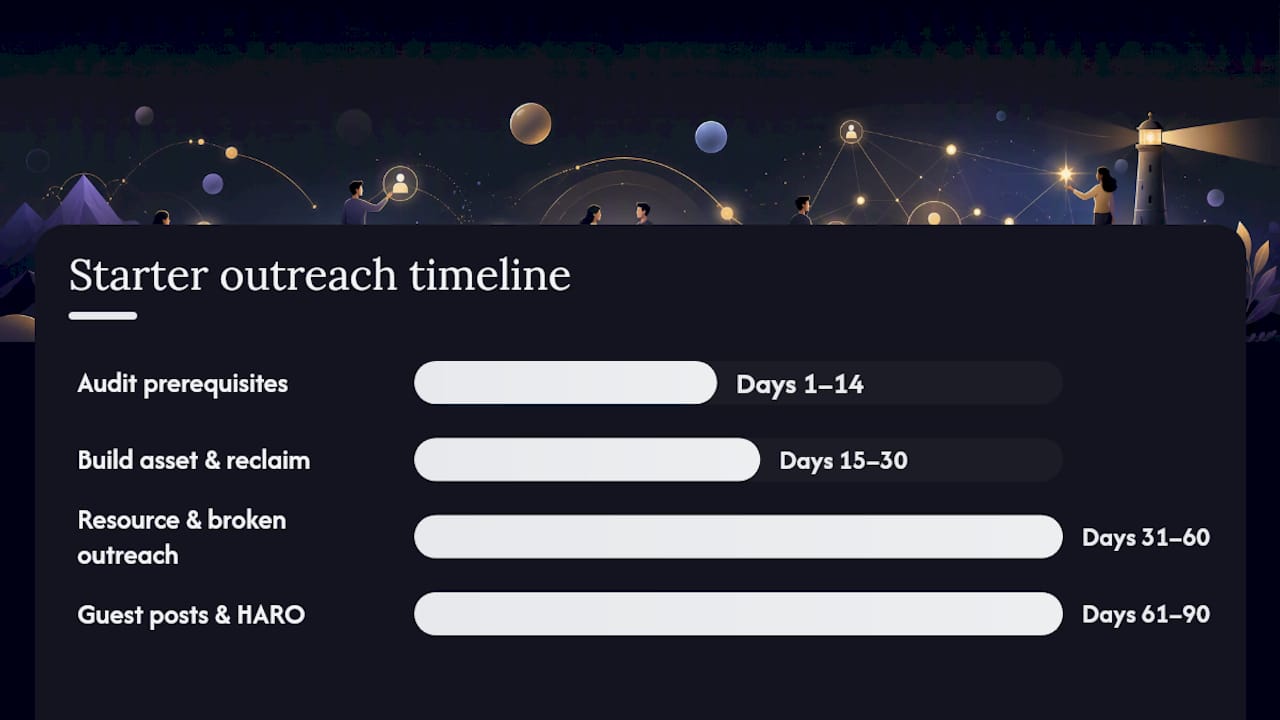
Days 61 to 90: Pitch your first guest post or two, respond to relevant HARO/media requests weekly, and start tracking which tactics are actually converting into published links.
Building your prospect list means more than collecting URLs. Qualify each site before you pitch: does it publish regularly, does it have real visitors, and does its content actually relate to your industry? A simple spreadsheet with columns for site name, contact, pitch status, and follow-up date keeps a solo beginner organized without needing dedicated outreach software.
- Track outreach sent, replies received, and links landed separately so you can see your actual conversion rate.
- Set a follow-up reminder for every pitch, five to seven days out.
- Review your list monthly and drop dead contacts or unresponsive sites after two follow-ups.
Which Tools and Metrics Actually Matter?
You don’t need an expensive software stack to start. A short list of free and entry-level tools covers almost everything a beginner needs.
- Google Search Console (free): shows which pages are indexed, which queries bring traffic, and flags manual actions or penalties.
- Screaming Frog (free tier): crawls your site to find broken links and technical issues worth fixing before outreach.
- Connectively (formerly HARO) or Featured: connects you with journalists looking for expert sources.
- Ahrefs, Semrush, or Moz (free features): each offers a limited free backlink checker or site audit tool, useful for a quick competitor snapshot before you commit to a paid plan.
The metrics worth watching are simpler than most beginners assume. Referring domains (the number of unique sites linking to you) matters more than raw backlink count, since ten links from ten different sites beats fifty links from one site. Referral traffic tells you whether people are actually clicking through, not just whether a link exists. Anchor text diversity keeps your profile looking natural rather than over-optimized. And a qualitative relevance check, simply asking “does this site’s audience overlap with mine?”, catches problems no automated score will flag.
A modern link building workflow treats measurement as a core step, not an afterthought, because you can’t improve outreach you’re not tracking.
| Tool or Metric | Best Use Case |
|---|---|
| Google Search Console | Tracking indexing status and organic query data |
| Screaming Frog (free tier) | Finding broken links and site crawl issues |
| Connectively / Featured | Landing links through journalist and expert requests |
| Ahrefs / Semrush / Moz (free tools) | Quick backlink and competitor snapshots |
| Referring domains | Weekly check on link profile growth |
| Referral traffic | Monthly check on whether links drive real visitors |
For your first few months, check referring domains and outreach reply rates weekly, and review referral traffic and anchor text mix monthly. That cadence is frequent enough to catch problems without turning into a full-time obsession.
- Weekly: outreach sent, replies received, new referring domains.
- Monthly: referral traffic trends, anchor text diversity, ranking movement on target keywords.
Common Beginner Mistakes That Waste Time or Risk Penalties
Buying links is the mistake that costs beginners the most, because it feels like a shortcut and instead creates a liability that can trigger a manual penalty months later. Mass, unpersonalized outreach blasted to hundreds of sites at once produces a dismal reply rate and can get your domain flagged as spam by email providers. Over-optimizing anchor text (using your exact target keyword in every single link) looks unnatural to search engines and is one of the fastest ways to trigger scrutiny. And chasing Domain Rating above everything else means beginners often ignore genuinely relevant sites with real human traffic in favor of chasing a bigger number that doesn’t convert.
Use this checklist before you pitch any prospect:
- Does the site publish original content regularly, or does it look abandoned?
- Does its existing backlink profile look natural, or is it stuffed with obviously paid, irrelevant links?
- Is the content thin, AI-spun, or duplicated from elsewhere?
- Would a real reader in your industry actually land on this page?
If a mistake has already happened, here’s the fix:
- Bought a link that looks spammy? Request removal, and if that fails, disavow it through Google Search Console.
- Sent identical mass emails with no replies? Cut the list down and personalize the next round instead of sending more volume.
- Over-optimized anchor text on existing links? Reach out and ask the site to vary the wording, or accept it and focus new outreach on natural anchor variation going forward.
Pro Tip: If a link opportunity feels like it requires paying cash specifically for the link itself, walk away. Paying for placement in a legitimate sponsored post that’s clearly disclosed is different from paying to manipulate rankings, and Google’s guidelines treat the two very differently.
How Long Until You See Results?
Your first reclaimed mentions can turn into live links within days of sending a request, since you’re asking someone to make a small edit to a page they’ve already published. Broken link fixes and resource page placements typically take one to three weeks to land, depending on how quickly the site owner responds. Guest posts and digital PR placements often take four to eight weeks from pitch to publication, since editorial calendars move slower.
Measurable ranking movement is the slowest metric to show up. Expect early wins in the form of referral traffic and a steady trickle of new referring domains within the first month or two. Actual ranking improvements for competitive keywords tend to show up over three to six months, once you’ve built enough relevant, varied links for search engines to register a real pattern rather than a one-off spike.
| Tactic | Typical Time to First Link | Expected Outcome for Beginners |
|---|---|---|
| Reclaiming unlinked mentions | Days to 1 week | Fast link, some referral traffic |
| Resource page outreach | 1 to 3 weeks | Steady, low-volume link growth |
| Broken link building | 1 to 3 weeks | Moderate success rate, relevant links |
| HARO/media requests | 2 to 6 weeks | Occasional high-authority placements |
| Guest posts | 4 to 8 weeks | Fewer but higher-quality links |
| Linkable assets/digital PR | 2 to 6 months | Slow start, compounding long-term links |
Early signs you’re on the right track: referral traffic ticking upward, replies coming in from your outreach emails, and a small but growing number of unique referring domains. Longer-term signs of real progress: your target pages climbing in rankings, and other sites starting to link to your content without you asking. That second signal, unprompted links, is usually the clearest indicator that your linkable asset strategy is finally paying off.
- Early wins (weeks 1 to 8): referral traffic bumps, first reclaimed mentions, first resource page placements.
- Longer-term wins (months 3 to 6): ranking improvements, unprompted links, rising referring domain count.
The Fastest Win: Reclaiming Mentions and Auditing Linkable Assets
If you only do one thing from this entire article, reclaim your unlinked mentions first. It’s the tactic with the highest success rate for the least effort, precisely because the publisher has already decided you’re worth mentioning. You’re not pitching a stranger cold. You’re asking someone who already referenced you to finish the job.
Run this audit today:
- Search
"[your business name]"in Google, in quotes, and scroll through several pages of results. - Check any press mentions, local news coverage, podcast show notes, or community forum posts.
- Search your product or founder’s name separately, since mentions sometimes skip the business name entirely.
- Note the URL, the exact sentence mentioning you, and whether a link already exists.
Once your list is built, work through outreach in this order:
- Sort mentions by site relevance and traffic, prioritizing the ones most likely to send real visitors.
- Send a short, specific request referencing the exact page and sentence, using the template from earlier in this article.
- Follow up once after five to seven days if you haven’t heard back.
- Log every reclaimed link in your tracking spreadsheet so you can measure your actual success rate over time.
While you’re doing this, keep a running list of linkable assets already sitting on your site. A veteran SEO observation worth taking seriously: link building becomes far harder when you’re trying to build links to content that isn’t actually worth linking to. Audit what you already have before you invest in creating something new.
What Do Google’s Link Guidelines Actually Prohibit?
Google’s link spam guidelines focus on intent, not just the existence of a link. Buying or selling links that pass ranking credit, excessive link exchanges, and automated link schemes are all explicitly against Google’s guidelines and can trigger a manual action that tanks your visibility overnight. The guidelines aren’t trying to ban every paid placement outright. A clearly disclosed sponsored post using a sponsored or nofollow attribute is treated very differently from a hidden paid link designed to look organic.
The practical takeaway for a beginner: if a link exists because you paid specifically to manipulate your ranking, or because you’re part of a link exchange network built purely to inflate authority scores, you’re exposed to a penalty. If a link exists because a real editor decided your content was worth citing, you’re on solid ground. When in doubt about a specific paid placement or link scheme, disclose it properly and lean conservative. A penalty removal process can take months and cost you far more traffic than the shortcut ever gained.
How Do You Keep a Healthy Link Profile Long Term?
Link health isn’t a one-time setup. It needs a light monthly check to stay clean. Run a backlink audit every month or two using your chosen tool’s free or paid tier, and watch for new links that look spammy, irrelevant, or suspiciously clustered around one exact-match anchor phrase.
If you spot a toxic-looking link, first try requesting removal directly from the site owner. If that goes nowhere and the link genuinely looks harmful (part of an obvious spam network, for instance), Google’s disavow tool in Search Console lets you tell Google to ignore it. Use this sparingly. Most links, even mediocre ones, aren’t worth the effort of disavowing.
Beyond cleanup, monitor for natural decay. Sites shut down, redesign, or remove old content, and links die along with them. A quarterly check for broken outbound links pointing to you (the same broken link building tactic you use on other people’s sites, run in reverse) catches these before they quietly erode your referring domain count. Treat your link profile the way you’d treat a garden: not something you plant once and forget, but something you check on a regular schedule and prune when needed.
What I’d Focus On If I Were Starting Today
If you’re new to this, resist the urge to chase every tactic at once. Start with relevance and small wins: reclaim your mentions, fix a handful of broken links, get listed on two or three resource pages that genuinely fit your industry. Measure what actually converts into a live link and a real visitor, then scale whichever tactic is working, rather than spreading thin effort across six approaches simultaneously.
For a small site or a new business, a lean starter stack does the job: Google Search Console for visibility, a free backlink checker for competitor snapshots, and a simple spreadsheet for outreach tracking. You genuinely don’t need an expensive tool subscription in month one. Once you’ve proven a tactic works and you’re ready to scale volume, that’s usually the point where bringing in outside help, whether that’s a freelancer or an agency familiar with small business SEO, starts making financial sense instead of feeling premature.
[Author bio placeholder]
[Case study link placeholder]
Ready for Hands-On Help With Your First Campaign?
Reclaiming mentions and pitching resource pages gets you real results, but it takes hours most small business owners simply don’t have between running the actual business. If you’ve worked through the starter plan above and you’re ready to move faster without hiring a full outreach team, Ibrand builds and runs link building campaigns specifically for small and new sites, starting with the same audit-first approach this article walks through.
We start every engagement with a free look at your current backlink profile and site fundamentals, the same checks recommended in the preflight section above, so you know exactly where you stand before committing to anything. That’s the natural next step for a beginner who has tried the DIY tactics and wants someone else to run the outreach cadence while you focus on the business itself. If that’s where you are, check out our SEO optimization guide for small businesses and reach out for a starter plan built around your specific site.
Sources
- Similarweb blog: Backlinks (reclaiming mentions)
- Link building for SEO: What works in 2026 – Semrush
- Link Building: The Free SEO Beginner’s Guide – Moz
- How to Start Link Building: Beginner’s Step-by-Step Guide – BacklinkGrid
- Link Building for Beginners: Start Getting Backlinks Today | Backlynk
FAQ
How Do I Learn Link Building as a Beginner?
Start by reading one solid foundational guide, then practice one tactic immediately, like reclaiming unlinked mentions, since hands-on outreach teaches more than reading alone. Track your results from day one so you learn what actually works for your specific site.
Is Link Building Easy for Someone New to SEO?
The easiest tactics, like reclaiming mentions and resource page outreach, require no technical skill and can produce results within days. Harder tactics like guest posting and digital PR take more time, patience, and writing skill to execute well.
How Do I Build My First Backlinks as a Beginner?
Audit for existing unlinked mentions and send personalized requests to add a link, then move into resource page outreach and broken link building once you’re comfortable with the outreach process. Both require minimal budget and no advanced tools.
When Should I Start Link Building for a New Site?
Start once your site is indexed in Google Search Console and you have at least one page genuinely worth linking to. Beginning outreach before your site is crawlable or before you have content worth citing wastes effort on both sides.
Do I Need Paid Tools Like Ahrefs or Semrush to Start?
No. Free tools like Google Search Console and Screaming Frog’s free tier cover a beginner’s needs, and Ahrefs, Semrush, and Moz all offer limited free backlink-checking features useful for early competitor research.
Recent Comments