
TL;DR:
- Brand storytelling creates emotional connections by centering the customer as the hero and the brand as the guide. This approach is more memorable and effective at influencing behavior than traditional feature-based advertising. Building a consistent, authentic narrative long-term strengthens brand identity and promotes loyalty in competitive markets.
Brand storytelling is defined as the practice of using narrative to create emotional connections between a company and its audience, replacing feature lists with meaning. The role of storytelling in branding goes far beyond creative writing. A 2026 meta-analysis published in the International Journal of Film and Media Research found that brand perceptions improve by 38% when storytelling replaces traditional advertising. That single finding reframes how marketers should think about every campaign they build. Stories do not just entertain. They build the emotional foundation that turns first-time buyers into loyal advocates.
How does storytelling enhance branding effectiveness?
Storytelling outperforms traditional advertising on every measurable dimension. An Ipsos analysis of 15,000 ads found that ads using storytelling are twice as effective at changing consumer behavior and nearly three times more memorable than feature-based ads. That gap is not a creative preference. It reflects how the human brain processes information.
Neuroscience explains the mechanism clearly. Stories activate multiple brain regions simultaneously, including areas tied to sensory experience, emotion, and memory. They also trigger the release of oxytocin, a neurochemical directly linked to trust. Feature lists activate only the language-processing centers. The difference in brain engagement is the difference between a message that sticks and one that disappears.
The memorability gap is even wider than most marketers expect. Stories are 22 times more memorable than facts presented alone. That means a brand narrative told well in one campaign can outlast dozens of product-feature ads in a customer’s memory.
Despite this evidence, half of current advertising still relies on product-feature pitches. That is a missed opportunity at scale. Brands that default to listing specifications are competing on the weakest possible ground, where differentiation is nearly impossible and price becomes the only lever.
- Feature-based ads describe what a product does and appeal to rational decision-making only.
- Story-based ads show what a product means and engage emotion, memory, and identity.
- Emotional connection is the primary driver of brand loyalty, not product quality alone.
- Memorability compounds over time. A story remembered today shapes purchase decisions months later.
Pro Tip: Before writing any campaign brief, ask one question: “What does this change for the customer?” If your answer describes a feature, rewrite it as a transformation. That shift moves you from advertising to storytelling.
What storytelling frameworks build a stronger brand identity?
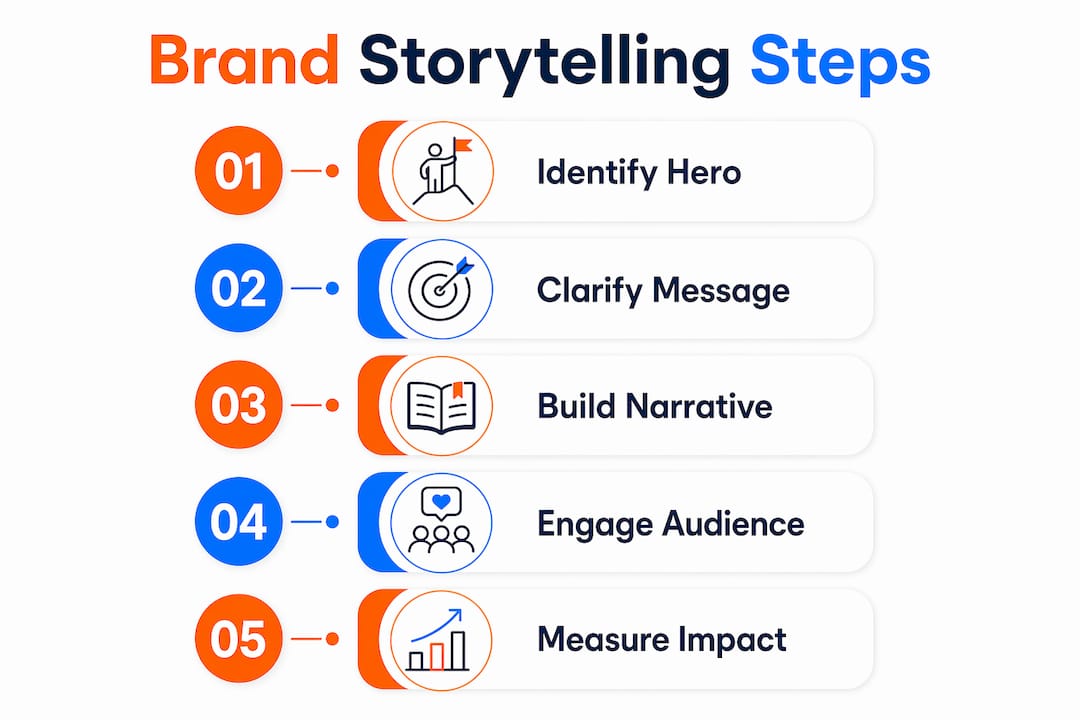
The most effective storytelling frameworks share one principle: the customer is the hero, not the brand. The StoryBrand framework developed by Donald Miller makes this explicit. The brand plays the role of guide, like Yoda to Luke Skywalker. When brands cast themselves as the hero, audiences disengage. When brands position the customer as the protagonist overcoming a real problem, audiences see themselves in the story.
The four pillars of brand storytelling
Strong brand narratives are built on four structural pillars:
- People. Real characters with real stakes. Audiences connect with individuals, not demographics.
- Places. Specific settings that ground the story in reality and make it believable.
- Purpose. A clear reason the story exists beyond selling. What does the brand stand for?
- Plot. A sequence of events with tension, change, and resolution.
The five Cs of narrative structure
The five Cs give marketers a repeatable structure for any story format:
- Character. Who is the protagonist, and what do they want?
- Context. What is the world they live in, and what makes their situation relatable?
- Conflict. What stands between them and what they want? Conflict is the engine of every story.
- Climax. The moment of decision or transformation where the brand’s guidance matters most.
- Closure. The resolution that shows a measurable, meaningful change in the character’s life.
Specificity is what separates authentic stories from marketing copy. Authentic brand stories use real names, numbers, and places rather than vague claims. “A customer saved money” is forgettable. “Maria, a bakery owner in Austin, cut her ad spend by $800 in three months” is a story. The details create credibility that no polished tagline can match.
For digital and social content, the three-beat micro-structure works within tight time limits. Short-form social videos use a situation, action, transformation arc to tell a complete story in 15 seconds. The situation establishes the character’s problem. The action shows the turning point. The transformation reveals the outcome. This structure works on Instagram Reels, TikTok, and YouTube Shorts without sacrificing narrative integrity.
Pro Tip: Map every piece of content you create to one of the five Cs. If a post does not serve at least one element of the narrative arc, it is not storytelling. It is noise.
How does storytelling shape brand identity in competitive markets?
Brand identity built on storytelling is harder to copy than any product feature. A competitor can match your price, replicate your packaging, and undercut your distribution. They cannot replicate the emotional meaning your brand holds in a customer’s mind. That is the strategic differentiation storytelling provides-5) in saturated markets.
The mechanism is emotional humanization. When a brand tells real stories about real people, it stops being a company and starts being a presence in a customer’s life. That shift changes the entire relationship. Customers who feel emotionally connected to a brand do not just buy. They advocate, defend, and return.
“Storytelling creates meaningful brand experiences that mediate consumers’ path to purchase rather than directly driving sales.” — Journal of Managerial Sciences and Studies, 2026
Storytelling influences purchase intention indirectly by building brand experience and engagement first. This is a critical insight for marketers who measure storytelling by immediate conversion rates. The path runs through experience and trust, not through a direct click. Brands that understand this invest in narrative consistency over time rather than chasing short-term response metrics.
Storytelling also works as a values signal. Brands that tell stories centered on mission and purpose attract customers who share those values. That alignment creates loyalty that price promotions cannot buy and competitors cannot easily disrupt. Building brand awareness online through consistent narrative is one of the most durable long-term investments a marketer can make.
- Emotional humanization turns a company into a character audiences root for.
- Values alignment attracts customers who stay loyal because they share the brand’s beliefs.
- Narrative consistency compounds brand equity across every channel and touchpoint.
- Indirect purchase influence means storytelling works through trust, not just persuasion.
Practical steps for implementing brand storytelling
Effective brand storytelling starts with a clear decision about who the protagonist is. The customer must occupy that role in every story you tell. Your brand is the guide that helps them succeed. That single reorientation changes the tone, structure, and emotional impact of everything you produce.

Identify the real customer journey. Talk to actual customers. Find the specific moment when your product or service changed something for them. That moment, with its real details and real stakes, is your story. Generic success claims do not work. Specific transformations do.
Use measurable outcomes. Numbers make stories credible. “She grew her client base” is weak. “She signed four new clients in six weeks” is a story with stakes and proof. Specificity signals authenticity, and authentic storytelling beats polished marketing every time.
Sustain the narrative over time. Storytelling is not a campaign. It is a practice. Brands that tell one great story and then revert to feature advertising lose the equity they built. Consistency across quarters and channels is what converts story into brand identity.
Match the format to the platform. Long-form narratives work on your website and email. The three-beat micro-structure works on social. Testimonials and case studies work as social proof in marketing across multiple channels. Each format serves the same narrative but adapts to how audiences consume content in that context.
Pro Tip: The most common mistake in brand storytelling is making the brand the hero of every story. Review your last five pieces of content. Count how many times “we” or your brand name appears versus how many times the customer’s name or experience appears. That ratio tells you everything.
Key Takeaways
Brand storytelling is the single most effective tool for building emotional brand equity, and it works by positioning the customer as the hero while the brand serves as the trusted guide.
| Point | Details |
|---|---|
| Storytelling lifts brand perception | A 2026 meta-analysis shows brand perceptions improve by 38% with storytelling versus traditional ads. |
| Stories outperform features on recall | Stories are 22 times more memorable than facts alone, making narrative the strongest tool for long-term loyalty. |
| Customer is always the hero | Frameworks like StoryBrand work because they center the customer’s transformation, not the brand’s achievements. |
| Specificity creates credibility | Real names, numbers, and places make stories believable and far more persuasive than vague marketing claims. |
| Storytelling builds indirect purchase intent | Narrative drives sales through brand experience and trust, not through direct persuasion alone. |
Why most brands are still getting storytelling wrong
I have reviewed hundreds of brand campaigns over the years, and the pattern is almost always the same. The brand is the hero. The product is the star. The customer is an afterthought. That structure feels natural to the people building the brand, but it is exactly backwards from what works.
The hardest shift for most marketing teams is giving up control of the narrative. Authentic storytelling means letting a real customer’s messy, specific, imperfect experience carry the message. That feels risky. Polished brand copy feels safe. But polished copy is what half of all ads still rely on, and it is also what audiences have learned to ignore.
The brands that get storytelling right treat it as a long-term investment, not a campaign tactic. They build story libraries. They interview customers regularly. They train their entire team to recognize a good story when they hear one. That discipline is what separates brands with genuine emotional equity from brands that are just spending on awareness.
My honest advice: start with one real customer story told with full specificity. Name, situation, conflict, outcome. Publish it without over-polishing it. Then measure how it performs against your best feature-based content. The results will make the argument better than any framework can.
— TONY
How Ibrand helps you build a brand story that connects
Ibrand works with small and medium-sized businesses that want their brand to mean something online, not just appear in search results. If your current messaging focuses on what you offer rather than what you change for your customers, that is the gap Ibrand helps you close.
Ibrand’s digital branding services cover everything from messaging strategy to website optimization for search, so your story reaches the right audience at the right moment. The team helps you identify your customer’s real narrative, build it into your brand identity, and distribute it across the channels where your audience actually spends time. If you are ready to move from feature-based marketing to story-driven brand building, Ibrand is the place to start.
FAQ
What is the role of storytelling in branding?
Brand storytelling is the practice of using narrative to build emotional connections between a brand and its audience. A 2026 meta-analysis found it improves brand perceptions by 38% compared to traditional advertising.
Why are stories more effective than product-feature ads?
Stories activate multiple brain regions and trigger oxytocin release, which builds trust. An Ipsos analysis of 15,000 ads found story-based ads are twice as effective at changing behavior and nearly three times more memorable.
What is the StoryBrand framework?
StoryBrand positions the customer as the hero of the narrative and the brand as the guide. This structure works because audiences engage with stories about their own transformation, not a brand’s achievements.
How do I use storytelling on social media?
Short-form social content works best with a three-beat micro-structure: situation, action, and transformation. This arc delivers a complete narrative in 15 seconds and is effective across platforms like Instagram Reels and TikTok.
Does storytelling actually drive sales?
Storytelling drives purchase intention indirectly by building brand experience and engagement first. Research published in the Journal of Managerial Sciences and Studies confirms that narrative influences buying decisions through trust, not direct persuasion.
Recent Comments