
TL;DR:
- Testimonials act as peer-driven social proof that builds trust and reduces buyer hesitation. Strategic placement, relevant formats, and regular updates maximize their conversion and revenue impact. Implementing automated, targeted collection systems ensures continuous, high-quality testimonial growth.
Testimonials in marketing are defined as authentic statements from real customers that function as peer-driven social proof, directly influencing buyer trust and purchasing decisions. The role of testimonials in marketing goes far beyond simple praise. Five or more reviews lift conversion rates by 270%, which means a single well-placed testimonial block can outperform months of ad spend. Brands like Spiegel Research Center and data aggregators like BigCommerce have confirmed that social proof is not a nice-to-have feature. It is a conversion mechanism. Video testimonials push that advantage further, generating conversion lifts between 20% and 80% depending on placement and format.
How do testimonials influence consumer trust and buying decisions?
Testimonials work because they transfer trust from a known peer to an unknown brand. When a prospective buyer reads a review from someone in a similar role or situation, the psychological distance between “stranger’s claim” and “believable truth” collapses. This is peer identification, and it is the core engine behind testimonial effectiveness.

72% of consumers say positive testimonials increase their trust in a business. That number reflects a behavioral reality: buyers are skeptical of brand claims but receptive to customer voices. A company saying “our product saves time” carries far less weight than a customer saying “I cut my onboarding process from two weeks to three days.”
Peer testimonials reduce perceived risk in high-stakes B2B buying more effectively than celebrity endorsements. Buyers fear making costly mistakes, and they trust people who have already faced the same decision. An endorsement from a Fortune 500 executive means less to a 10-person SaaS startup than a quote from another 10-person SaaS startup that solved the same problem.
Credibility signals within the testimonial itself also matter. Testimonials with real customer photos increase credibility by 35%. A face reduces cognitive friction. It signals that a real person, not a marketing copywriter, produced the quote. Adding a job title and company name compounds that effect.
Video testimonials carry the highest emotional weight of any format. Tone of voice, facial expressions, and genuine pauses communicate authenticity in ways that text cannot replicate. For high-consideration purchases, a two-minute video testimonial from a satisfied customer can do more persuasive work than a five-page case study.
Pro Tip: When collecting written testimonials, always ask for a headshot and job title alongside the quote. That combination alone can increase the credibility lift from 0% to 35% without changing a single word of the testimonial itself.
What types of testimonials exist and how do they compare?
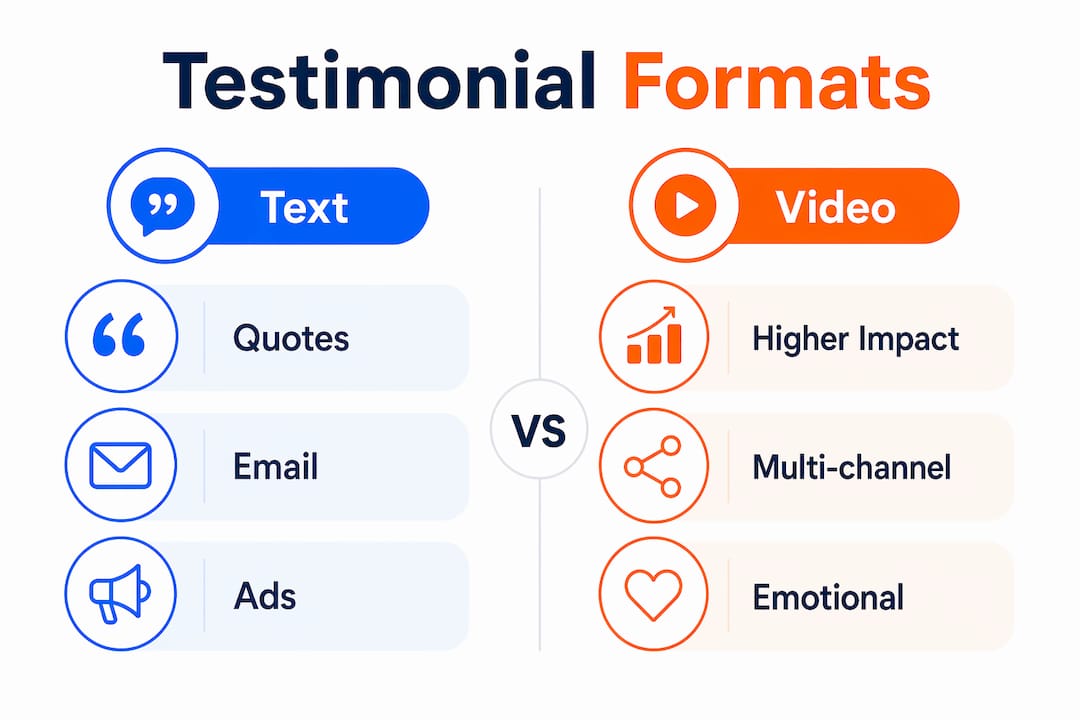
Not all testimonials perform equally across every channel or buyer stage. Choosing the right format for the right context is what separates a testimonial strategy from a testimonial collection.
| Format | Best use case | Conversion impact |
|---|---|---|
| Text quote | Landing pages, email, ads | Moderate; highest when paired with photo and title |
| Video testimonial | Sales pages, paid ads, email sequences | High; 20–80% conversion lift |
| Case study | B2B sales decks, proposal support | High for late-stage buyers; builds detailed proof |
| Social media mention | Retargeting ads, homepage feeds | Moderate; signals organic enthusiasm |
| Star ratings with reviews | E-commerce product pages | High volume effect; 92% of consumers read reviews before buying |
Text testimonials are the most versatile format. They load fast, fit in tight spaces, and work across email, landing pages, and paid ads without production overhead. Their weakness is that they are easy to fabricate, which is why the photo and verification signals matter so much.
Video testimonials demand more effort to produce but deliver returns across multiple channels simultaneously. A single video can appear on a landing page, inside a sales email sequence, in a retargeting ad, and as a leave-behind in a sales deck. Video testimonials generate ROI across landing pages, sales decks, emails, and paid ads with minimal added cost per channel. That multi-channel leverage makes the production investment worthwhile.
Case studies occupy a different category entirely. They are not testimonials in the traditional sense but function as extended success stories in marketing. For B2B buyers evaluating a $50,000 software contract, a detailed case study showing measurable outcomes from a peer company is the most persuasive asset in your library.
Here is how to match format to buyer stage:
- Awareness stage: Social media mentions and star ratings build initial familiarity
- Consideration stage: Text testimonials with photos and job titles address specific objections
- Decision stage: Video testimonials and case studies close the credibility gap and reduce perceived risk
Where should testimonials be placed for maximum impact?
Placement determines whether a testimonial converts or gets ignored. The most common mistake marketers make is building a dedicated testimonials page and treating it as a destination. Buyers rarely visit that page. They need social proof at the exact moment they are weighing a decision.
Placing testimonials near CTAs increases conversion rates by 34% and click-through rates by 25%. That single data point should reshape your entire placement strategy. The testimonial’s job is to neutralize the hesitation that exists right before a buyer clicks “Buy Now” or “Request a Demo.”
Curated testimonials on key pages outperform large volumes on isolated pages. Three highly relevant testimonials placed next to a pricing table will outperform thirty testimonials buried on a separate page. Context matching is the principle at work here. The testimonial content should directly address the objection or question the buyer has at that specific point in the page.
The sweet spot for testimonials per page is three to five. Fewer than three feels thin. More than five starts to feel curated to the point of suspicion, or simply overwhelms the reader’s attention. Mix formats where possible: one video, two text quotes with photos, and one star-rating aggregate covers multiple trust signals without cluttering the layout.
Pro Tip: Match the testimonial to the page’s specific message. A pricing page testimonial should mention value or ROI. A features page testimonial should reference a specific capability. Generic praise placed anywhere on the page is far less persuasive than specific proof placed in the right spot.
High-impact placement locations include:
- Directly above or below the primary CTA button
- Inside the hero section of the homepage
- Adjacent to pricing tiers on the pricing page
- Within email sequences at the point of a purchase offer
- On checkout or cart pages to reduce abandonment
How to collect and maintain a high-quality testimonial library
A testimonial library is not built in a single campaign. It requires a system that runs continuously and targets the right customers at the right moment.
-
Target NPS promoters first. Customers who score you 9 or 10 on a Net Promoter Score survey are already primed to advocate. They have the enthusiasm. Your job is to make it easy for them to express it in a format you can use.
-
Time your request strategically. The best moment to ask for a testimonial is immediately after a customer achieves a measurable result. A SaaS company should trigger a testimonial request when a user hits a usage milestone. A service agency should ask within 48 hours of a successful project delivery.
-
Use automated trigger-based systems. Automated testimonial systems targeting promoters and recent successful customers improve both collection rates and testimonial quality. Tools like Typeform, Bonjoro, or CRM-integrated workflows can fire testimonial requests without manual intervention.
-
Reduce friction with pre-drafted options. Most customers want to help but do not know what to say. Provide two or three example sentences they can edit rather than a blank text box. Pre-drafted quotes reduce the cognitive effort required and consistently produce more specific, usable testimonials.
-
Refresh your library regularly. A testimonial dated three years ago signals stagnation. Buyers notice timestamps. Set a quarterly review cycle to retire outdated testimonials and replace them with recent success stories. Stale or isolated testimonial pages reduce trust and undermine the credibility they are meant to build.
Specificity is the quality marker that separates a useful testimonial from a generic one. “Great service, highly recommend” is forgettable. “We reduced our customer onboarding time by 40% in the first month using this platform” is persuasive. Train your collection process to draw out numbers, timelines, and specific outcomes.
What is the measurable ROI of testimonials?
The financial case for investing in testimonials is direct and well-documented. Conversion lifts, shorter sales cycles, and lower acquisition costs all compound into significant revenue impact.
“Testimonials are not a credibility accessory. They are a revenue mechanism. The data consistently shows that strategic social proof placement produces measurable lifts at every stage of the funnel.”
The conversion data tells a clear story. Displaying five or more reviews produces a 270% lift in purchase likelihood. Video testimonials generate conversion increases between 20% and 80% depending on format and placement. Video testimonials can shorten B2B sales cycles by 20–35%, which translates directly into faster revenue recognition and 15–20% higher sales team throughput per quarter.
| Metric | Impact |
|---|---|
| Conversion rate lift (5+ reviews) | Up to 270% higher purchase likelihood |
| CTA page conversion lift | 34% average increase with adjacent testimonials |
| B2B sales cycle reduction | 20–35% shorter with video testimonials |
| Credibility increase with photo | 35% higher perceived trustworthiness |
| Consumer trust increase | 72% of buyers trust businesses more after reading testimonials |
The cost-per-acquisition benefit is equally significant. When testimonials handle objection resolution on the page, your sales team spends less time on persuasion and more time on closing. For B2B buyers using peer testimonials, the trust transfer happens before the first sales call, which compresses the qualification cycle.
Testimonials also affect customer lifetime value. Buyers who converted partly because of social proof tend to have stronger initial alignment with the product’s value proposition. That alignment reduces early churn and increases the likelihood of upsell and referral behavior, creating a compounding return on the original testimonial investment.
Key takeaways
Testimonials drive measurable revenue growth when placed strategically near decision points, matched to buyer personas, and maintained as a living system rather than a static collection.
| Point | Details |
|---|---|
| Placement over volume | Three relevant testimonials near a CTA outperform thirty on an isolated page. |
| Format selection matters | Video testimonials deliver 20–80% conversion lifts and multi-channel ROI across ads, email, and sales decks. |
| Peer matching increases persuasion | Matching testimonials to buyer personas by job title or company size consistently outperforms generic praise. |
| Photos and specificity build credibility | Real customer photos increase credibility by 35%; specific outcomes outperform vague endorsements. |
| Freshness is a trust signal | Outdated testimonials signal stagnation; quarterly library reviews maintain buyer confidence. |
Why testimonial strategy beats testimonial volume every time
Most marketers I work with treat testimonials as a collection problem. They focus on getting more of them. The real problem is almost always a placement and relevance problem. You can have 200 testimonials and still see a flat conversion rate if none of them appear where buyers are actually hesitating.
The insight that changed how I think about this: a testimonial is not a credential. It is an objection handler. Every buyer arrives at your page with a specific fear. “Is this too expensive?” “Will this work for a company my size?” “Have other people in my industry used this?” The testimonial that answers that exact fear, placed at the exact moment the buyer is feeling it, is worth ten generic “great product!” quotes placed anywhere else on the page.
Video testimonials are worth the production effort, even for small businesses. I have seen a single two-minute customer video outperform an entire written testimonial section on a sales page. The authenticity signal is simply higher. You cannot fake a genuine pause, a real laugh, or the specific way someone describes a problem they actually had. For any high-consideration purchase, video should be your first investment in social proof, not your last.
The other thing most businesses get wrong is treating testimonial collection as a campaign rather than a system. One email blast to your customer list will produce a handful of usable quotes. An automated trigger that fires 48 hours after a customer milestone will produce a steady stream of specific, timely, high-quality testimonials indefinitely. Build the system once, and it pays you back for years.
— TONY
Let Ibrand help you turn testimonials into a conversion engine
Knowing the strategy is one thing. Executing it across your website, ad campaigns, and email sequences is where most businesses stall. Ibrand works with small and medium-sized businesses to build testimonial systems that are integrated directly into high-intent pages, not buried in a corner of the site.
From website optimization for search to testimonial placement within your sales funnel, Ibrand combines technical SEO, web design, and content strategy to make your social proof work harder. If your testimonials are sitting on a page no one visits, that is a fixable problem. Explore how Ibrand can help you increase website conversions by putting the right proof in front of the right buyer at the right moment.
FAQ
What is the role of testimonials in marketing?
Testimonials serve as peer-driven social proof that transfers trust from satisfied customers to prospective buyers, directly reducing purchase hesitation and increasing conversion rates. They function as objection handlers placed at key decision points in the buyer journey.
How many testimonials should a page include?
Three to five testimonials per page is the proven sweet spot. Fewer than three feels insufficient; more than five can overwhelm readers or appear overly curated.
Do video testimonials outperform written ones?
Video testimonials generate conversion lifts between 20% and 80% and shorten B2B sales cycles by 20–35%, making them the highest-performing format for high-consideration purchases.
Where should testimonials be placed on a website?
Testimonials placed directly adjacent to CTAs produce a 34% average conversion rate increase. High-impact locations include pricing pages, hero sections, checkout pages, and inside email sequences at the point of a purchase offer.
How do you get better quality testimonials from customers?
Target NPS promoters immediately after they achieve a measurable result, provide pre-drafted example sentences to reduce friction, and use automated collection systems triggered by customer milestones. Specific outcomes and numbers consistently produce more persuasive testimonials than open-ended requests.
Recent Comments