
TL;DR:
- Most businesses mistakenly believe that running ads, sending emails, and maintaining websites constitute a comprehensive marketing strategy. Omnichannel marketing creates a unified, customer-centric experience by seamlessly integrating online and offline channels and sharing data across all touchpoints. Implementing this approach requires a unified customer database, identity resolution, connected systems, aligned teams, and automation to enhance customer satisfaction, loyalty, personalization, and conversion rates.
Most businesses think running ads on Facebook, sending email newsletters, and maintaining a website counts as a solid marketing strategy. It does not. What is omnichannel marketing, then? It is a customer-centric approach that connects every channel and touchpoint into one unified experience. Unlike simply showing up in multiple places, omnichannel marketing integrates digital and physical channels so customers never have to repeat themselves or start over when they switch from your app to your store to your inbox.
Table of Contents
- Key takeaways
- What omnichannel marketing really means
- Omnichannel vs multichannel marketing
- Operational essentials for implementing omnichannel
- Benefits of omnichannel marketing for your business
- How to start building your omnichannel strategy
- My take on why most omnichannel efforts fail
- Ready to build a stronger marketing presence?
- FAQ
Key takeaways
| Point | Details |
|---|---|
| Omnichannel centers on the customer | Every channel connects to serve one continuous customer journey, not separate campaigns. |
| Integration separates it from multichannel | Omnichannel shares data across channels; multichannel treats each channel as its own island. |
| Identity resolution is non-negotiable | Linking customer identifiers across touchpoints is what makes personalization and continuity possible. |
| Alignment matters as much as technology | Teams across marketing, sales, and support must share data to avoid conflicting customer experiences. |
| Start small and build from data | Audit your current channels, unify customer data, and expand from there rather than overhauling everything at once. |
What omnichannel marketing really means
The term gets thrown around loosely, but the industry definition is specific. Omnichannel marketing is a strategy that creates a continuous, personalized experience as customers move between touchpoints. A customer might discover your brand through Instagram, visit your website on their laptop, add something to their cart, and then buy it in person at your store. With a true omnichannel approach, each of those steps knows what came before it.
The channels involved typically include:
- Online channels: websites, email, mobile apps, paid search, and social media
- Offline channels: physical retail stores, call centers, and direct mail
- Transactional touchpoints: point-of-sale systems, order confirmations, and customer service interactions
What holds all of this together is a unified customer view, sometimes called a 360-degree customer profile. This is a single record that consolidates a customer’s demographics, purchase history, browsing behavior, preferences, and support interactions. Marketing, sales, and service teams all draw from this same source. That shared access is what prevents the frustrating experience of a customer explaining their problem to a support agent who has no idea they just bought something yesterday.
Consistent brand messaging is the visible result. The tone, offers, and information a customer sees on your website should match what they hear from your sales team and read in your emails. Omnichannel marketing makes that consistency the default, not the exception.

Omnichannel vs multichannel marketing
This distinction is where most confusion lives, and it matters more than most people realize.
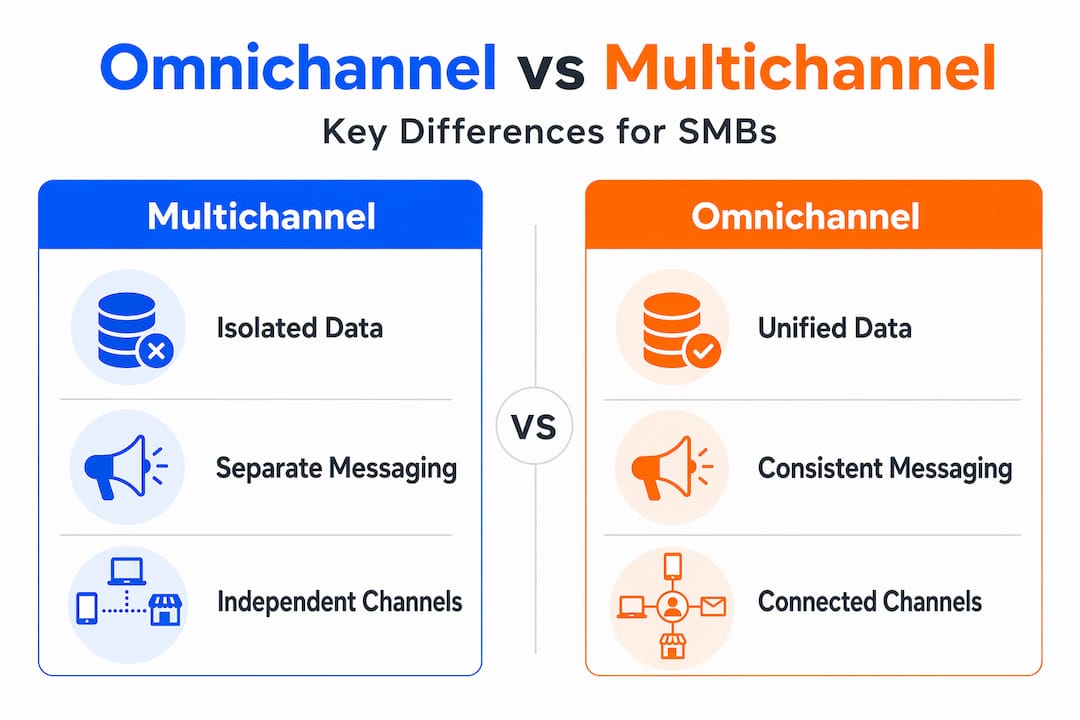
Multichannel marketing means your brand is present across several channels, like email, social media, and a physical store. Each channel has its own strategy, its own metrics, and often its own team. They run in parallel but rarely share data or coordinate experiences. Multichannel systems operate as separate islands, which limits how coherent a customer experience can actually feel.
Omnichannel marketing treats those channels as parts of one connected system. Data flows between them. A customer’s action on one channel influences what they see on another. The experience feels consistent because it actually is.
Here is how the two approaches compare directly:
| Factor | Multichannel | Omnichannel |
|---|---|---|
| Data sharing | Siloed by channel | Unified across all channels |
| Customer experience | Inconsistent and fragmented | Continuous and personalized |
| Personalization | Limited to individual channel data | Informed by full customer history |
| Team coordination | Separate teams per channel | Shared data across marketing, sales, support |
| Operational impact | Repeated customer inputs, conflicting messages | Seamless handoffs and consistent messaging |
The practical difference shows up in moments like this: a customer emails your support team about a delayed order, then calls in twenty minutes later and has to explain the entire situation again from scratch. That is a multichannel failure. In an omnichannel setup, the call center agent already sees the email, the order status, and the customer’s purchase history before they say hello.
Pro Tip: When evaluating whether your current setup is multichannel or omnichannel, ask one question: can every customer-facing team see what every other team has already done with that customer? If the answer is no, you have silos, not integration.
Understanding multichannel vs omnichannel at this level of specificity helps you make better technology and process decisions rather than just chasing the latest marketing buzzword.
Operational essentials for implementing omnichannel
Knowing what omnichannel means and actually building it are two very different challenges. Most businesses underestimate the operational lift required.
Here are the foundational pieces you need in place:
-
Unified customer database. Every customer interaction needs to write to and read from a single record. This is not a nice-to-have. Without it, you are recreating fragmented experiences regardless of how many channels you add.
-
Identity resolution. This is the process of linking customer identifiers across different touchpoints, like email address, phone number, loyalty ID, and device, to one profile. Without identity resolution, a customer who browses on mobile and buys on desktop looks like two different people to your systems.
-
Connected commerce systems. Your ecommerce platform, point-of-sale system, inventory management, and marketing tools all need to talk to each other. Connecting these systems is what removes data silos and keeps service context intact across channels.
-
Aligned teams and processes. Technology alone does not create omnichannel experiences. Your marketing, sales, and support teams need shared access to customer data and agreed-upon workflows for how to use it. Misaligned teams produce conflicting messages even when their tools are technically integrated.
-
Automation for orchestration. Manual coordination across channels does not scale. Marketing automation tools let you trigger personalized follow-ups, adjust messaging based on behavior, and route customers to the right experience without requiring your team to manually monitor every interaction.
Common pitfalls include treating omnichannel as a technology project rather than a business process change, and adding channels without first cleaning up the customer data that feeds them. Both mistakes lead to systems that look integrated on a slide deck but feel fragmented to actual customers.
Pro Tip: Before investing in new tools, audit your existing customer data quality. Duplicate records, missing identifiers, and inconsistent naming conventions will sabotage any integration project before it starts.
Benefits of omnichannel marketing for your business
The case for investing in an omnichannel strategy becomes clear quickly when you look at what it actually delivers.
-
Higher customer satisfaction. When customers do not have to repeat themselves or restart their journey, friction drops significantly. Consistent, connected channels reduce the effort customers have to exert, which directly improves how they feel about your brand.
-
Stronger loyalty and retention. Customers who have smooth experiences across channels come back more often. The importance of omnichannel marketing shows up most clearly in repeat purchase rates and customer lifetime value, both of which improve when the experience is consistent.
-
Better personalization at scale. A unified customer profile lets you send the right message at the right time across any channel. Instead of generic broadcasts, you deliver offers and content that reflect what each customer has actually done and expressed interest in.
-
More efficient marketing spend. When channels share data, you stop wasting budget on ads that target customers who already purchased or re-engaging people who churned for known reasons. You allocate spend based on real behavior rather than incomplete channel-level snapshots.
-
Higher conversion rates. Customers who experience consistent brand messaging across touchpoints convert at higher rates because trust accumulates across every interaction, not just within a single channel.
A retail business, for example, that lets customers buy online and return in-store with no friction, while also sending personalized follow-up emails based on purchase history, is practicing omnichannel marketing. That approach builds the kind of relationship with customers that purely digital or purely in-store competitors cannot replicate.
How to start building your omnichannel strategy
You do not need to overhaul everything at once. A phased approach works better, especially for small and mid-sized businesses.
-
Audit your current channels and data. Map every touchpoint your customers interact with and assess whether the data from those touchpoints lives in one place or many. This tells you the size of your integration gap.
-
Build or consolidate your customer profile system. Whether you use a CRM, a customer data platform, or a purpose-built tool, the goal is one record per customer that all teams can access. This is your foundation.
-
Align your teams around shared data. Hold a structured conversation between marketing, sales, and customer service about what data they each need and what data they each generate. Shared workflows prevent conflicting customer messages.
-
Map the customer journey. Identify where customers typically move between channels and where the experience breaks down. These gaps are your highest-priority fixes. Pairing this with cross-channel promotion tactics gives you a clearer picture of where coordination is missing.
-
Introduce automation for key touchpoints. Start with high-impact moments: abandoned cart sequences, post-purchase follow-ups, and re-engagement campaigns. Automate these first so your team can focus on higher-level strategy.
-
Measure and adjust continuously. Track metrics that cut across channels, like customer lifetime value, repeat purchase rate, and cross-channel conversion rate. Channel-specific metrics alone will not tell you whether your omnichannel experience is actually working.
My take on why most omnichannel efforts fail
I have worked with enough marketing teams to spot the pattern early. The businesses that invest in omnichannel and still end up with a fragmented customer experience almost always made the same mistake: they treated it as a channel expansion project rather than a data infrastructure project.
What I have found is that without data integration, adding more channels makes things worse, not better. You create more entry points for customers with no way to connect the dots between them. The experience does not feel unified. It feels like talking to five different companies that happen to share a logo.
The other thing most marketers miss is identity resolution. I have seen companies invest heavily in personalization tools and still send irrelevant content because their customer records are full of duplicates and mismatched identifiers. The technology only works as well as the data feeding it.
And then there is the team alignment piece, which honestly gets the least attention but causes the most damage. A customer support agent using one data set and a marketing team using another will produce conflicting experiences no matter how good the individual tools are. Omnichannel is as much an organizational commitment as a technical one.
My honest advice: expect this to take longer than you plan for, and start with data quality before adding channels. The businesses that get this right do not do it all at once. They build the foundation, prove it works, and expand from there.
— TONY
Ready to build a stronger marketing presence?
If this breakdown of omnichannel strategy has you thinking about the gaps in your current marketing setup, Ibrand is built to help businesses like yours close them. From local SEO services that make sure customers find you where they are searching, to tailored digital marketing strategies that align your channels around real customer behavior, Ibrand works with small and mid-sized businesses to grow their online presence without wasting budget on disconnected efforts.
Whether you are starting from scratch or trying to connect channels that are already running, Ibrand’s team builds plans around your actual goals. Explore what a local marketing strategy looks like when it is designed specifically for your business and your customers.
FAQ
What is omnichannel marketing in simple terms?
Omnichannel marketing is a strategy that connects all your marketing channels, online and offline, into one unified customer experience. Customers can move between touchpoints without losing context or having to start over.
How does omnichannel differ from multichannel marketing?
Multichannel marketing runs each channel independently with separate data, while omnichannel shares customer data and context across all channels to create a continuous, personalized experience.
What do I need to implement an omnichannel strategy?
The three core requirements are a unified customer database, identity resolution to link customer interactions across touchpoints, and connected systems so your ecommerce, POS, and marketing tools share data with each other.
What are the main benefits of omnichannel marketing?
The top benefits include higher customer satisfaction, improved loyalty and retention, more precise personalization, better ad spend efficiency, and higher conversion rates driven by consistent brand experiences across all channels.
Can small businesses realistically implement omnichannel marketing?
Yes, and the best approach is phased. Start by auditing your current data, consolidating customer records into one system, and aligning your teams before adding new channels or automation tools.
Recent Comments