
Most venue owners believe reputation management requires expensive agencies or complex software. In reality, 90% of consumers read reviews before visiting a business, yet many small venues ignore simple, cost-effective strategies that directly impact bookings. This guide reveals practical methods specifically designed for hospitality and service venues operating on tight budgets. You’ll discover how to monitor, improve, and leverage your online reputation to increase visibility, build customer trust, and drive more event bookings without breaking the bank.
Table of Contents
- Key takeaways
- What is venue reputation management and why it matters
- Core strategies for managing and improving your venue’s reputation affordably
- Tools and technology that simplify reputation management for venue owners
- Measuring success and refining your reputation management approach
- Boost your venue’s reputation with expert SEO and marketing services
- Frequently asked questions
Key Takeaways
| Point | Details |
|---|---|
| Affordable basics | Set up Google Alerts and platform reviews monitoring and respond within 24 hours to show ongoing community engagement. |
| Solicit reviews | Proactively ask satisfied customers for reviews to build a steady stream of authentic feedback. |
| Engage on social | Post authentic content three times weekly and respond to comments promptly to convey your venue personality. |
| Monitor and optimize | Use free tools like Google Alerts and platform notifications to catch mentions and improve local search visibility. |
What is venue reputation management and why it matters
Venue reputation management encompasses every action you take to shape how customers perceive your business online and offline. This includes monitoring and responding to reviews across platforms like Google, Yelp, and TripAdvisor, maintaining active social media profiles, addressing customer feedback promptly, and optimizing your search visibility. For local venues competing in saturated markets, reputation often becomes the primary differentiator between you and competitors offering similar services.
The stakes are remarkably high. Research shows that venue reputation critically influences consumer decisions, with potential customers forming opinions within seconds of viewing your online profiles. A single negative review left unaddressed can cost you dozens of potential bookings, while consistent positive feedback creates a compounding effect that elevates your visibility in local search results. The importance of online reviews extends beyond simple star ratings to encompass response quality, review frequency, and overall sentiment patterns.
Small venues face unique challenges in this landscape. Unlike large hotel chains with dedicated PR teams, you’re likely managing reputation alongside countless other responsibilities. However, this constraint actually works in your favor. Customers increasingly value authentic, personal interactions over corporate responses. Your ability to respond quickly and genuinely gives you a competitive advantage that larger competitors struggle to replicate.
“Your online reputation isn’t just about damage control. It’s your most powerful marketing asset, working 24/7 to attract or repel potential customers based on how you manage it.”
The components of effective reputation management include:
- Proactive review solicitation from satisfied customers
- Rapid response protocols for both positive and negative feedback
- Social media monitoring to catch mentions and conversations
- Local SEO optimization to improve discoverability
- Staff training to ensure consistent service quality
Core strategies for managing and improving your venue’s reputation affordably
The foundation of affordable reputation management starts with systematic review engagement. Set up Google Alerts for your venue name and create accounts on every platform where customers might leave feedback. Dedicate 15 minutes each morning to checking these channels, responding to new reviews within 24 hours. This consistency signals to both customers and search algorithms that you’re actively engaged with your community.
Social media presence requires minimal investment but delivers substantial returns. Post authentic content three times weekly, showcasing real events, behind-the-scenes moments, and customer celebrations. Engage with comments and messages promptly, treating each interaction as an opportunity to demonstrate your venue’s personality and values. Small business owners significantly boost reputation through regular engagement using simple, often free tools.
Monitoring mentions doesn’t require expensive enterprise software. Free tools like Google Alerts, Mention’s basic tier, and social platform notifications catch most conversations about your venue. Set up alerts for your business name, common misspellings, and location-based keywords. When you spot mentions, engage thoughtfully whether the sentiment is positive, negative, or neutral. This proactive approach prevents small issues from escalating into reputation crises.

Staff training represents your most valuable reputation investment. Employees create the experiences that generate reviews, so equip them with clear service standards and empower them to resolve issues immediately. Hold monthly 15-minute huddles reviewing recent feedback, celebrating wins, and discussing improvement opportunities. When staff understand their direct impact on reputation, service quality improves organically.
Local SEO tactics amplify your reputation efforts by ensuring potential customers actually find your positive reviews. Claim and optimize your Google Business Profile with accurate hours, photos, and service descriptions. Encourage customers to mention specific services or event types in their reviews, creating keyword-rich content that improves your venue’s online reputation and search rankings simultaneously.
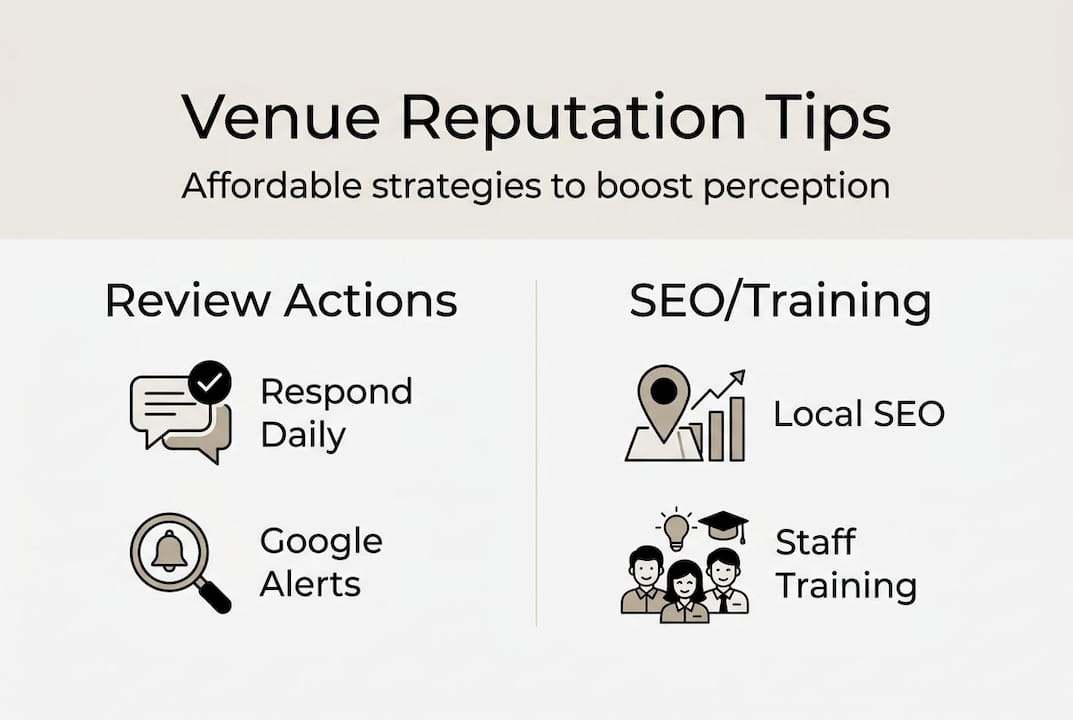
Pro Tip: When responding to negative reviews, acknowledge the specific issue, apologize sincerely, explain corrective actions taken, and invite the customer to discuss further offline. This approach demonstrates accountability to future customers reading the exchange while giving you a chance to convert a detractor into an advocate.
Tools and technology that simplify reputation management for venue owners
Technology transforms reputation management from overwhelming to manageable, even on limited budgets. Review monitoring platforms aggregate feedback from multiple sources into single dashboards, eliminating the need to check dozens of sites individually. These tools send instant notifications when new reviews appear, enabling rapid responses that customers and algorithms both reward.
Marketing technologies provide essential insights allowing streamlined oversight for small and medium businesses. Sentiment analysis features automatically categorize feedback as positive, negative, or neutral, helping you identify patterns and prioritize responses. Some platforms even suggest response templates, though you should always personalize these to maintain authenticity.
The right tool depends on your specific needs and budget. Consider these options:
| Tool | Key Features | Best For | Approximate Cost |
|---|---|---|---|
| Callback CRM | Review monitoring, automated requests, response management | Venues prioritizing review generation | $49-199/month |
| Podium | Multi-platform messaging, review requests, payment processing | Full-service customer communication | $289+/month |
| Birdeye | Comprehensive reputation suite, listings management, surveys | Growing venues needing scalability | $299+/month |
| Reputation.com | Enterprise features, competitive benchmarking, AI insights | Established venues with multiple locations | Custom pricing |
| Google Alerts + Manual | Free monitoring, manual responses | Budget-conscious startups | Free |
Automation saves countless hours while improving consistency. Set up automated review request emails triggered 24 hours after events, when customer satisfaction peaks but before memories fade. Configure alerts for keywords indicating problems, like “disappointed,” “cold food,” or “unprofessional,” enabling immediate intervention. Schedule social media posts in batches during slower periods, maintaining presence without daily effort.
Integration multiplies tool effectiveness. Connect your reputation management tools with booking systems to automatically identify customers for review requests. Link email platforms to send personalized follow-ups mentioning specific event details. Sync calendar apps to schedule review monitoring during optimal response windows. These connections create seamless workflows that run efficiently with minimal ongoing input.
Many reputation management software platforms offer free trials, allowing you to test features before committing. Start with one or two core tools, master their capabilities, then expand your stack as needs and budget grow. The goal isn’t using every available tool but finding the minimal effective combination that fits your workflow and delivers measurable results.
Pro Tip: Integrate review request automation with your booking confirmation emails, including a direct link to your Google Business Profile. This strategic timing catches customers while their positive experience is fresh, dramatically increasing review volume and quality.
Measuring success and refining your reputation management approach
Effective measurement begins with defining clear key performance indicators that align with business objectives. Track your average star rating across platforms, total review count, review velocity (new reviews per month), response rate and time, sentiment distribution (positive/negative/neutral ratios), and social media engagement metrics. These KPIs provide objective evidence of reputation trends and strategy effectiveness.
Gather data systematically using a simple spreadsheet or your reputation management platform’s analytics dashboard. Record weekly snapshots of core metrics, noting any significant changes or anomalies. Compare current performance against previous periods to identify trends, and benchmark against local competitors to understand your relative market position. This historical data reveals patterns invisible in daily operations.
Analyzing results requires moving beyond surface-level numbers to understand underlying causes. Follow this systematic process:
- Identify significant changes in any KPI, whether positive or negative shifts exceeding 10% month over month.
- Correlate changes with actions by reviewing what you did differently during that period, such as new staff training, menu changes, or marketing campaigns.
- Read representative reviews from the period, looking for recurring themes in both praise and criticism that explain metric movements.
- Assess competitive context by checking if competitors experienced similar changes, indicating market-wide trends versus venue-specific factors.
- Develop hypotheses and test by implementing targeted improvements, then monitoring whether metrics move as predicted over the following weeks.
Reputation management demands ongoing attention because customer expectations, competitive landscapes, and platform algorithms constantly evolve. Monitoring reputation metrics helps businesses adapt strategies and maximize positive impact over time. Schedule monthly 30-minute review sessions to assess performance, celebrate wins, and adjust tactics based on data insights.
Integrate reputation data into broader marketing decisions for maximum impact. Use positive review quotes in advertising copy and social media posts. Identify services generating the most enthusiastic feedback and feature them prominently in promotional materials. Address recurring complaints by refining operations, then publicize improvements to demonstrate responsiveness. Connect reputation insights with your venue marketing strategies to create cohesive campaigns that amplify your strengths while addressing weaknesses.
The most successful venues treat reputation management as a continuous improvement cycle rather than a one-time project. Small, consistent refinements compound over months into substantial competitive advantages. Your willingness to measure honestly, learn from feedback, and adapt accordingly separates thriving venues from those struggling to fill their calendars.
Boost your venue’s reputation with expert SEO and marketing services
While DIY reputation management delivers solid results, partnering with experienced professionals accelerates your progress and unlocks advanced strategies. Professional SEO optimization for venues combines technical expertise with reputation management to maximize your visibility in local search results, ensuring potential customers discover your positive reviews before competitors’ listings.
Comprehensive venue marketing strategies integrate reputation management with content marketing, paid advertising, and conversion optimization to transform positive sentiment into actual bookings. Expert teams handle time-consuming tasks like review monitoring, response crafting, and performance analysis, freeing you to focus on delivering exceptional customer experiences. Whether you’re just beginning to understand SEO optimization basics or ready to implement advanced tactics, professional guidance ensures your reputation investment generates maximum returns.
Frequently asked questions
What is the most cost-effective way to start managing my venue’s reputation?
Begin by claiming your Google Business Profile and setting up free monitoring through Google Alerts for your venue name. Actively encourage satisfied customers to leave reviews immediately after successful events, and commit to responding to all feedback within 24 hours. These foundational steps cost nothing but time and deliver immediate improvements in search visibility and customer trust.
How often should I check and respond to online reviews?
Check review platforms and social media at least once daily, ideally during morning hours when you can respond promptly to overnight feedback. Respond to every review within 24 hours maximum, as rapid responses signal active engagement to both customers and search algorithms. Setting phone notifications for new reviews ensures you never miss time-sensitive feedback requiring immediate attention.
Are there any affordable tools recommended for small venues to manage their reputation?
Callback CRM offers robust features starting under $50 monthly, making it accessible for budget-conscious venues. Free tools like Google Alerts, Hootsuite’s basic plan for social monitoring, and built-in review management within your Google Business Profile provide solid foundations. Many venues successfully manage reputation using only these free resources combined with disciplined daily monitoring routines.
Can managing my venue’s online reputation really increase bookings?
Absolutely. Positive reputation management increases trust, leading directly to more bookings and revenue for venues across all categories. Venues that actively manage reputation typically see 20-30% increases in inquiry volume within three months, as improved ratings and responsive engagement distinguish them from competitors. The compounding effect of consistent reputation management creates sustainable competitive advantages that drive long-term business growth.
Recommended
- Venue Marketing Strategies for Small Business Success 2025 | Ibrandmedia
- SEO Optimization for Venues: Boost Event Bookings Easily | Ibrandmedia
- Top Venue Email Marketing Tips for Local Businesses 2025 | Ibrandmedia
- How to Manage Online Reputation: A 2025 Guide for Local Businesses | Ibrandmedia
- Callback CRM: Reputation Management for Better Results
Recent Comments