
Over half of local home service marketing budgets now flow into digital advertising, yet many contractors still rely on expensive flyers and radio spots. This shift isn’t just trendy, it’s profitable. Digital ads deliver measurable results at lower costs, helping you attract clients precisely when they need your services. This guide reveals how to leverage affordable digital advertising strategies to increase your visibility and grow your client base in 2026.
Table of Contents
- Understanding The Role Of Digital Ads In Home Services Marketing
- Top Digital Advertising Platforms And Their Effectiveness For Home Services
- Common Misconceptions And Challenges In Digital Advertising For Home Services
- Optimizing Digital Ad Campaigns For Maximum Client Acquisition
- Comparing Digital Ads With Traditional Advertising For Home Services
- Practical Case Studies: Success Stories From Home Service Businesses
- Boost Your Home Service Marketing With Expert Digital Solutions
- Frequently Asked Questions
Key takeaways
| Point | Details |
|---|---|
| Digital dominance | Over 50% of home service marketing budgets now go to digital ads with better ROI than traditional methods. |
| Platform selection | Google Ads and Facebook each serve distinct purposes based on service type and customer search behavior. |
| Affordable entry | Effective campaigns start at just $300 monthly, making digital ads accessible for small businesses. |
| Geo-targeting power | Local landing pages and geographic targeting boost lead conversion rates by 25-30%. |
| Proven results | Real case studies show client acquisition increases exceeding 35% using strategic digital advertising. |
Understanding the role of digital ads in home services marketing
The home service industry has undergone a marketing revolution. Digital ads now constitute over 50% of marketing budgets for local services, and this shift makes perfect sense. Traditional advertising methods like newspaper ads, direct mail, and radio spots offer limited targeting and zero real-time tracking.
Digital advertising changes everything. You can target homeowners within a five-mile radius who just searched for emergency plumbing services. You track every click, call, and conversion. This precision transforms marketing from a cost center into a measurable investment.
Home service buyers behave differently today. They search online for immediate solutions, compare reviews, and make fast decisions. Your digital presence must intercept this buyer journey at the right moment. Digital ads position your business exactly where customers look.
The advantages over traditional media are clear:
- Precise geographic and demographic targeting reaches only potential customers
- Real-time performance tracking shows exactly which ads generate leads
- Budget flexibility allows you to start small and scale what works
- Quick optimization means underperforming ads can be improved within days
- Lower cost per lead compared to print, radio, or TV advertising
Even small budgets compete effectively in digital spaces. A $500 monthly investment in local digital advertising can outperform a $2,000 traditional media campaign because every dollar targets qualified prospects. The playing field has leveled for small home service businesses willing to embrace digital strategies.

Top digital advertising platforms and their effectiveness for home services
Choosing the right platform determines your success. Not all digital advertising channels deliver equal results for home services. Google Ads offers $20-$70 average cost per lead for home services, making it the ROI leader for search-driven services.
Google Ads dominates for planned services like HVAC installation, kitchen remodeling, or routine plumbing maintenance. Customers actively searching for these services demonstrate high purchase intent. Your ad appears precisely when they need you most.
Facebook and Instagram ads double engagement on emergency services compared to Google. These platforms excel for building brand awareness and capturing urgent needs. A homeowner scrolling Facebook might not be searching for a plumber, but a compelling ad about 24/7 emergency service plants your name in their mind.
Here’s how leading platforms compare for home services:
| Platform | Best For | Avg Cost Per Lead | Key Advantage |
|---|---|---|---|
| Google Ads | Planned services, high search intent | $20-$70 | Captures active searchers ready to buy |
| Facebook/Instagram | Emergency services, brand awareness | $15-$50 | Visual storytelling and demographic targeting |
| Nextdoor | Hyper-local community trust | $25-$60 | Neighborhood recommendations and credibility |
| Yelp Ads | Reputation-driven services | $30-$80 | Integrates with reviews and ratings |
Your service type should guide platform selection. Emergency plumbers benefit from Facebook’s immediate engagement. Landscape designers showcase visual portfolios on Instagram. HVAC companies capture Google searchers ready to replace failing systems.
Combining platforms amplifies results. A plumber might allocate 60% of budget to Google Ads for active searchers and 40% to Facebook for brand building. This diversification reaches customers at multiple touchpoints throughout their decision journey.
Budget allocation depends on your target segments. Higher-value services like HVAC replacement justify higher cost per lead. Quick-turnaround services like drain cleaning require lower acquisition costs. Match your platform strategy to your service margins and customer lifetime value.
Pro Tip: Start with one platform, master it, then expand. Many businesses spread budgets too thin across multiple platforms before understanding what works. Test Google Ads first if you offer search-driven services. Once you’re generating consistent leads, layer in social media advertising to expand reach.
Common misconceptions and challenges in digital advertising for home services
Myths prevent many home service businesses from leveraging digital ads effectively. The biggest misconception is that digital advertising requires massive budgets. Reality tells a different story. Effective campaigns start at $300 per month and generate measurable leads for small businesses.
Another damaging myth is that digital ads produce instant client floods. Building effective campaigns requires testing, optimization, and patience. Your first month establishes baseline performance. Months two and three refine targeting and messaging. Sustainable growth compounds over time, not overnight.
Discount-focused advertising creates another trap. Constantly promoting 20% off or slashed prices attracts price shoppers who never become loyal customers. These campaigns erode profit margins and damage brand perception. Quality-focused messaging attracts better clients willing to pay fair prices.
Broad, untargeted campaigns waste money fast. Running ads across an entire city when you only service three neighborhoods burns budget on unqualified clicks. Geographic targeting focuses spending on areas you actually serve.
Common challenges that trip up beginners include:
- Believing digital ads are too complex without professional help
- Setting unrealistic expectations for immediate results
- Failing to track phone calls and form submissions properly
- Neglecting landing page optimization while focusing only on ads
- Comparing digital ad costs directly to traditional media without considering tracking benefits
Traditional advertising feels familiar but delivers inferior results. A $1,500 radio campaign might reach 10,000 people, but how many needed your service that week? Digital ads reach 500 people actively searching for what you offer. The smaller, qualified audience converts at dramatically higher rates.
The learning curve intimidates some business owners. Platforms like Google Ads appear complex initially. Start with simple campaign structures, learn from results, and expand gradually. Many successful home service businesses began with basic campaigns and refined their approach through practical experience.
Optimizing digital ad campaigns for maximum client acquisition
Effective optimization separates profitable campaigns from money pits. Start by defining your local target audience with precision. A general contractor serving upscale neighborhoods should target homeowners aged 45-65 with household incomes above $150,000. This specificity eliminates wasted ad spend on unqualified prospects.
Follow these steps to maximize campaign performance:
- Research competitor ads to identify messaging gaps and opportunities in your market.
- Create compelling ad copy highlighting specific benefits like 24/7 availability or licensed technicians.
- Design local landing pages that match ad promises and include clear contact forms.
- Implement call tracking numbers to measure which ads generate phone inquiries.
- Set up conversion tracking for form submissions, calls, and appointment bookings.
- Review performance data weekly and adjust bids on high-performing keywords.
- Pause underperforming ads quickly rather than letting them drain budget.
Your landing pages determine conversion success as much as your ads. A click costs money whether or not it converts. Local landing pages optimized for conversions increase leads by 25% compared to sending traffic to generic homepages. Each landing page should address one specific service with relevant images, trust signals, and obvious contact options.
Geo-targeting boosts conversion rates by 30% because you reach people in your service area. Someone 50 miles away clicking your ad wastes money. Set geographic boundaries matching where you actually work. For emergency services, tighten the radius. For specialized services, expand it slightly to capture surrounding suburbs.
Real-time analytics improve acquisition efficiency by 40% when you actually use them. Log into your ad platform weekly. Identify which keywords, locations, and times generate leads. Double down on what works and cut what doesn’t.
Keyword selection requires strategic thinking. Broad terms like “plumber” cost more and convert worse than specific phrases like “emergency pipe repair near me.” Long-tail keywords attract ready-to-buy customers at lower costs.
Pro Tip: Create separate campaigns for emergency versus planned services. Emergency campaigns should run 24/7 with higher bids during evenings and weekends. Planned service campaigns can reduce bids during off-hours when conversion rates drop. This schedule optimization stretches budgets further without sacrificing lead volume.
Test different ad variations continuously. Run two headlines against each other. Try different call-to-action phrases. Small improvements compound into significant performance gains. A 2% improvement in click-through rate might generate 20 additional leads monthly from the same budget.
Comparing digital ads with traditional advertising for home services
The cost difference between digital and traditional advertising is stark. Traditional ads cost 20-50% more per lead than digital ads while providing zero tracking capability. You can’t measure how many people called after hearing your radio ad versus seeing your truck.
Digital advertising provides granular performance data. You know exactly which ad generated which lead. Traditional media offers broad reach estimates with no conversion tracking. This transparency makes digital campaigns continuously improvable.
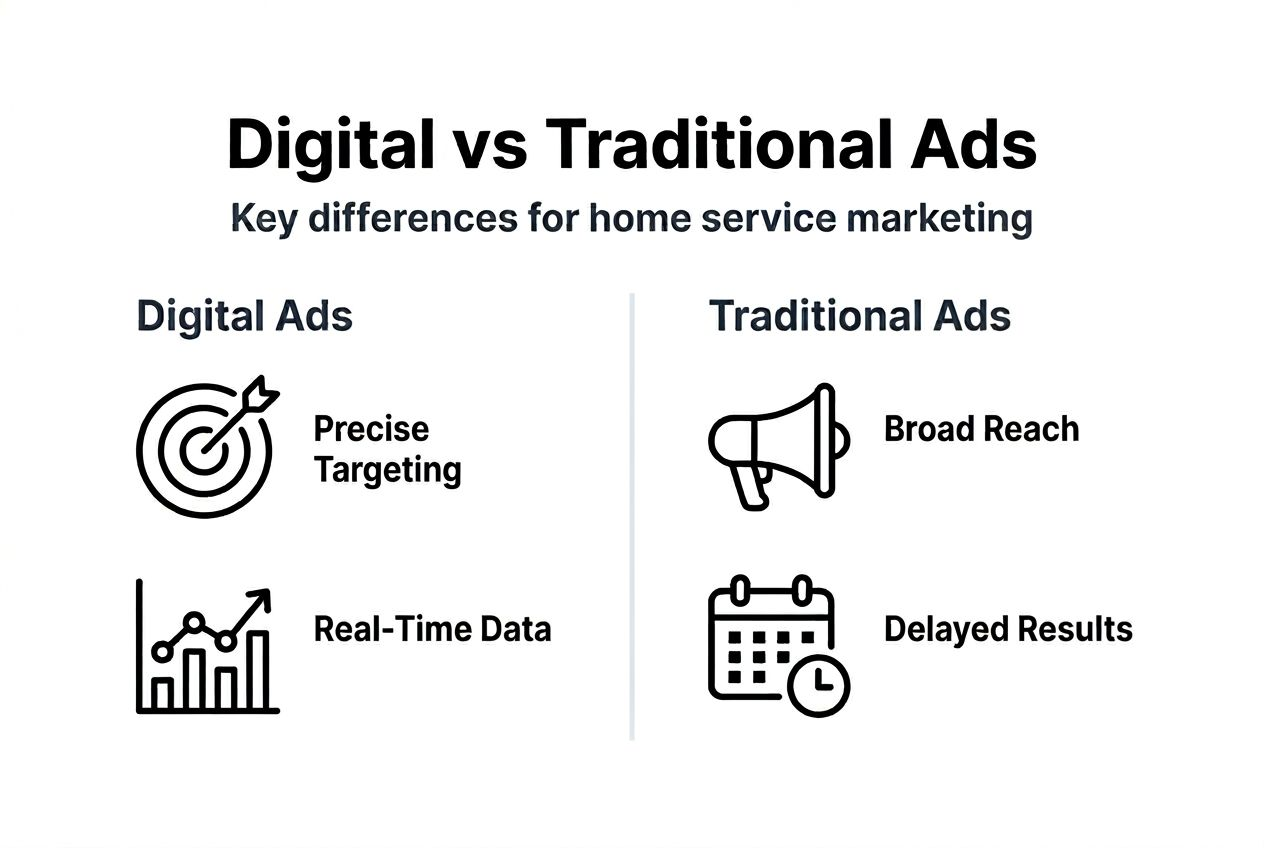
Consider this comparison:
| Factor | Digital Ads | Traditional Ads |
|---|---|---|
| Targeting precision | Geographic, demographic, behavioral | Broad reach with minimal targeting |
| Cost per lead | $20-$70 average | $50-$150 average |
| Performance tracking | Real-time, conversion-based | Estimated reach only |
| Optimization speed | Adjust within hours | Fixed for campaign duration |
| Budget flexibility | Start at $300/month | Minimum $1,000+ commitments |
| ROI measurement | Track every dollar | Estimate based on overall sales |
Real businesses demonstrate the performance gap. A local HVAC company spent $2,000 monthly on newspaper ads generating approximately 8-12 leads. Switching to digital advertising with the same budget produced 25-30 qualified leads monthly. The improvement stemmed from targeting homeowners actively searching for HVAC services.
Traditional advertising made sense when options were limited. Customers found businesses through phone books, newspaper ads, and word of mouth. Today’s customer journey starts with online searches. Your digital presence intercepts this journey at the moment of need.
The feedback loop differs dramatically. Traditional ads run for weeks or months before you assess results. Digital campaigns provide hourly performance updates. Underperforming ads get paused immediately. High performers receive additional budget the same day.
Some argue traditional media builds brand recognition better than digital. This belief ignores how people actually discover home service businesses today. Online reviews, search results, and social media profiles shape brand perception more powerfully than any billboard or radio spot.
Practical case studies: success stories from home service businesses
Real results validate digital advertising strategies better than theories. A plumbing business increased client acquisition 35% in 6 months using Google Ads combined with geo-fencing technology. This dramatic improvement came from targeting homeowners within their service radius actively searching for plumbing solutions.
The strategy combined several elements:
- Google Ads targeting emergency plumbing keywords in specific ZIP codes
- Geo-fencing around competitor locations to capture customers seeking alternatives
- Mobile-optimized landing pages emphasizing 24/7 availability
- Call tracking revealing peak inquiry times for bid optimization
- Weekly budget adjustments based on conversion data
Another HVAC company reduced cost per lead from $89 to $34 within three months. They achieved this by shifting budget from broad awareness campaigns to targeted search ads. Instead of general “HVAC services” ads, they created specific campaigns for furnace repair, AC installation, and emergency heating.
The increased leads translated directly to revenue growth. More qualified inquiries meant the sales team focused energy on ready-to-buy customers. Conversion rates from lead to job improved because digital targeting pre-qualified prospects.
A landscaping business struggled with seasonal fluctuations. Digital advertising allowed them to promote spring cleanup services in February and March, then shift to irrigation and maintenance as seasons changed. This flexibility maximized relevance throughout the year. Traditional media commitments would have locked them into fixed messaging.
These success stories share common patterns. Businesses that succeed with digital advertising start with clear goals, track performance religiously, and optimize continuously. They don’t set campaigns and forget them. Active management drives results.
Key lessons from successful campaigns include starting small with one platform, testing different ad messages, focusing on high-intent keywords, and creating service-specific landing pages. Businesses that implement these fundamentals see measurable improvements within 60-90 days.
Boost your home service marketing with expert digital solutions
Transforming digital advertising knowledge into results requires the right foundation. Your website must convert the traffic your ads generate. Optimized websites turn clicks into customers through clear messaging, mobile responsiveness, and compelling calls to action.
Combining SEO strategies with paid advertising creates sustainable growth. While ads deliver immediate visibility, SEO builds long-term organic traffic. Together, they dominate search results and maximize your online presence. Our proven approaches help home service businesses attract more local clients without breaking marketing budgets.
Starting your digital transformation doesn’t require technical expertise. Practical guides and professional support make marketing to local customers straightforward and effective. Whether you’re launching your first campaign or optimizing existing efforts, expert guidance accelerates results and prevents costly mistakes. Partner with experienced professionals who understand home service marketing challenges and deliver measurable outcomes for businesses like yours.
Frequently asked questions
What is the most affordable digital ad budget for home service businesses?
Budget-friendly campaigns begin at $300 monthly and still generate measurable leads when properly targeted. Focus your limited budget on high-intent keywords in your immediate service area. As you identify what works, scale spending gradually to maximize ROI without risking large sums.
How can I measure the success of my digital ad campaigns?
Use real-time analytics tools to monitor leads, click-through rates, cost per conversion, and return on ad spend. Real-time tracking improves efficiency by 40% when you adjust targeting and budgets based on actual performance data. Set up call tracking and form analytics to capture all conversion points, not just online actions.
Are digital ads better than traditional ads for home services?
Digital ads provide superior targeting, measurable ROI, and lower cost per lead compared to traditional media. Traditional advertising costs 20-50% more per lead and lacks precise tracking capabilities. Digital campaigns let you reach customers actively searching for your services right when they need help, making every dollar work harder.
Which digital platforms work best for different home service types?
Google Ads suits plumbing and HVAC services with high search intent, delivering qualified leads from active searchers. Facebook and Instagram excel for emergency repairs and visual services like landscaping because higher engagement captures attention when customers aren’t actively searching. Match your platform to how customers naturally discover and evaluate your specific service type.
How long before I see results from digital advertising campaigns?
Expect initial results within 2-4 weeks as campaigns gather data and optimize. Significant improvements typically appear after 60-90 days of continuous testing and refinement. Digital ads aren’t instant magic, but they deliver faster, more measurable results than traditional advertising ever could. Patience and active management turn initial tests into profitable growth engines.
Recommended
- Best 6 Digital Advertising Platforms for Home Services – Expert Comparison 2025 | Ibrandmedia
- Boosting Plumbing Business Visibility with Digital Marketing | Ibrandmedia
- Effective Digital Marketing for Builders: Grow Your Business | Ibrandmedia
- Ibrandmedia – A Complete Digital Strategy For Your Business
- LinkedIn Lead Generation & AI-Powered Sales Strategies
Recent Comments