
Most American small businesses miss critical opportunities online by underestimating mobile optimization. Over half of mobile users leave a website if it takes more than three seconds to load, causing local service providers to miss out on valuable leads. With more customers searching for HVAC and home contracting via smartphones, knowing what truly matters for mobile-friendly design can be the difference between steady growth and lost revenue.
Table of Contents
- Mobile Optimization Fundamentals And Misconceptions
- Key Features Of Mobile-Friendly Websites
- Mobile-First Indexing And SEO Impact
- Improving User Experience And Conversion Rates
- Financial Risks Of Poor Mobile Optimization
- Comparing Responsive And Adaptive Design Choices
Key Takeaways
| Point | Details |
|---|---|
| Comprehensive Mobile Optimization | Mobile optimization involves more than visual design; it includes technical performance, user experience, and functionality. Small businesses must adopt a holistic approach to ensure effectiveness. |
| Impact on Search Rankings | Google utilizes mobile-first indexing, meaning mobile performance is critical for visibility. Businesses that neglect mobile optimization risk losing search engine rankings and potential customers. |
| Financial Risks | Poor mobile optimization can translate to significant financial losses due to reduced engagement and higher abandonment rates. Investing in ongoing mobile performance improvements is essential for sustained growth. |
| Responsive vs. Adaptive Design | Choose between responsive and adaptive design based on business needs: responsive offers low maintenance with cross-device consistency, while adaptive allows for tailored experiences but requires more resources. |
Mobile optimization fundamentals and misconceptions
Mobile optimization represents far more than simply resizing a website to fit smaller screens. Local businesses often misunderstand this critical digital strategy, believing that a responsive design automatically solves all mobile accessibility challenges. In reality, mobile optimization requires a comprehensive approach that goes beyond visual layout.
True mobile optimization involves multiple technical and user experience dimensions. This includes improving page load speeds, ensuring intuitive navigation, adapting content for touch interfaces, and guaranteeing cross-platform compatibility. Local service providers like HVAC contractors or home repair businesses cannot afford to ignore these nuanced requirements. A poorly optimized mobile site can mean lost customer interactions, reduced search engine rankings, and diminished credibility in an increasingly mobile-first marketplace.
Common misconceptions persist about what constitutes effective mobile design. Many business owners wrongly assume that simply making their website “look good” on smartphones is sufficient. However, technical performance metrics like loading speed, interactive responsiveness, and content adaptability are equally crucial. Mobile users expect near-instant access to information, with studies showing that 53% of mobile visitors will abandon a site if it takes longer than three seconds to load.
Pro tip: Regularly test your mobile website using free tools like Google PageSpeed Insights to identify and address performance bottlenecks that could be driving potential customers away.
Key features of mobile-friendly websites
Mobile-friendly websites go beyond simple visual adaptation, requiring a holistic approach to design and functionality. Responsive design technologies like CSS3 and media queries play a critical role in creating seamless user experiences that work across different device types and screen sizes. For local businesses, this means crafting websites that look and perform perfectly whether accessed on a smartphone, tablet, or desktop computer.
The core features of a truly mobile-friendly website include several key technical and design elements. Fast load times, touch-friendly navigation, and easily readable content are fundamental to engaging mobile users. This involves optimizing image sizes, using clear and legible fonts, implementing responsive menu designs, and ensuring that critical information is immediately accessible without excessive scrolling or zooming.
Local businesses must pay special attention to specific mobile optimization strategies. This includes creating large, easily tappable buttons, minimizing complex form fields, implementing accelerated mobile pages (AMP), and ensuring that contact information and call-to-action elements are prominently displayed. Search engines like Google also prioritize mobile-friendly websites in their rankings, making these features not just a user experience consideration but a critical component of digital marketing strategy.
Here’s how key mobile optimization features benefit local businesses:
| Feature | What It Does | Business Impact |
|---|---|---|
| Fast load speed | Minimizes waiting time | Reduces visitor drop-off |
| Touch-friendly design | Makes navigation easy on devices | Increases user engagement |
| Readable content | Ensures text is clear and legible | Boosts information accessibility |
| Strong call-to-action | Prominently displays action buttons | Drives more inquiries and bookings |
| Optimized images | Reduces unnecessary file size | Enhances overall site performance |
Pro tip: Use free mobile responsiveness testing tools to evaluate your website across multiple devices and screen sizes, identifying and fixing potential user experience barriers before they impact your customer engagement.
Mobile-first indexing and SEO impact
Mobile-first indexing represents a fundamental shift in how search engines evaluate and rank websites. Google now prioritizes the mobile version of a website as the primary source for content indexing and ranking across all devices, which means local businesses must take mobile optimization extremely seriously. This approach fundamentally changes how websites are evaluated, placing mobile performance at the center of search engine visibility.
For small local businesses, this shift carries significant implications. Websites that are not optimized for mobile devices will experience substantial penalties in search rankings, potentially losing critical visibility to competitors who have invested in responsive design. Search engine optimization now directly correlates with mobile performance, with businesses seeing dramatic differences in traffic and engagement based on their mobile site’s quality. Factors like page load speed, content readability, and touch-friendly navigation become critical determinants of online success.
The technical requirements for mobile-first indexing are comprehensive and demanding. Businesses must ensure content parity between desktop and mobile versions, maintain consistent metadata, implement responsive design principles, and optimize page performance across multiple device types. Local service providers like contractors, repair professionals, and small retailers cannot afford to treat mobile optimization as an afterthought—it is now a fundamental component of digital marketing strategy that directly impacts customer acquisition and revenue generation.
Pro tip: Conduct a thorough mobile performance audit using free tools like Google PageSpeed Insights and mobile-friendly test resources to identify and immediately address any potential optimization barriers.
Improving user experience and conversion rates
User experience sits at the heart of mobile website performance for local businesses, directly impacting customer engagement and revenue generation. Research demonstrates that intuitive mobile design principles can significantly boost user retention and conversion metrics, transforming how small businesses approach their digital presence. Successful mobile experiences go far beyond aesthetic considerations, focusing on creating seamless, frictionless interactions that guide potential customers effortlessly toward their desired actions.

Mobile user experience directly correlates with conversion rates, with empirical studies showing that streamlined, user-friendly design can dramatically reduce customer abandonment. For local service providers like HVAC technicians, plumbers, or home repair specialists, this means creating mobile websites that simplify the customer journey. Critical elements include fast-loading pages, clear navigation, easily readable content, and strategically placed contact and booking options that minimize user effort and maximize conversion potential.
Local businesses must recognize that mobile users have fundamentally different expectations compared to desktop visitors. They demand instant information, quick loading times, and simple interaction mechanisms. This requires implementing responsive design techniques, optimizing image and content sizes, creating touch-friendly buttons, and ensuring that critical information like service descriptions, pricing, and contact details are immediately accessible. Businesses that fail to meet these mobile user experience standards risk losing potential customers to more digitally sophisticated competitors.
Pro tip: Conduct monthly mobile user experience audits using tools like Google Analytics and heatmap tracking to continuously identify and eliminate potential friction points in your website’s customer journey.
Financial risks of poor mobile optimization
Local businesses face significant financial consequences when they neglect mobile website optimization. Hidden costs of poor mobile performance can quickly escalate, transforming what seems like a minor technical issue into a substantial financial liability. These risks extend far beyond simple website appearance, impacting everything from customer acquisition to long-term revenue streams.
Neglecting mobile optimization directly translates to measurable economic losses, including reduced traffic, lower conversion rates, and diminished brand value. Small service businesses like home repair contractors, HVAC technicians, and local retailers can lose substantial potential revenue when their mobile websites fail to meet modern user expectations. Studies indicate that websites with poor mobile performance can lose up to 60% of potential customer interactions, representing a critical financial risk that many small businesses underestimate.
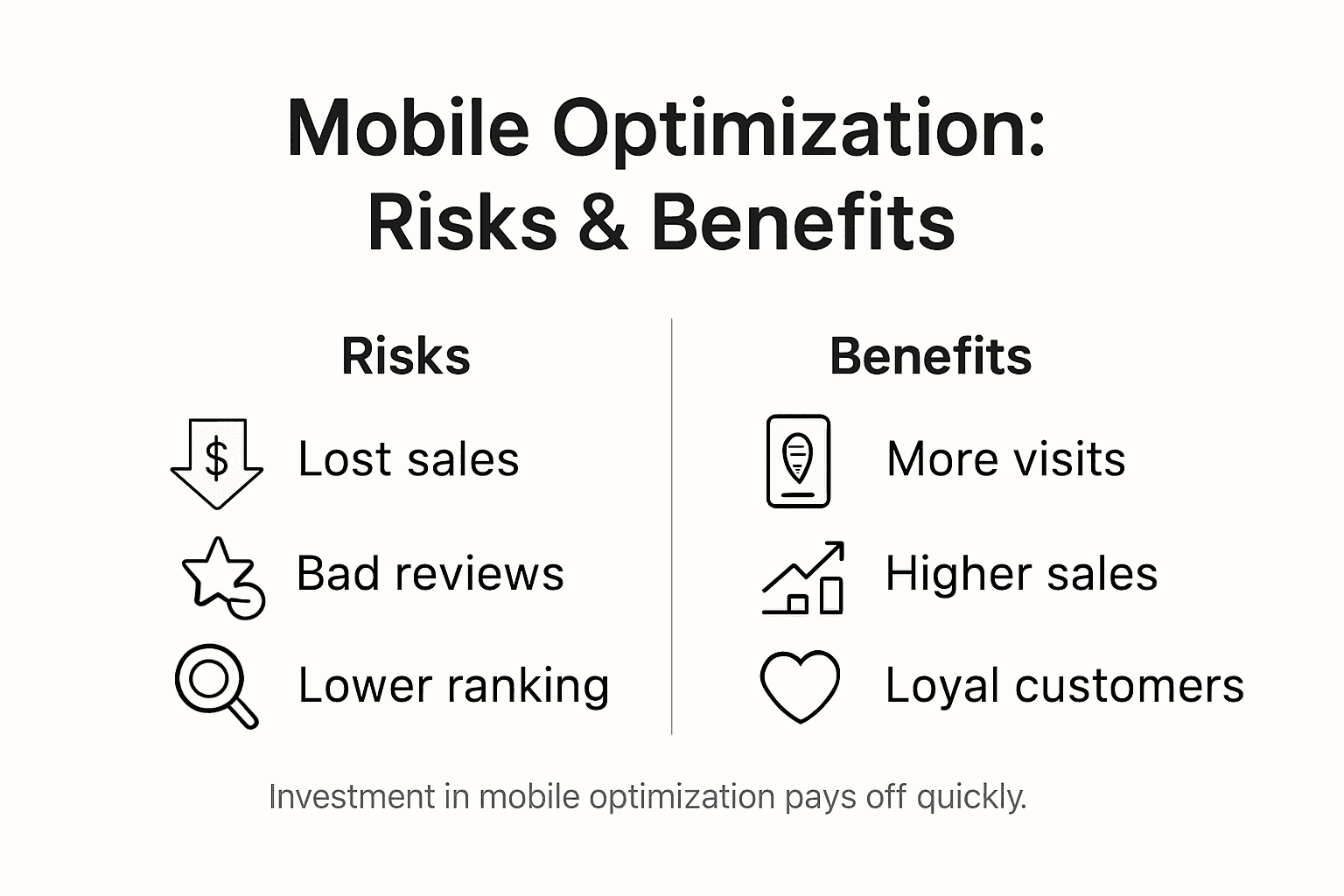
The financial implications of poor mobile optimization are multifaceted and complex. Beyond immediate revenue loss, businesses face increased customer support costs, higher marketing expenses to compensate for reduced organic visibility, and potential long-term reputation damage. Platform fragmentation, varying device capabilities, and rapidly changing mobile technologies mean that mobile optimization is not a one-time expense but an ongoing investment requiring continuous adaptation and refinement.
Pro tip: Allocate a specific quarterly budget for mobile website performance testing and optimization to proactively identify and address potential technical and user experience issues before they impact your bottom line.
Comparing responsive and adaptive design choices
Responsive and adaptive design represent two distinct approaches to creating mobile-friendly websites for local businesses, each with unique strengths and considerations. A systematic review of web design technologies reveals that these approaches differ fundamentally in their technical foundations and implementation strategies, challenging businesses to select the most appropriate method for their specific needs.
Responsive design consistently demonstrates superior usability and cross-device consistency, making it an attractive option for most local service providers. This approach uses flexible layouts and CSS media queries to automatically adjust website content to fit different screen sizes, ensuring a uniform experience across smartphones, tablets, and desktop computers. For small businesses like HVAC contractors or home repair services, responsive design offers a cost-effective solution that requires minimal maintenance and provides a consistent brand presentation.
Adaptive design, by contrast, creates multiple fixed layouts for specific device types, allowing more granular control over user experience but demanding significantly more development resources. While this approach can deliver highly tailored experiences at different breakpoints, it requires creating and maintaining separate design versions for various device categories. Local businesses must carefully weigh the trade-offs: adaptive design provides more customization but increases complexity and ongoing maintenance costs, whereas responsive design offers a more streamlined, future-proof solution that works across an expanding range of devices.
Compare responsive and adaptive design approaches:
| Approach | How It Works | Maintenance Effort | Ideal For |
|---|---|---|---|
| Responsive | Flexible layouts adapt to any screen | Low | Small businesses, wide audiences |
| Adaptive | Multiple fixed layouts per device type | High | Sites needing device tailoring |
Pro tip: Conduct a comprehensive audit of your target audience’s most common devices and screen sizes before selecting between responsive and adaptive design approaches.
Unlock Your Local Business Potential with Expert Mobile Optimization
Mobile optimization is more than a tech upgrade It is a vital step to avoid losing customers due to slow loading times or frustrating navigation issues Local business owners face real challenges like improving page load speed and creating touch-friendly designs that engage visitors and boost conversions At ibrand.media, we understand these crucial pain points and tailor solutions focused on delivering fast loading, clear content, and strong call-to-actions to help your business stand out in a competitive market
Are you ready for a mobile-first world where your website drives growth not traffic loss Discover how our Uncategorized | Ibrandmedia services integrate proven SEO strategies and cutting-edge web design to meet Google’s mobile-first indexing demands IMAGE:cta_image] Start transforming your mobile user experience today with a personalized strategy from iBrand Media Crafted to increase engagement and sales quickly and affordably Visit us at [ibrand.media to get your custom plan and see why local businesses trust us to elevate their digital presence
Frequently Asked Questions
Why is mobile optimization important for local businesses?
Mobile optimization is crucial for local businesses as it enhances user experience, increases search engine rankings, and improves customer engagement. A well-optimized mobile site ensures that potential customers can easily access information, leading to higher conversion rates.
What are the key features of a mobile-friendly website?
Key features of a mobile-friendly website include fast load times, touch-friendly navigation, easily readable content, prominent call-to-action buttons, and optimized images. These elements ensure that users have a seamless experience across various devices.
How does mobile-first indexing affect my website’s SEO?
Mobile-first indexing means that search engines prioritize the mobile version of your website for ranking and indexing. This shift necessitates that businesses optimize their mobile sites to avoid penalties in search rankings and to maintain visibility in search results.
What are common misconceptions about mobile optimization?
Common misconceptions include the belief that responsive design alone suffices for mobile optimization. In reality, effective mobile optimization requires a comprehensive approach that includes fast load speeds, intuitive navigation, and content adaptability to meet user expectations.
Recommended
- Understanding Mobile-Friendly Websites: Why They Matter | Ibrandmedia
- Top SEO Techniques for Small Business Owners in 2025 | Ibrandmedia
- Understanding the Benefits of Local SEO for Small Businesses | Ibrandmedia
- Mobile-Friendly Website Benefits: Complete Guide | Ibrandmedia
- Mobiele Optimalisatie: Alles Over Belang En Voordelen | BYTE24
Recent Comments