
A responsive search ad pulls from up to 15 headlines and 4 descriptions, then lets Google’s system assemble whichever combination it predicts will perform best for each search. The single most important move you can make is loading each RSA with diverse, non-repetitive assets until Google Ads rates it Good or Excellent for Ad Strength. Everything below, including copy-ready templates by industry, exists to help you hit that bar fast.
TL;DR:
- Using diverse, non-repetitive headlines and descriptions until Ad Strength reaches Good or Excellent significantly improves click and conversion rates.
- Keep the number of asset variations below the maximum limits and avoid excessive pinning, as both reduce Google’s ability to optimize effectively.
- Incorporate varied role-specific headlines, such as keywords, benefits, proof points, and calls to action, to maximize ad performance.
- Regularly review Ad Strength and combination reports every two weeks to identify underperforming assets and make incremental improvements.
- Prioritize creating at least two ads rated Good or Excellent per ad group, as adding more strong RSAs yields incremental conversion gains.
Table of Contents
- What Are Responsive Search Ads and How Do They Work?
- RSA Specs, Limits, and the Mistakes That Sink Ad Strength
- Responsive Search Ads Examples by Industry You Can Adapt Today
- How to Write RSAs That Actually Earn Good or Excellent Ad Strength
- Step-by-Step: Creating a Responsive Search Ad in Google Ads
- Reading Ad Strength, Combination Reports, and Pairing With Smart Bidding
- What a 15-Minute Weekly RSA Routine Actually Looks Like
- Templates Beat Theory: The Editorial Take
- Get Your RSAs Built and Optimized Without the Guesswork
- Sources
- FAQ
What Are Responsive Search Ads and How Do They Work?
A responsive search ad is not one fixed ad. It is a pool of headlines and descriptions that Google’s system mixes and matches in real time, testing which combination earns the click for a given search query, device, and user intent. Write ten headlines about your plumbing business and Google might show three of them together for a search about “emergency drain repair” and a completely different three for “affordable water heater install.”
That flexibility is the whole point. A static text ad shows the same message to everyone. An RSA adapts, which is why Google’s own guidance recommends filling out as many unique, relevant assets as you reasonably can rather than writing the legal minimum.
Here’s what actually displays on a search results page:
- Up to 3 headlines show at once, out of the 15 you can write.
- Up to 2 descriptions show at once, out of the 4 you can write.
- Google rotates through eligible combinations based on predicted relevance to the query.
- Unused headlines and descriptions from other ads in the same ad group can sometimes serve as additional assets, stretching your creative pool further than you might expect.
You can pin a headline or description to a fixed position, such as pinning your brand name to position one so it always appears. Pinning is useful for compliance language or brand consistency, but it comes at a cost: every pin locks that slot and shrinks the number of combinations Google can test. Pin too aggressively and you have basically rebuilt a static ad with extra steps.
RSA Specs, Limits, and the Mistakes That Sink Ad Strength
The technical ceiling is fixed and worth memorizing before you write a single line of copy. Google Ads lets you enter up to 15 headlines and 4 descriptions per RSA, with headlines capped at 30 characters and descriptions capped at 90 characters.
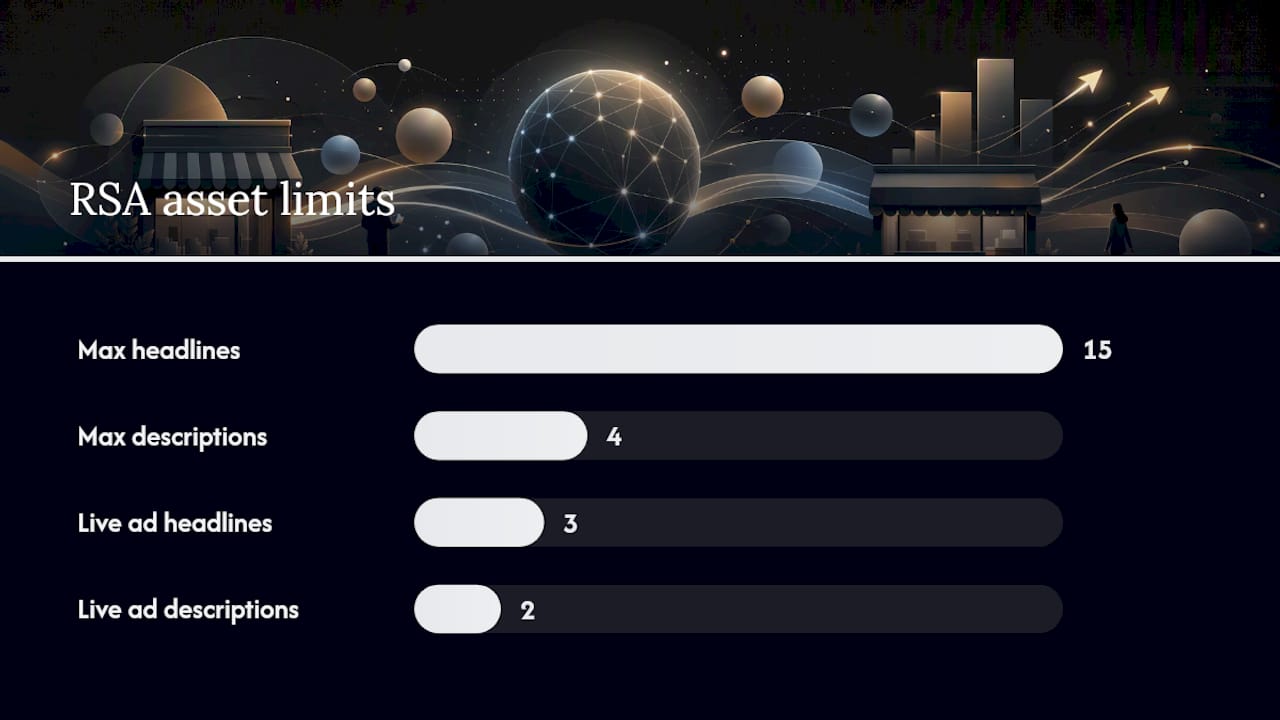
Minimums matter too. Google requires at least 3 headlines and 2 descriptions to publish an RSA, but that floor exists for technical eligibility, not for good performance. Publishing at the minimum is like entering a talent show with one act.
Quick reference for asset limits:
- Headlines: 3 minimum, 15 maximum, 30 characters each.
- Descriptions: 2 minimum, 4 maximum, 90 characters each.
- Display in a live ad: up to 3 headlines and 2 descriptions at once.
- Pinning: optional, per asset, per position, but reduces testable combinations.
Ad Strength benchmark: Google’s guidance ties improved Ad Strength to real performance gains. Advertisers who raise an ad from Poor to Excellent see an average 15% lift in clicks and conversions, and running a second RSA per ad group adds roughly another 6.6% in conversions, with a third adding about 3.7% more.
The most common pitfalls are near-duplicate headlines (three variations of “Free Shipping” that all read the same to the algorithm), descriptions that get truncated mid-sentence on mobile because they were written to hit exactly 90 characters, and pinning every single slot out of a desire for control. Each mistake shrinks the pool Google needs to actually optimize.
Responsive Search Ads Examples by Industry You Can Adapt Today
These are not abstract placeholders. Each set below gives you real headline and description language you can drop into Google Ads and adjust for your business, location, or offer. Swap in your city, product, or promotion where it fits, and keep the mechanics intact: mix keyword-matching headlines with benefit statements, urgency, and a clear call to action.
1. Local Services (Plumbers, Electricians, Salons, Contractors)
Local service businesses win by pairing urgency with trust signals. Headlines here mix service-specific keywords with proof points like licensing or availability.
Headlines: “24/7 Emergency Plumbing,” “Licensed & Insured Techs,” “Same-Day Service Available,” “Free Estimates, No Obligation,” “5-Star Rated Local Plumber,” “Fast Response, Fair Pricing,” “Serving [City] Since 2010,” “Book Online in 60 Seconds,” “No Hidden Fees, Ever,” “Certified Master Electrician”
Descriptions: “Fast, reliable plumbing repairs from a team your neighbors trust. Call now for same-day service.” / “Upfront pricing, no surprises. Licensed technicians ready to help today.”
The reason this works: local intent searches skew toward speed and trust. A headline like “Licensed & Insured Techs” answers an objection before the searcher even asks it.
2. E-Commerce and Retail
E-commerce RSAs perform best when they lead with the product or category keyword, then stack proof and urgency underneath.
Headlines: “Shop [Product Category] Online,” “Free Shipping Over $50,” “30-Day Returns, No Hassle,” “New Arrivals Every Week,” “Limited Stock, Shop Now,” “Rated 4.8 Stars by Shoppers,” “Buy Now, Pay Later Available,” “Exclusive Online Deals,” “Fast, Trackable Shipping,” “Save 20% Your First Order”
Descriptions: “Discover top-rated [product] with free shipping and easy returns. Shop the collection today.” / “Thousands of happy customers. Order now and get 20% off your first purchase.”
Pro Tip: Put your strongest offer (percentage off, free shipping threshold) in at least two different headlines phrased differently. Google will test both, and you’ll see which framing actually converts instead of guessing.
3. B2B and SaaS
B2B searchers are often problem-aware but solution-agnostic, so lead with the pain point, then pivot to outcome.
Headlines: “Cut Onboarding Time in Half,” “Software Built for [Industry],” “No Credit Card Required,” “Trusted by 500+ Teams,” “Automate Your Workflow Today,” “See a Live Demo Now,” “Enterprise-Grade Security,” “Free 14-Day Trial,” “Integrates With Your Stack,” “Built for Growing Teams”
Descriptions: “Stop losing hours to manual tasks. See how teams like yours save time with our platform.” / “Try it free for 14 days. No commitment, no credit card, cancel anytime.”
4. Events and Courses
Event and course ads convert on specificity: dates, formats, and outcomes beat vague enthusiasm every time.
Headlines: “Register for [Event Name],” “Live Workshop, [Date],” “Learn From Industry Experts,” “Early Bird Pricing Ends Soon,” “Virtual & In-Person Options,” “Certificate Upon Completion,” “Limited Seats Available,” “Self-Paced Course Access,” “Save Your Spot Today,” “Beginner-Friendly Curriculum”
Descriptions: “Join hundreds of professionals building real skills. Early bird pricing ends this week.” / “Flexible learning, real results. Enroll today and start at your own pace.”
5. Seasonal Promotions
Seasonal RSAs need a hard deadline in at least one or two headlines. That deadline pressure is what separates a browsing click from a buying click.
Headlines: “Holiday Sale, Up to 40% Off,” “Black Friday Deals Live Now,” “Limited-Time Offer Ends Soon,” “Shop Our Biggest Sale Yet,” “Gift Guide: Shop by Category,” “Free Gift With Purchase,” “Last Chance, Sale Ends [Date],” “Stock Up Before It’s Gone,” “Deals Refresh Every Day”
Descriptions: “Our biggest sale of the year is live. Shop now before your size or color sells out.” / “Free gift with every order over $75. Sale ends [date], don’t wait.”
How to Write RSAs That Actually Earn Good or Excellent Ad Strength
Ad Strength is Google’s own scorecard, and it rewards variety more than clever phrasing. A high score comes from covering different angles: a keyword-matching headline, a benefit headline, a social proof headline, and a call-to-action headline, none of which repeat the same words or structure.
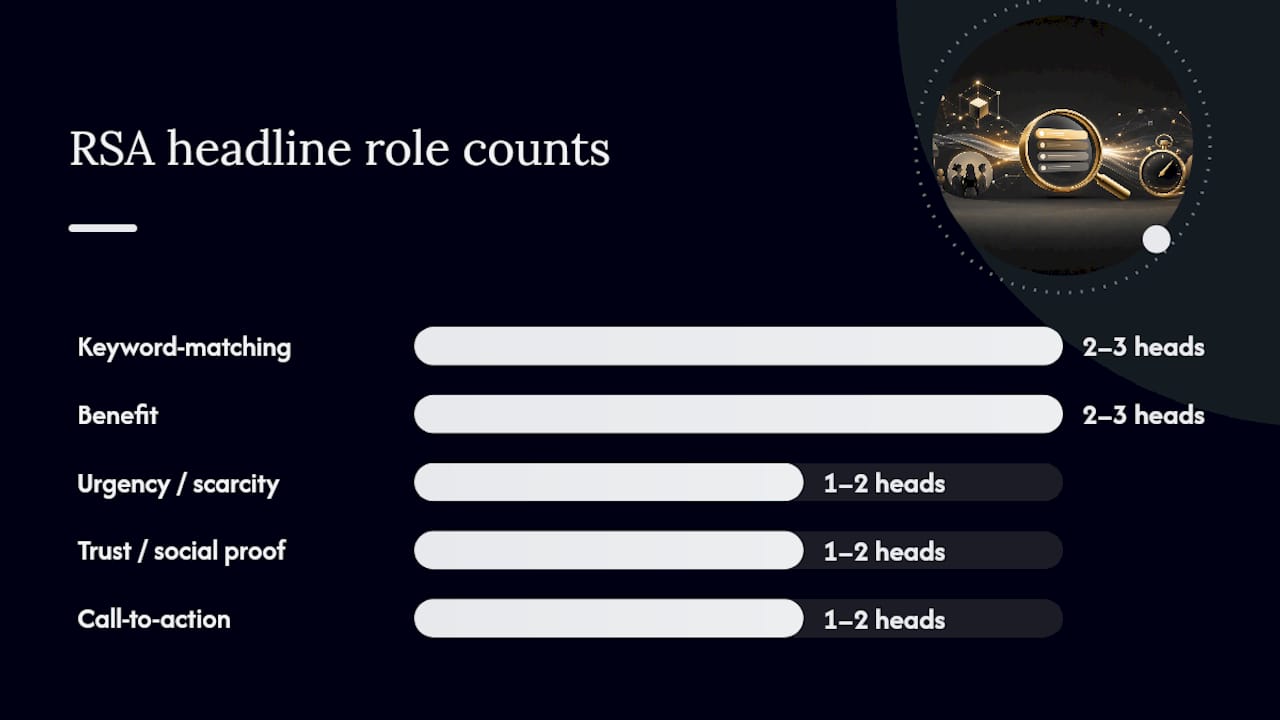
Think of your 15 headline slots as four or five different jobs, not fifteen attempts at the same job. Assign roles:
- Two or three headlines that mirror likely search terms directly.
- Two or three that state a concrete benefit (“Save 20% Today” beats “Great Savings”).
- One or two built around urgency or scarcity.
- One or two built around trust or proof (“Rated 4.9/5 by 2,000 Customers”).
- One or two dedicated to a clear call to action (“Get Your Free Quote”).
Vary sentence length and structure across these too. If every headline is a five-word imperative phrase, Google has less room to find a natural-sounding three-headline combination. Mix short punchy fragments with slightly longer benefit statements.
Pin sparingly, and only for genuine compliance or branding needs, like a legally required disclaimer or a headline containing your business name that must always appear first. When you do pin, pin two or three interchangeable variations to the same slot instead of one fixed line, so Google can still test within that position rather than locking it entirely.
Treat your RSA as a living document, not a one-time submission. Review performance every two weeks during an active campaign, retire anything Google’s reporting flags as underperforming, and write a fresh replacement headline in its place. This cadence matters more than getting the copy perfect on day one, because you will learn things from real query data that no amount of pre-launch brainstorming reveals.
Pro Tip: Write your call-to-action headlines in at least three different verbs (Get, Book, Try, Claim, Start) instead of reusing “Get” five times. Google treats near-identical phrasing as low variety even when the words technically differ.
For B2B and service businesses specifically, pair problem-aware headlines (“Struggling With Late Payments?”) with benefit-focused descriptions (“Get paid 2x faster with automated invoicing”) to cover both the searcher who just realized they have a problem and the one already comparing solutions.
Step-by-Step: Creating a Responsive Search Ad in Google Ads
Building your first RSA takes fifteen minutes if your headlines and descriptions are already written. Here’s the actual workflow inside the platform:
- Navigate to your campaign and ad group, then click the blue plus button and select “Responsive search ad.”
- Enter your final URL first. Google Ads will offer to auto-populate headline and description suggestions based on your landing page content, which is a fast starting point even if you rewrite most of them.
- Add at least 8 to 10 headlines, mixing keyword, benefit, urgency, and CTA angles as covered above, and add all 4 descriptions.
- Use the Ad Strength meter on the right panel as you type. It updates live and flags specific fixes, like “add more headlines” or “make your headlines more unique.”
- Pin only where necessary, and preview the ad using the “See ad strength and performance details” panel to check how different combinations actually read together before publishing.
- Confirm your final URL is unique to this RSA if you’re running multiple ads to different landing pages within the same ad group, since a shared URL across mismatched ads muddies your conversion tracking.
- Publish, then check back in 7 to 14 days. Look specifically at impressions per headline (via the Asset details view), early click-through rate by combination, and whether Ad Strength has shifted as real traffic data comes in.
Don’t touch the ad again in the first week beyond checking Ad Strength. Google’s system needs a real sample of impressions across combinations before its predictions mean anything, and early tinkering just resets that learning process.
Reading Ad Strength, Combination Reports, and Pairing With Smart Bidding
Ad Strength is not a vanity metric. Google’s own performance data shows that moving an ad from Poor to Excellent correlates with roughly 15% more clicks and conversions at the same spend level, which is why “Good” or “Excellent” should be treated as the minimum bar before you consider an RSA finished, not a nice-to-have.
Recommended benchmark: Google Ads best practices call for at least two RSAs per ad group, each rated Good or Excellent, because running a second strong RSA adds an average 6.6% more conversions and a third adds roughly 3.7% on top of that.
The combination report, found in the Ads and assets view, shows which specific headline and description pairings Google has actually served and how often. Cross-reference it with the asset performance ratings (Low, Good, Best) in the Asset details tab. Any asset sitting at “Low” after a couple weeks of real traffic is a candidate for replacement, not a candidate for patience.
Practical steps once you have data:
- Replace any headline rated “Low” with a new variation rather than deleting it outright and leaving a gap.
- If one description consistently pairs with your top headlines, consider writing a second description with a similar structure to give Google more strong options.
- Add a second RSA to the ad group once your first one is stable at Good or Excellent, rather than overloading a single ad with 15 headlines competing against each other.
Pairing RSAs with Smart Bidding and broad match keywords tends to compound results, since Google’s bidding algorithm and ad assembly system work off the same signal set, letting the system match the right ad combination to the right bid for each auction rather than you managing both manually. Prioritize conversion rate and cost per conversion over raw click-through rate when judging whether a change helped, since a combination that gets fewer clicks but more qualified conversions is the one worth keeping.
What a 15-Minute Weekly RSA Routine Actually Looks Like
Small businesses rarely have a dedicated person watching Ad Strength daily, and they don’t need one. A realistic routine is 15 minutes, once a week: open the Asset details tab, scan for anything rated Low, swap it for a new variation, and glance at the combination report to see if a new pattern has emerged.
A practical checklist for that weekly pass:
- Check Ad Strength on every active RSA; anything below Good gets flagged for a rewrite that week.
- Pull the combination report and note which headline pairs are showing up most.
- Write one new headline variation per Low-rated asset instead of batch-rewriting everything at once.
- Confirm final URLs still match current landing pages, especially after a website update.
- Log conversion rate and cost per conversion week over week, not just click-through rate.
This kind of steady, low-effort cadence tends to outperform sporadic overhauls, mostly because Google’s system rewards consistent data over disruptive resets.
Templates Beat Theory: The Editorial Take
Most RSA advice online reads like a specifications sheet: character limits, minimums, a paragraph on Ad Strength, done. That approach leaves marketers with the rules but no actual copy to type into the box, which is exactly where most small businesses stall out and publish three headlines because that’s the minimum required.
The research behind this piece points somewhere more useful: variety, measured by Google’s own Ad Strength tool, correlates with real performance gains, and the fastest way to get variety is to start from templates and adapt them, not stare at a blank field. A plumber adapting the local-services template above will beat a plumber who writes three generic headlines from scratch, every time, because the template forces role diversity (keyword, benefit, urgency, proof, CTA) that most first-drafts skip entirely.
Prioritize this first: get one RSA per ad group to Good or Excellent before you worry about a second one. A single strong ad beats two mediocre ones, and Google’s own combination reporting will tell you when you’re ready to add another.
— TONY
Get Your RSAs Built and Optimized Without the Guesswork
Writing fifteen headlines that hit different angles, monitoring combination reports, and cycling out weak assets every two weeks is exactly the kind of ongoing work that eats a business owner’s week without moving the needle on sales. Ibrand handles that entire cycle for you, from initial copywriting through the weekly Ad Strength checks most small businesses never get around to doing.
Ibrand’s ad services fit time-poor service businesses, local shops, and small e-commerce sellers who want their campaigns managed by people watching the data daily, not once a quarter. That includes an audit of your current ads, industry-specific copywriting using the same template logic covered above, full campaign setup, and ongoing optimization tied to conversion rate rather than vanity metrics. Pair that with proven online advertising strategies built for small business budgets, and your ad spend works harder without you learning the platform yourself.
Start with a digital advertising audit to get a plain-language breakdown of what your current ads are missing, then decide if a managed setup makes sense for your business.
Sources
- About responsive search ads — Google Ads Help
- Responsive search ads: a guide to writing ads that perform — Google (pdf)
FAQ
How Do I Create a Responsive Search Ad?
In Google Ads, go to your ad group, click the plus button, select “Responsive search ad,” enter your final URL, then add at least 8 to 10 headlines and all 4 descriptions before publishing.
How Many Responsive Search Ads Should Be in an Ad Group?
Google recommends at least two RSAs per ad group, each rated Good or Excellent for Ad Strength, since adding a second strong RSA adds an average 6.6% more conversions and a third adds roughly 3.7% more.
Can You Give Some Examples of Search Ads?
Yes. A local plumbing RSA might pair the headline “24/7 Emergency Plumbing” with “Licensed & Insured Techs” and a description like “Fast, reliable repairs from a team your neighbors trust,” while an e-commerce ad might pair “Free Shipping Over $50” with “New Arrivals Every Week.”
What Is the Difference Between Dynamic and Responsive Search Ads?
Responsive search ads let you write your own pool of headlines and descriptions that Google assembles automatically for each search, while dynamic search ads generate headlines directly from your website content and don’t require you to write headlines at all.
What Character Limits Apply to RSA Headlines and Descriptions?
Headlines are capped at 30 characters each, and descriptions are capped at 90 characters each, with a maximum of 15 headlines and 4 descriptions per ad.
Recent Comments