
Claim and perfect your Google Business Profile first, then knock out your NAP audit before touching anything else. After that, work through Apple Business Connect, Bing Places, Facebook, Yelp, and the BBB in the same sitting if you can. These listings feed the local pack, power map results, and verify to customers and search engines that your business is real and reachable.
TL;DR:
- Claim and verify your Google Business Profile first, as it most strongly influences your local rankings and appears in search results instantly.
- Focus on top-tier citation sites like Apple Business Connect, Bing Places, Facebook, and Yelp, which drive actual customer traffic and carry high domain authority.
- Maintain consistency in your NAP information across all listings, paying close attention to exact formatting, punctuation, and business name to avoid ranking penalties.
- Prioritize claiming multi-location or industry-specific directories after the top sites to strengthen niche authority and local relevance.
- Use citation audit tools or hire services if managing multiple locations or extensive mismatches; manual cleanup is time-consuming but manageable for single-location businesses.
Table of Contents
- What Are the Best Local Citation Sites to Claim First?
- How Should You Prioritize Your Citation Work?
- How Do You Claim, Verify, and Audit Your Citations?
- Should You Use Citation Tools or Hire a Service?
- Which Industry-Specific Directories Should You Add?
- What NAP Mistakes Hurt Your Local Rankings Most?
- Does Fixing Citations Actually Move Your Rankings?
- How Do You Fix Incorrect or Outdated Citation Data?
- Why Do Reviews Inside Citation Profiles Matter So Much?
- Agency View: How Ibrand Approaches Citation Audits
- How Ibrand Handles Citation Cleanup So You Don’t Have To
- Sources
- FAQ
What Are the Best Local Citation Sites to Claim First?
Not every directory deserves equal effort. A handful of local citation sites carry enough domain authority and search visibility to move your rankings; the rest are filler that takes time without moving the needle. BrightLocal’s Top 50 general citation sites list ranks these by domain authority and activity level, and that ranking is a smarter way to sequence your work than an alphabetical checklist.
Start with the tier that touches the most searches and map queries.
Google Business Profile sits at the top for a reason: it’s free, it feeds directly into Google Maps and the local pack, and it’s usually the first result a customer sees when they search your business name. Fill in every field: business category, service area or address, hours, phone number, website, photos, and a business description. Verification now typically runs through a video or postcard process, and most businesses get approved within a few days to two weeks.
Apple Business Connect is Apple’s answer to GBP, and it controls how your business shows up in Apple Maps, Siri results, and Apple’s search. It’s free and takes about 20 to 30 minutes once you have an Apple ID tied to your business. Verification is usually instant if your business address matches public records.
Bing Places feeds Microsoft’s search engine and, increasingly, AI-assisted search results inside Windows and Edge. It’s free, the setup mirrors GBP almost field for field, and you can often import your Google listing to speed things up. Budget 15 minutes.
Facebook functions as a citation and a discovery channel at once. Claim your Page, fill in category, address, phone, hours, and website, and make sure your “About” section matches your other listings word for word. It’s free, takes about 30 minutes to set up properly, and doubles as a review magnet.
Yelp still drives real foot traffic, particularly for restaurants, home services, and retail. The free tier covers the basics; Yelp’s paid ads are optional and not required for a solid citation. Claiming takes about 20 minutes, but verification can take a few days by phone or postcard.
BBB (Better Business Bureau) functions less as a search-ranking lever and more as a trust signal consumers actively check before hiring. Some businesses get a free basic listing; full accreditation carries an annual fee that varies by region and business size. Budget an hour for setup if you’re pursuing accreditation.
OpenStreetMap is a free, editable mapping database that some navigation apps and services pull from directly. It’s overlooked by most owners, which is exactly why it’s worth the 15 minutes it takes to add or claim your pin.
Foursquare still powers location data behind several apps and services you’d never guess trace back to it. It’s free, takes about 15 minutes, and rarely requires phone verification.
LinkedIn matters more for B2B businesses and service providers than retail, but a completed Company Page with matching address and phone still counts as a citation. Free, roughly 20 minutes.
Below that top tier sit three long-standing general directories worth claiming the same week: Yellow Pages, Manta, and Chamberofcommerce. None will single-handedly move your rankings, but each is free to claim at a basic level and adds another consistent data point search engines can cross-reference.
| Site | Cost | Critical fields | Verification method | Time to complete |
|---|---|---|---|---|
| Google Business Profile | Free | Category, address/service area, hours, phone, photos | Video or postcard | 20 to 30 minutes |
| Apple Business Connect | Free | Address, category, hours, photos | Apple ID + public record match | 20 to 30 minutes |
| Bing Places | Free | Same as GBP, importable | Email or phone | 15 minutes |
| Free | Category, address, hours, About section | Instant or Page confirmation | 30 minutes | |
| Yelp | Free (paid ads optional) | Category, hours, address, photos | Phone or postcard | 20 minutes + wait |
| BBB | Free tier / paid accreditation | Business name, address, category | Manual review | 60 minutes |
| OpenStreetMap | Free | Location pin, category, hours | Community edit review | 15 minutes |
| Foursquare | Free | Address, category, hours | Rarely required | 15 minutes |
| Free | Company details, address, industry | Email domain match | 20 minutes | |
| Yellow Pages | Free tier / paid upgrades | Business name, category, address | Phone confirmation | 20 minutes |
| Manta | Free | Business description, category, address | Email confirmation | 20 minutes |
| ChamberofCommerce.com | Free / paid membership tiers | Business name, address, category | Manual review | 30 minutes |
Pro Tip: Import your Google Business Profile data into Bing Places using its GBP import tool. It cuts your setup time roughly in half and eliminates the chance of a typo creating a NAP mismatch between the two.
How Should You Prioritize Your Citation Work?
The mistake most owners make is treating every citation as equally urgent. It isn’t. A structured priority order saves hours and gets you ranking improvements faster.
Before you claim a single listing, decide on one canonical NAP (name, address, phone) format and write it down somewhere permanent, like a shared document or spreadsheet header. BrightLocal’s guidance on NAP consistency is blunt about this: inconsistent formatting between “Suite 200” and “Ste. 200,” or “(555) 123-4567” versus “555.123.4567,” confuses the algorithms that cross-check your business identity across the web. Pick one format. Use it everywhere, forever.
Once you have that canonical record, work through this order:
- Google Business Profile — the single biggest lever in local search, and the one most likely to show up in the local pack within days of full completion.
- Top review and discovery sites — Apple Business Connect, Bing Places, Facebook, and Yelp. These see the most consumer traffic and carry real domain authority.
- Industry-specific directories — the associations, licensing boards, or vertical directories your competitors already appear on.
- General-purpose directories — Yellow Pages, Manta, ChamberofCommerce.com, and similar sites that add consistency signal without much individual ranking weight.
BrightLocal’s own research treats Google Business Profile as the canonical source of truth for a reason: most audits find it’s the listing that moves rankings fastest, and every other citation should mirror what it says, not the other way around.
Two situations change this order slightly. Service-area businesses without a public storefront should hide their address on GBP and rely more heavily on service-area settings, then lean harder into review generation on Yelp and Facebook since map-pack visibility works differently for them. Businesses with multiple locations or franchise structures need a separate, verified listing per location. Never let one physical location’s listing cover multiple addresses. That single shortcut creates NAP conflicts that can take months to unwind.
How Do You Claim, Verify, and Audit Your Citations?
A citation audit isn’t complicated, but it does require a system. Here’s the workflow that keeps a solo owner or a hired virtual assistant from losing track of what’s done and what’s pending.
Step 1: Build your inventory. Search “[your business name] [your city]” and note every directory that already has a listing, even an unclaimed one. Run a site: search combined with your business name to catch stray directory pages. Check where your closest competitors are listed, since directories that accept them will almost always accept you. A free audit tool from a service like BrightLocal or Backlynk will also scan dozens of directories at once and flag existing listings automatically.
Step 2: Claim and verify the top tier. Start with Google Business Profile: verification now usually runs through a short video walkthrough of your location or a mailed postcard code, and either method typically resolves within one to two weeks. Apple Business Connect verifies almost instantly when your business address matches public records. Bing Places accepts a GBP import, which skips most manual data entry.
Step 3: Fix mismatches as you find them. Every time you find an existing but outdated listing, correct it to match your canonical NAP exactly, down to abbreviations and punctuation.
Step 4: Document everything. Build a simple spreadsheet with columns for platform name, login email, claim date, verification status, last-checked date, and notes on any mismatch found. This single sheet becomes your source of truth if you ever hand the work to a contractor or a marketing agency.
Step 5: Set a monitoring cadence. Recheck top-tier listings monthly and full directory sweeps quarterly. Listings drift. Old phone numbers get scraped and republished on random directories years later, so a periodic sweep matters even after your initial cleanup is done.
A few friction points come up constantly during this process:
- Postcard verification for GBP can take a varying amount of time to arrive by mail, so start it early.
- Directories that use scraped data sometimes list a decade-old address; you can’t always find who owns the listing to correct it directly.
- Some platforms require a business email domain rather than a personal Gmail address for verification.
- Multi-location businesses often need separate verification codes mailed to each address, which stacks timelines.
Should You Use Citation Tools or Hire a Service?
The DIY-versus-paid decision usually comes down to how many locations you manage and how much your time is worth per hour. A single-location business with a couple of hours to spare can realistically handle its own citation cleanup. Multi-location businesses, franchises, or owners with zero spare time are better served by a paid service.
Several tools handle different pieces of the job:
- BrightLocal runs citation audits and tracks NAP consistency across dozens of directories, with monthly reporting built for agencies and multi-location businesses.
- Whitespark specializes in citation building and cleanup, including manual outreach to directories that won’t self-correct.
- Yext syncs listing data across a large network of directories and apps from a single dashboard, which suits businesses that update hours or services often.
- Moz Local focuses on distributing and monitoring NAP data across the major data aggregators that feed dozens of smaller directories.
- Backlynk offers audit and cleanup services aimed at agencies and businesses that want the manual fix-it work done for them rather than flagged for self-service.
Manual cleanup costs nothing but your time, roughly two to six hours for a single location depending on how many stray listings turn up. Paid services and software subscriptions run anywhere from a modest monthly fee for basic monitoring tools up to several hundred dollars for a full-service cleanup and ongoing sync, with turnaround typically running two to six weeks depending on how many directories need manual correction.
Pro Tip: If you only have budget for one paid tool, choose a monitoring subscription over a one-time cleanup. Citations decay over time as directories get scraped and republished, so ongoing monitoring protects the work you already did.
Which Industry-Specific Directories Should You Add?
General directories build a foundation, but industry-specific ones often carry more ranking weight per listing because they’re narrower and harder to spam. A law firm benefits more from a listing on a legal directory like Avvo or FindLaw than from a fifth general business directory nobody checks.
The pattern holds across verticals. Healthcare providers gain from Healthgrades and Vitals. Home service businesses like plumbers and electricians benefit from Angi and HomeAdvisor. Hospitality businesses, restaurants, and venues see real traffic from TripAdvisor and OpenTable. Legal, medical, and licensed trades also often have state-specific licensing board directories that double as citations and carry real authority because they’re government-linked.
Finding the right ones for your vertical doesn’t require guesswork. Search for your top two or three competitors by name and see where they’re listed beyond the obvious general sites. If three competitors all show up on the same niche directory, that’s a strong signal it’s worth your time.
A handful of well-chosen industry citations beats twenty scattered low-quality directory listings. Neil Patel’s research on citation sources backs this up: a focused set of relevant, active directories carries more ranking signal than volume for its own sake, and chasing every directory that will take your listing wastes hours you could spend on the sites that actually move your visibility.
What NAP Mistakes Hurt Your Local Rankings Most?
Small formatting inconsistencies do more damage than owners expect. A suite number written as “#200” on one directory and “Suite 200” on another, a phone number formatted three different ways, or an old legal business name lingering on a directory you forgot existed. Each one chips away at the confidence search engines place in your business data.
BrightEdge’s guidance on NAP recommends displaying your name, address, and phone number as visible text on your website, not just inside an image or a contact form, and backing it up with LocalBusiness schema markup so search engines can parse it programmatically. You can check whether your schema is set up correctly using Google’s Rich Results Test tool, which flags missing or malformed LocalBusiness fields in seconds.
Quick verification checklist for a VA or a spare hour of your own time:
- Confirm your legal business name matches exactly across your top ten listings, including punctuation like commas or “LLC.”
- Check that suite, unit, or floor numbers use the same abbreviation everywhere.
- Verify your phone number format matches character for character, including area code parentheses or dashes.
- Search your old business name or previous address to catch stale listings still floating around from a move or rebrand.
Does Fixing Citations Actually Move Your Rankings?
Local citations function as votes of confidence search engines use to confirm a business is real, active, and located where it claims to be. When Google Business Profile, Bing Places, and a dozen other directories all agree on the same name, address, and phone number, that consistency reduces the ambiguity search algorithms have to resolve when deciding which business to surface for a “near me” query.

The effect compounds. A business with accurate, consistent listings across ten authoritative directories gives search engines ten confirmations instead of one. A business with mismatched or missing listings creates uncertainty, and uncertainty tends to push a listing further down the local pack in favor of a competitor with cleaner data.
Citations alone won’t outrank a competitor with dramatically stronger reviews, more relevant content, or better site optimization. They’re a foundational layer, not a silver bullet. Think of citation cleanup as removing friction rather than adding rocket fuel: it clears obstacles that are actively working against you, which frees up your other SEO efforts, like content and on-page optimization, to actually convert into ranking improvements instead of fighting inconsistent data in the background.
How Do You Fix Incorrect or Outdated Citation Data?
Wrong information sitting on a directory you don’t remember claiming is more common than most owners realize, especially after a move, a rebrand, or a change in phone provider. The fix depends on whether you can access the listing directly.
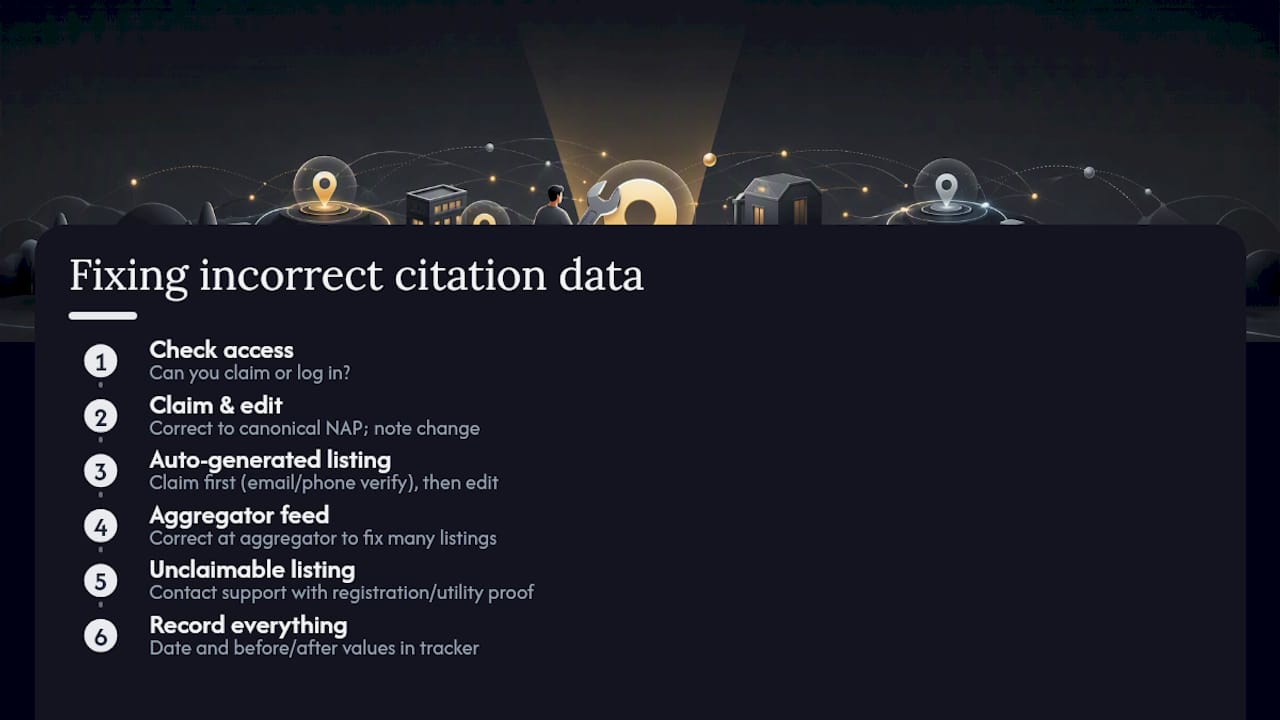
If you can log in or claim the listing, correct it immediately to match your canonical NAP record and note the change in your tracking spreadsheet. If the listing was auto-generated by a data aggregator scraping public records, you’ll need to claim it first, which usually just requires an email or phone verification step, then edit it.
Some directories pull from third-party data providers rather than letting you edit directly. In those cases, correcting your information at the aggregator level (the data source feeding multiple smaller directories at once) fixes several downstream listings simultaneously instead of chasing each one individually. This is exactly the kind of repetitive, detail-heavy work that paid cleanup services specialize in, since they already know which aggregators feed which directories.
For listings you genuinely can’t claim or edit, a request through the directory’s support contact, citing your business’s official registration or utility bill as proof, usually resolves it within a few weeks. Document every fix with a date and the before/after values in your tracking sheet. Six months from now, when you’re deciding whether an old error crept back in, that record saves you from re-diagnosing a problem you already solved.
Why Do Reviews Inside Citation Profiles Matter So Much?
Reviews sitting inside your Google Business Profile, Yelp, and Facebook listings do double duty: they influence whether a customer clicks your listing, and they factor into how search engines assess your business’s relevance and trustworthiness for local queries. A listing with accurate NAP data but zero reviews reads as less credible than one with the same data and thirty recent reviews.
Volume matters, but recency and response rate matter just as much. A business with steady, recent reviews signals ongoing activity; a business with fifty reviews from three years ago and nothing since can look stalled, even if it’s thriving.
Encouraging reviews doesn’t require gimmicks. Ask satisfied customers directly, in person or through a simple follow-up text or email, right after a positive interaction. A direct link to your Google Business Profile review page, sent at the moment satisfaction is highest, converts far better than a generic request buried in a monthly newsletter. Responding to every review, positive or negative, professionally and promptly, also signals to both customers and search engines that the business is actively managed. A listing that never responds to a complaint looks abandoned, even if the underlying business is fine.
Agency View: How Ibrand Approaches Citation Audits
Our workflow follows the same logic outlined above, just executed at scale across many client accounts at once: audit first, establish one canonical NAP record, claim and verify the top-tier sites, then move into ongoing monitoring rather than a one-time fix. The order rarely changes, even for clients in wildly different industries, because Google Business Profile and the top general directories carry the most weight regardless of vertical.
[Author biography: TONY, case studies, and client testimonials to be added]
Whether an owner should DIY this or hand it off usually comes down to three factors: how many locations need separate listings, how much the owner’s own time is worth per hour, and how many existing mismatches the initial audit turns up. A single clean location with no history of address changes is a weekend project. A five-location business with three name changes over the past decade is a different animal entirely, and that’s where a managed cleanup earns back its cost quickly.
— TONY
How Ibrand Handles Citation Cleanup So You Don’t Have To
This service is the alternative to spending your weekends hunting down stray directory listings one by one. Instead of you manually checking fifty sites for mismatched suite numbers, a team runs the audit, builds your canonical NAP record, claims and verifies your priority listings, and keeps monitoring them so old errors don’t quietly creep back in six months later.
A typical engagement starts with a full audit of your existing footprint across general and industry directories, followed by cleanup of any mismatches we find, then ongoing monitoring with regular reporting so you can see exactly what changed and when. You get a clear picture of your listing health without spending your own hours doing the digging.
If you’d rather have your local search presence handled than manage it yourself between everything else running your business, take a look at Ibrand’s search optimization services and request a custom plan built around your specific locations and industry.
Sources
The recommendations above draw on primary directory sources and established local SEO research rather than guesswork.
FAQ
What Are Some Free Local Citation Sites?
Google Business Profile, Apple Business Connect, Bing Places, Facebook, OpenStreetMap, and Foursquare are all free to claim, and each one accepts full listings without requiring a paid tier.
What Are Some Good Online Citation Sites for a US Business?
Beyond the free top tier, Yelp, BBB, Yellow Pages, Manta, and ChamberofCommerce.com round out a solid general citation list, with industry-specific directories added based on your vertical.
What Is a Good Local Citation List for the USA?
A strong starting list includes Google Business Profile, Apple Business Connect, Bing Places, Facebook, Yelp, BBB, OpenStreetMap, Foursquare, LinkedIn, Yellow Pages, Manta, and ChamberofCommerce.com, prioritized in that order for maximum impact.
What Is the Best Free Citation Audit Tool?
Free audit tools from providers like BrightLocal scan dozens of directories at once to flag existing and mismatched listings, which saves hours compared to manually searching each site one by one.
How Long Does a Full Citation Cleanup Take?
A single-location business can typically finish a full audit and top-tier cleanup in two to six hours; multi-location businesses or ones with years of mismatched data often need a paid service and two to six weeks for full resolution.
Recent Comments