
For many North American small business owners, watching customers visit your website without finalizing a purchase is a familiar frustration. Building online visibility and strengthening customer loyalty often feel out of reach when every advertising dollar counts. Remarketing offers a practical way to reconnect with those potential buyers using personalized ads targeted by user behavior, delivering cost-effective solutions that can increase sales and make your marketing efforts more efficient.
Table of Contents
- Remarketing Basics For Small Businesses
- Popular Remarketing Types And How They Differ
- How Remarketing Campaigns Work
- Common Mistakes And Success Factors
- Compliance, Privacy, And Cost Concerns
Key Takeaways
| Point | Details |
|---|---|
| Remarketing Enhances Engagement | Utilizing remarketing allows small businesses to re-engage potential customers who showed interest but did not convert. |
| Diverse Remarketing Approaches | Small businesses should consider various remarketing techniques like Standard, Dynamic, and Email Remarketing to maximize their advertising efforts. |
| Audience Segmentation is Critical | Proper audience segmentation improves targeting effectiveness, significantly boosting conversion rates and campaign success. |
| Compliance is Essential | Adhering to privacy regulations while executing remarketing campaigns builds customer trust and protects business integrity. |
Remarketing Basics for Small Businesses
Remarketing represents a strategic digital advertising technique that enables small businesses to re-engage potential customers who previously interacted with their website but did not complete a purchase. By targeting audiences based on digital behavior, businesses can create personalized advertising experiences that dramatically improve conversion rates.
Small businesses can leverage several powerful remarketing approaches:
- Standard Remarketing: Display ads to previous website visitors across various online platforms
- Dynamic Remarketing: Show specific products users previously viewed
- Video Remarketing: Target audiences who engaged with video content
- Email Remarketing: Send targeted follow-up communications to potential customers
The strategic advantages of remarketing for small businesses are significant. Digital marketing techniques like remarketing help companies maintain brand presence, reconnect with potential customers, and guide them back into the sales funnel. This approach is particularly effective because it focuses advertising efforts on audiences who have already demonstrated interest.

Successful remarketing requires careful audience segmentation and strategic ad placement. Small business owners should track user interactions, create compelling ad content, and design clear conversion pathways that make returning to your website and completing a purchase as seamless as possible.
Pro tip: Start with a small remarketing budget and continuously test different ad creatives and audience segments to optimize your campaign performance.
Popular Remarketing Types and How They Differ
Remarketing offers small businesses multiple strategic approaches to reconnect with potential customers across different digital channels. Remarketing strategies encompass several distinct types, each targeting audiences through unique methods and platforms.
The primary remarketing types include:
- Search Remarketing: Displaying targeted ads to users who previously searched for related keywords
- Display Remarketing: Showing visual ads across websites and platforms users frequently visit
- Social Media Remarketing: Targeting users with ads on social platforms based on previous website interactions
- Email Remarketing: Sending personalized follow-up communications to potential customers
- Video Remarketing: Presenting ads to users who have engaged with video content
Remarketing differs from traditional retargeting by utilizing multiple channels and more comprehensive audience engagement strategies. While retargeting typically focuses on pay-per-click advertising platforms, remarketing adopts a broader approach that integrates various digital touchpoints.
Small business owners should carefully select remarketing types that align with their specific audience behaviors and marketing objectives. Understanding the nuanced differences between these approaches enables more precise targeting, potentially increasing conversion rates and maximizing advertising investments.
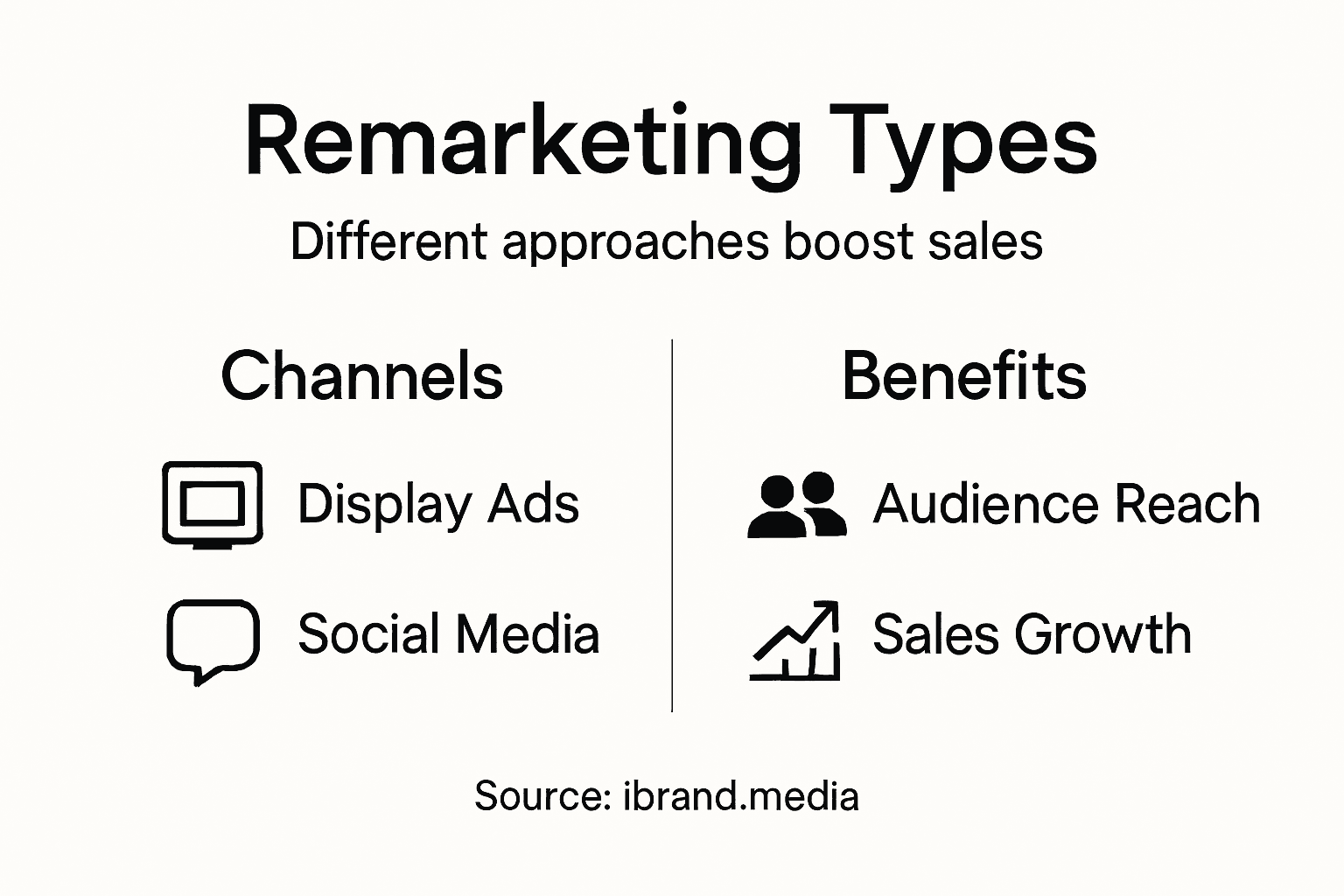
Here is a summary comparing major remarketing types by their primary channel and typical business benefits:
| Remarketing Type | Main Channel Used | Typical Business Benefit |
|---|---|---|
| Search Remarketing | Search Engines | Captures high-intent audiences |
| Display Remarketing | Visual Ad Networks | Sustains branded visual presence |
| Social Media Remarketing | Social Platforms | Encourages engagement and sharing |
| Email Remarketing | Drives targeted, direct follow-ups | |
| Video Remarketing | Video Platforms | Reinforces messages with visuals |
Pro tip: Analyze your website analytics to identify which remarketing type generates the most engagement for your specific business model and customer demographic.
How Remarketing Campaigns Work
Remarketing campaigns represent a sophisticated digital strategy that allows businesses to reconnect with potential customers who have previously interacted with their website. Remarketing campaigns begin by tracking website visitors through advanced technological methods like cookies and tracking pixels, creating a comprehensive digital footprint of user behavior.
The typical remarketing campaign process involves several critical stages:
- Tracking: Installing tracking pixels on website pages to identify and tag potential customers
- Segmentation: Categorizing website visitors based on specific behaviors and interactions
- Targeting: Creating personalized ad content for each identified audience segment
- Placement: Displaying targeted ads across multiple digital platforms
- Optimization: Continuously analyzing campaign performance and adjusting strategies
Successful remarketing requires precise audience understanding and strategic messaging. By analyzing user interactions, businesses can create highly personalized ad experiences that speak directly to individual customer interests and previous engagement patterns. This approach transforms generic advertising into a targeted, efficient marketing tool that dramatically improves conversion potential.
Technical implementation demands careful planning and continuous monitoring. Small businesses must invest time in understanding their audience’s digital journey, creating compelling ad content, and selecting appropriate platforms that maximize their remarketing investments.
Pro tip: Implement conversion tracking alongside your remarketing efforts to precisely measure the return on investment for each audience segment.
Common Mistakes and Success Factors
Remarketing strategies require precision and careful planning to effectively convert potential customers. Common remarketing mistakes can significantly undermine campaign performance, with many small businesses inadvertently reducing their marketing effectiveness through poor targeting and messaging approaches.
Key mistakes to avoid include:
- Generic Messaging: Using identical ad content for all audience segments
- Poor Segmentation: Failing to categorize website visitors based on specific behaviors
- Lack of Personalization: Creating ads that do not align with individual user interests
- Inappropriate Targeting: Showing ads to users at the wrong stage of their buying journey
- Frequency Mismanagement: Overwhelming users with too many repetitive advertisements
Successful remarketing demands strategic implementation and continuous refinement. By respecting user privacy and maintaining relevant ad placements, businesses can create more effective remarketing campaigns that genuinely engage potential customers without feeling intrusive.
The most successful remarketing efforts focus on understanding customer behavior, creating dynamic and personalized ad experiences, and using data-driven insights to continuously optimize targeting strategies. Small businesses should invest time in analytics, conduct regular A/B testing, and remain flexible in their approach to maximize campaign performance.
Pro tip: Create detailed user personas and map out specific ad content for each stage of the customer journey to improve remarketing precision and engagement.
Compliance, Privacy, and Cost Concerns
Remarketing strategies must navigate complex legal and ethical landscapes while maintaining cost-effectiveness. Compliance with privacy regulations requires careful data handling, ensuring small businesses protect user information and maintain transparency in their digital marketing efforts.
Key compliance and privacy considerations include:
- Legal Framework: Understanding regulations like GDPR and CCPA
- Consent Management: Obtaining explicit user permission for data tracking
- Transparent Communication: Clearly explaining data collection practices
- Data Security: Implementing robust protection mechanisms
- User Control: Providing options to opt-out of tracking
Cost management represents another critical aspect of remarketing strategy. Businesses must balance advertising spend with potential returns, avoiding excessive targeting that could alienate potential customers. International privacy regulations demand ongoing monitoring and investment in privacy-enhancing technologies, which can impact overall marketing budgets.
Successful remarketing requires a strategic approach that respects user privacy while delivering targeted advertising. Small businesses should invest in understanding legal requirements, implementing robust data protection measures, and creating transparent communication channels that build customer trust.
Below is a quick reference on privacy compliance steps and their impact on marketing performance:
| Compliance Step | Purpose | Impact on Remarketing |
|---|---|---|
| Consent Management | Obtain explicit user approval | Builds trust, reduces data risk |
| Transparent Policies | Clearly explain data practices | Enhances user confidence |
| Data Security | Protect user information | Reduces breach and penalty risk |
| Opt-Out Controls | Let users control tracking | Improves reputation and compliance |
Pro tip: Consult with a digital marketing compliance expert to develop a comprehensive privacy policy that aligns with current legal standards and protects both your business and your customers.
Boost Your Sales with Expert Remarketing Solutions
Struggling to turn website visitors into paying customers is a common challenge for many small businesses. This article highlights how remarketing can directly address this by targeting audiences who have already shown interest, creating personalized ad experiences, and maximizing your advertising budget. If you are looking to overcome issues like generic messaging, poor segmentation, or ineffective targeting, a tailored remarketing strategy can make all the difference.
Take control of your online growth today with ibrand.media, a trusted digital marketing agency specializing in remarketing and comprehensive online promotional services designed for small and medium-sized businesses. Explore actionable insights and proven strategies in our Uncategorized | Ibrandmedia blog and discover how our affordable, customized plans can bring quick, measurable results. Don’t wait to reconnect with your audience and increase conversion rates. Visit ibrand.media now and start transforming your website traffic into loyal customers.
Frequently Asked Questions
What is remarketing?
Remarketing is a digital advertising strategy that allows businesses to re-engage potential customers who visited their website but did not complete a purchase.
How does remarketing differ from retargeting?
Remarketing utilizes a broader range of digital channels and audience engagement strategies, while retargeting often focuses solely on pay-per-click advertising platforms.
What are the primary types of remarketing?
The main types of remarketing include search remarketing, display remarketing, social media remarketing, email remarketing, and video remarketing, each targeting users through different platforms and methods.
How can small businesses optimize their remarketing campaigns?
Small businesses can optimize their campaigns by analyzing website analytics, carefully segmenting audiences, testing different ad creatives, and continuously adjusting their strategies based on performance data.
Recommended
- Why Dentists Need Remarketing for Patient Growth | Ibrandmedia
- Digital Marketing for Retailers: Proven Strategies for 2025 | Ibrandmedia
- Digital Marketing for Retailers: Proven Strategies for 2025 | Ibrandmedia
- 7 Essential Web Design Tips for Retailers to Boost Sales | Ibrandmedia
- 2024 eCommerce Strategies: 13 Handy Tips for Retailers
Recent Comments