
Over 60% of American small businesses struggle to connect marketing efforts directly to their main goals. Without a clear link between strategy and business priorities, advertising budgets get wasted and growth stalls. Aligning your marketing plan with what truly matters ensures every dollar works harder for your success. Discover practical steps to set priorities, select top performing channels, and measure what really moves the needle for your American business.
Table of Contents
- Step 1: Define Marketing Goals Aligned With Business Priorities
- Step 2: Assess Current Performance And Identify Key Channels
- Step 3: Estimate Costs And Allocate Budget By Channel
- Step 4: Set Tracking Systems To Measure Campaign ROI
- Step 5: Adjust Allocations Based On Performance Insights
Quick Summary
| Key Point | Explanation |
|---|---|
| 1. Set SMART marketing goals | Use Specific, Measurable, Achievable, Realistic, and Time-based goals aligned with business priorities to guide your marketing efforts. |
| 2. Assess marketing channel performance | Regularly analyze key metrics across channels to identify the most effective platforms for reaching target customers. |
| 3. Allocate budget based on performance | Create a detailed budget that prioritizes channels with proven effectiveness, ensuring financial resources are optimally used. |
| 4. Implement tracking systems | Establish robust analytics tools to measure campaign performance and ROI, focusing on key performance indicators. |
| 5. Adjust budgets based on insights | Regularly review and reallocate your marketing budget according to performance data to enhance overall effectiveness. |
Step 1: Define marketing goals aligned with business priorities
Defining strategic marketing goals requires a clear understanding of your small business’s core objectives and potential growth pathways. By setting precise marketing objectives that connect directly to your broader business vision, you create a roadmap for targeted and effective promotional efforts.
The University of Oregon’s Small Business Management guide recommends using the SMART framework when establishing marketing goals. This means creating objectives that are Specific, Measurable, Achievable, Realistic, and Time-based. Start by analyzing your current business performance and identifying key areas where marketing can drive meaningful growth. Are you looking to increase brand awareness? Boost sales in a particular product line? Expand into new customer segments? Each goal should tie directly to a tangible business outcome.
To craft effective goals, break down your broader business strategy into clear marketing milestones. For example, instead of a vague goal like “grow our business,” develop a specific target such as “increase online sales by 25% in the first two quarters of 2025 through targeted social media advertising and email marketing campaigns.” This approach provides clear direction, allows for precise tracking, and ensures your marketing efforts remain focused and accountable.
Warning: Avoid setting unrealistic goals that could discourage your team. Marketing objectives should challenge your business while remaining within the realm of achievable outcomes.
Step 2: Assess current performance and identify key channels
Identifying the most effective marketing channels requires a strategic and analytical approach that evaluates your existing promotional efforts and potential growth opportunities. Selecting the right marketing channels can dramatically impact your business’s ability to reach and engage target customers.
The Seneca Business Journal recommends conducting a thorough assessment of your current marketing performance to determine which channels generate the best results. Start by analyzing key metrics across your existing platforms such as website traffic, social media engagement, email open rates, and conversion rates. Break down your data by channel to understand where your marketing efforts are producing the most significant returns. Are your Facebook ads driving more leads than your Instagram campaigns? Is your email marketing generating more sales than your Google AdWords strategy?
To optimize your marketing channel selection, create a comprehensive performance dashboard that tracks important indicators like customer acquisition cost, return on investment, and engagement rates. Look for patterns that reveal which channels resonate most with your target audience. Some small businesses might find that local Facebook groups generate more meaningful connections than broad digital advertising campaigns, while others might discover that targeted LinkedIn ads work best for their specific market segment.
Warning: Avoid spreading your marketing budget too thin across multiple channels. Concentrate your resources on the platforms that demonstrate consistent and measurable performance.
Step 3: Estimate costs and allocate budget by channel
Allocating your marketing budget requires a strategic approach that balances potential returns with financial constraints. Developing a precise digital marketing plan helps small businesses optimize their spending across different promotional channels.

The Seneca Business Journal emphasizes the importance of budgeting for each marketing channel based on performance data and strategic priorities. Start by creating a detailed spreadsheet that breaks down potential costs for each channel you identified in your previous performance assessment. Consider the average costs per lead or customer acquisition for platforms like Google Ads, Facebook advertising, email marketing services, and content creation. Assign percentage allocations based on historical performance data and projected growth potential. For instance, if Facebook ads have consistently delivered a lower cost per lead compared to other channels, you might allocate a larger portion of your budget there.
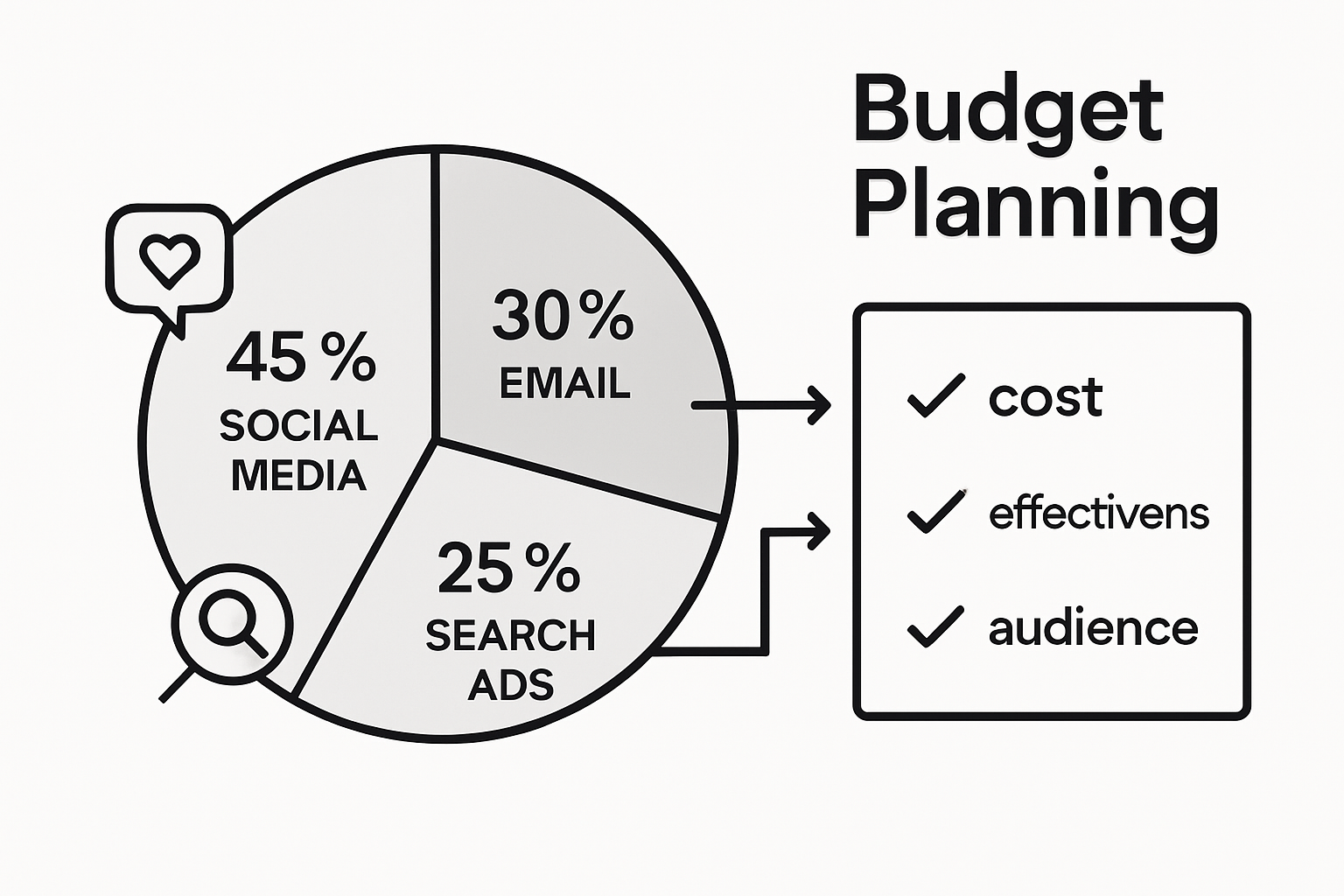
When estimating costs, factor in both direct advertising expenses and indirect costs such as content creation, graphic design, copywriting, and marketing tools. A typical small business might allocate their budget across channels like this: 30% social media advertising, 25% search engine marketing, 20% email marketing, 15% content creation, and 10% for experimental or emerging channels. Remember that these percentages are flexible and should be tailored to your specific business model and target audience.
Warning: Always maintain a contingency fund of 10 to 15% of your total marketing budget to accommodate unexpected opportunities or shifts in marketing performance.
Step 4: Set tracking systems to measure campaign ROI
Measuring the return on investment for your marketing campaigns requires a systematic approach that provides clear insights into your promotional efforts. Tracking digital marketing performance helps small businesses make data driven decisions that optimize their marketing strategy.
The Seneca Business Journal suggests establishing robust analytics tools to track campaign performance and assess ROI. Begin by implementing comprehensive tracking systems across all your marketing channels. This means setting up Google Analytics for website performance, Facebook Pixel for social media advertising insights, email marketing platform analytics for campaign effectiveness, and conversion tracking for paid advertising platforms. Create custom dashboards that aggregate data from multiple sources, allowing you to see a holistic view of your marketing performance. Key metrics to monitor include customer acquisition cost, conversion rates, click through rates, engagement percentages, and total revenue generated from each marketing initiative.
To effectively measure ROI, establish clear benchmarks and attribution models that accurately reflect how different marketing touchpoints contribute to your sales process. Consider using unique tracking links, promo codes, and dedicated landing pages for each marketing campaign to precisely track their individual performance. A sophisticated tracking approach might involve multi touch attribution models that recognize the complex journey customers take from initial awareness to final purchase.
Warning: Avoid getting overwhelmed by data. Focus on 3 to 5 core metrics that directly impact your business growth and make decisions based on consistent trends rather than isolated data points.
Step 5: Adjust allocations based on performance insights
Marketing budget optimization is an ongoing process that requires regular analysis and strategic reallocation of resources. Developing a comprehensive marketing strategy helps small businesses remain agile and responsive to changing performance metrics.
The Seneca Business Journal recommends using performance data to reallocate marketing budgets, focusing resources on high-performing channels to optimize overall strategy. Begin by conducting a quarterly review of your marketing performance data. Look for channels that consistently deliver lower customer acquisition costs, higher conversion rates, or stronger engagement metrics. If your Facebook advertising generates significantly more qualified leads than your Google AdWords campaigns, consider shifting budget percentages to favor the more effective platform. This might mean moving from a 25% allocation to 35% for social media advertising while reducing search engine marketing spending.
When reallocating your marketing budget, consider both short term performance and long term potential. Some channels might show slower initial results but demonstrate stronger growth potential. For instance, content marketing or search engine optimization might require more time to generate returns but can provide more sustainable long term benefits. Create a dynamic budget model that allows for incremental shifts based on rolling performance data. Track metrics like return on ad spend, customer lifetime value, and conversion rates to make informed decisions about where to invest your marketing dollars.
Warning: Avoid making drastic budget changes based on short term fluctuations. Implement changes gradually and give each channel sufficient time to demonstrate its true potential.
Maximize Your Marketing Budget with Expert Planning and Support
Struggling to define clear marketing goals or allocate your budget effectively Can you track the true ROI of each campaign Are you ready to shift resources for the best results Without precise tools and expertise these challenges can stall your business growth. This article highlights the importance of setting SMART objectives, analyzing channel performance, and continuously optimizing your spend—key steps to unlock measurable success.
Take control of your small business marketing budget today with tailored solutions from Uncategorized | Ibrandmedia.
Partner with ibrand.media to craft a marketing strategy focused on quick, affordable results. From SEO optimization to social media management and real-time performance tracking our team empowers you to make data-driven decisions that maximize every dollar. Start accelerating growth with a customized plan designed around your unique goals. Visit our website now and request your personalized consultation to turn budgeting insights into profits.
Frequently Asked Questions
How can I define marketing goals that align with my small business priorities?
Start by evaluating your business’s core objectives and potential growth areas. Use the SMART framework to set Specific, Measurable, Achievable, Realistic, and Time-based goals, ensuring each one links directly to your business outcomes.
What are the best practices for assessing current marketing performance?
Conduct a thorough review of your existing marketing channels by analyzing metrics like website traffic, social media engagement, and conversion rates. Create a comprehensive dashboard to track which channels deliver the best results, enabling you to make informed decisions moving forward.
How do I estimate costs and allocate a marketing budget effectively?
Begin by listing all potential marketing channels and estimating costs for each based on your performance data. Allocate percentages of your total budget according to historical effectiveness, ensuring to consider both direct and indirect costs involved in each channel.
What tracking systems should I implement to measure marketing campaign ROI?
Set up analytics tools that can track performance metrics across all marketing channels, such as Google Analytics and social media insights. Create custom dashboards to monitor key indicators like customer acquisition costs and conversion rates, focusing on 3 to 5 core metrics to guide your decisions.
How often should I adjust my marketing budget based on performance insights?
Conduct a quarterly review of your marketing performance data to determine which channels are underperforming or excelling. Based on these insights, gradually reallocate your budget to favor high-performing channels while allowing each one enough time to demonstrate its true potential.
What should I avoid when creating a marketing budget plan?
Steer clear of setting unrealistic goals that can demotivate your team or spreading your budget too thin across many channels. Focus on fewer, high-impact areas and maintain a contingency fund of 10 to 15% of your total marketing budget for unexpected opportunities.
Recommended
- Developing a Digital Marketing Plan: A 2025 Guide for Small Businesses | Ibrandmedia
- Developing a Digital Marketing Plan: A 2025 Guide for Small Businesses | Ibrandmedia
- Affordable Digital Marketing Tactics for Small Businesses 2025 | Ibrandmedia
- Affordable Digital Marketing for Small Businesses in 2025 | Ibrandmedia
- Small Business Accounting: Streamlining Your Kansas City Finances – Kenworthy Bookkeeping Blog
- Tech for Small Businesses: Complete Guide for 2025 – Projector Display
Recent Comments