
Many small business owners find themselves questioning why some brands spark genuine interest while others fade into the background. That difference often comes down to how a brand shares its story. Branded content gives your business a chance to engage people through entertainment and knowledge rather than plain promotion, making you memorable without pushing a hard sell. This introduction helps you see how shifting your approach can build stronger relationships and visibility right where it counts.
Table of Contents
- Defining Branded Content In Digital Marketing
- Types Of Branded Content Small Businesses Use
- How Branded Content Engages Audiences
- Branded Content Versus Traditional Advertising
- Common Pitfalls And Legal Considerations
Key Takeaways
| Point | Details |
|---|---|
| Branded Content vs. Traditional Advertising | Branded content engages audiences through storytelling and value, while traditional advertising interrupts and targets broad audiences. |
| Building Trust and Relationships | Consistent, quality branded content fosters trust with your audience, leading to increased loyalty and preference over time. |
| Selecting the Right Format | Choose content formats that align with your audience’s preferences and your business strengths for maximum impact. |
| Legal and Ethical Responsibilities | Ensure compliance with FTC guidelines by disclosing sponsorships and avoiding false claims to maintain credibility. |
Defining Branded Content in Digital Marketing
Branded content is often confused with traditional advertising, but the distinction matters. Unlike a standard commercial that interrupts your favorite show to sell you something, branded content represents entertainment funded by a brand designed to reflect its values and image without being explicitly promotional. Think of it this way: a commercial tells you to buy a product. Branded content tells a story that happens to align with what a brand stands for. For small business owners, this difference is crucial because it changes how you connect with your audience.
The core purpose of branded content is building awareness through engagement rather than direct selling. A software company might create a web series about remote work challenges featuring their tools naturally woven into the narrative. A fitness brand could produce educational videos about nutrition that genuinely help people, with the brand simply being the source of that knowledge. These approaches work because people consume them by choice, not because they feel forced to watch an advertisement. Research shows that content marketing effectiveness depends on clarity of strategy, alignment with target audience needs, and quality execution, and branded content succeeds when it delivers real value alongside brand visibility.
What makes branded content particularly valuable for your business is its flexibility across formats and platforms. You can launch a YouTube video series, create an interactive podcast, develop a free online tool your customers actually want to use, or even sponsor an event that brings your community together. A local cleaning service might produce a guide to spring cleaning shortcuts. An accounting firm could create weekly tips for small business tax planning. The formats vary wildly, but the principle remains the same: you’re creating something your target audience finds genuinely useful or entertaining, and your brand becomes associated with that value.
The relationship between branded content and sales isn’t always direct or immediate. You’re not expecting someone to watch your web series and immediately buy from you. Instead, you’re building trust, demonstrating expertise, and staying top of mind when they actually need what you offer. A prospect who discovers your brand through helpful branded content feels differently toward you than someone who sees a banner ad. They’ve already experienced your perspective, your quality standards, and your commitment to solving their problems. When the buying moment arrives, you’re the natural choice.
Pro tip: Start with one branded content format that matches how your customers already consume information—whether that’s YouTube videos, podcasts, blog posts, or social media content—rather than trying to create across all channels at once.
Types of Branded Content Small Businesses Use
You don’t need a massive budget to create branded content that resonates with your audience. Small businesses have access to several types of content formats that deliver real results without breaking the bank. The most effective formats depend on where your customers spend their time and what problems they’re trying to solve. Understanding your options helps you choose the right approach for your specific situation.
Social media content remains one of the most accessible and affordable branded content types. Posts on Instagram, Facebook, LinkedIn, or TikTok allow you to share behind-the-scenes glimpses of your business, customer success stories, or helpful tips related to your industry. A plumbing company might post quick maintenance tips on Facebook. A digital marketing agency could share client case studies on LinkedIn. The beauty of social media is that you control the frequency and format, allowing you to test what resonates before investing heavily. Blog posts and articles serve a similar purpose but with more depth. They establish your expertise, improve your search visibility, and give potential customers something valuable to read when researching solutions. A local veterinarian could write detailed guides about pet health, while an interior design business might create trend forecasts for seasonal decorating. Digital and physical media created to promote a brand includes these formats and many others, giving you flexibility in how you tell your brand story.
Video content has become increasingly important for small business branded content. You don’t need Hollywood production quality to make videos work. A quick tutorial showing how to use your product, customer testimonials, or educational content related to your industry performs well across YouTube, social media, and email. A fitness instructor could create workout videos. A tax preparation service could film explanations of common deductions. Email campaigns deserve attention too because they reach people who already know about you. Branded email content might include company news, educational content, customer stories, or exclusive offers. Podcasts represent another growing opportunity, especially if your target audience commutes or exercises regularly. You don’t need expensive equipment to start, and the format allows for deeper storytelling and expert interviews. Events, whether virtual webinars or in-person gatherings, create branded experiences that build community. Small businesses use social media marketing, search engine optimization, and email marketing to boost visibility and engagement through these various content types, each offering measurable results and opportunities for data-driven improvement.

The key to choosing the right branded content type is matching the format to your audience’s preferences and your business’s strengths. Don’t try to do everything at once. A service-based business with limited time might focus on one weekly blog post and regular LinkedIn updates. A product-based business might prioritize video content and Instagram. A local business might excel with event-based branded content and email newsletters. The most successful small businesses start with one or two formats they can sustain consistently, then expand once they understand what their audience responds to. Your choice of format should align with where your customers actually are and what type of content they actually consume.
Pro tip: Choose one branded content format that requires the least resources but plays to your strengths, whether that’s writing, video, speaking, or relationship-building, so you can maintain consistency without burning out.
How Branded Content Engages Audiences
Engagement doesn’t happen by accident. Branded content works because it follows a specific formula that captures attention and holds it long enough for people to actually care about your message. The difference between content that gets ignored and content that converts comes down to three core elements: clarity, relevance, and emotional connection. When you combine these factors, people stop scrolling past your content and start paying genuine attention to what you’re saying.
Clarity in messaging matters more than you might think. Your audience shouldn’t have to work hard to understand what you’re trying to communicate or why it matters to them. A pest control company explaining the dangers of termites doesn’t bury the problem deep in technical jargon. Instead, they show homeowners the real damage termites cause and offer practical prevention steps. A financial advisor creating content about retirement planning uses clear language, real examples, and straightforward numbers. Content that evokes appropriate emotional responses and is contextually appreciated enhances customer engagement, meaning you need to understand what your audience actually cares about, then address those concerns directly. When someone reads your blog post or watches your video and immediately thinks “this is about me,” you’ve cracked the engagement code.
Relevance ties directly to your audience’s needs and concerns. You’re not creating content to tell people about your business. You’re creating content to help them solve problems they’re actually experiencing. A personal trainer doesn’t create a video about how amazing their gym is. They create a video about how to recover from a workout injury or why certain exercises help people over 40 stay strong. A bookkeeper doesn’t post about their accounting software. They share tips about understanding what your profit margins really mean for your business. The shift from “here’s what we do” to “here’s what matters to you” changes everything about how people respond to your content. This approach works because you’re meeting people where they are, addressing real pain points, and positioning yourself as someone who understands their world.
Emotional resonance drives people to spend time with your content and share it with others. Content that triggers feelings like hope, excitement, relief, or confidence encourages longer reading or viewing times, thereby deepening engagement and improving brand communication effectiveness. A contractor might share before and after photos that evoke pride in homeownership. A fitness brand could tell a story about someone who overcame obstacles to reach their health goals, triggering hope and motivation. A small bakery might create content about family traditions around baking, invoking warm nostalgia. These emotional touches make people want to keep watching or reading. They make people want to comment and share. They make people want to work with you when the time comes to buy.
The beauty of this approach is that emotional engagement and business results go hand in hand. When people feel understood, valued, and inspired by your content, they develop positive attitudes toward your brand without you ever having to explicitly ask for the sale. They naturally think of you first when they need your type of solution. They recommend you to friends because they genuinely believe in what you’re doing. This is how branded content drives sales. Not through aggressive selling, but through building genuine connections with people who care about solving the same problems your business solves.
Pro tip: Before creating any branded content, write down three specific problems your ideal customer faces, then create content that solves one of those problems completely, making sure to use language and examples that directly match how your audience already talks about those issues.
Branded Content Versus Traditional Advertising
You see traditional advertising everywhere. A billboard on your commute. A commercial interrupting your favorite show. A print ad in a magazine. These formats have dominated marketing for decades because they work at scale and create brand awareness quickly. But they come with significant limitations that small business owners feel acutely. Traditional advertising costs money upfront regardless of results, targets broad audiences rather than specific people who need what you sell, and people have learned to tune it out. Most viewers skip commercials the moment they can. Most people drive past billboards without registering them. The advertising industry relies on repetition and reach, betting that enough eyeballs will eventually convert to customers.
Branded content integrates brand messaging into entertainment or informative content, offering engagement through storytelling and emotional connection, often at lower cost and enhanced audience targeting compared to traditional advertising’s broad but expensive approach. Here’s the fundamental difference: traditional advertising interrupts what people are doing and asks them to pay attention. Branded content is something people choose to engage with because it provides value. When someone watches a YouTube tutorial created by a home improvement store, they’re doing so because they want to learn, not because they have to sit through an ad. When someone reads a blog post by a financial advisor about managing debt, they’re seeking information that solves a real problem. The brand becomes associated with helpfulness rather than interruptiveness.
The cost difference matters significantly for small businesses. A single television commercial during prime time costs thousands of dollars, reaches millions of people you don’t want to reach, and guarantees nothing about actual sales. A blog post costs the price of your time or a freelancer’s fee and stays online indefinitely, continuing to drive traffic and engage customers months or years later. A social media video costs almost nothing to create and distribute, yet can reach thousands of highly targeted people who already follow you or search for related topics. You can measure exactly which content drives engagement and which does not, allowing you to optimize spending based on actual performance rather than guessing. This data-driven capability gives small businesses a real competitive advantage over larger companies that still rely on expensive traditional channels.
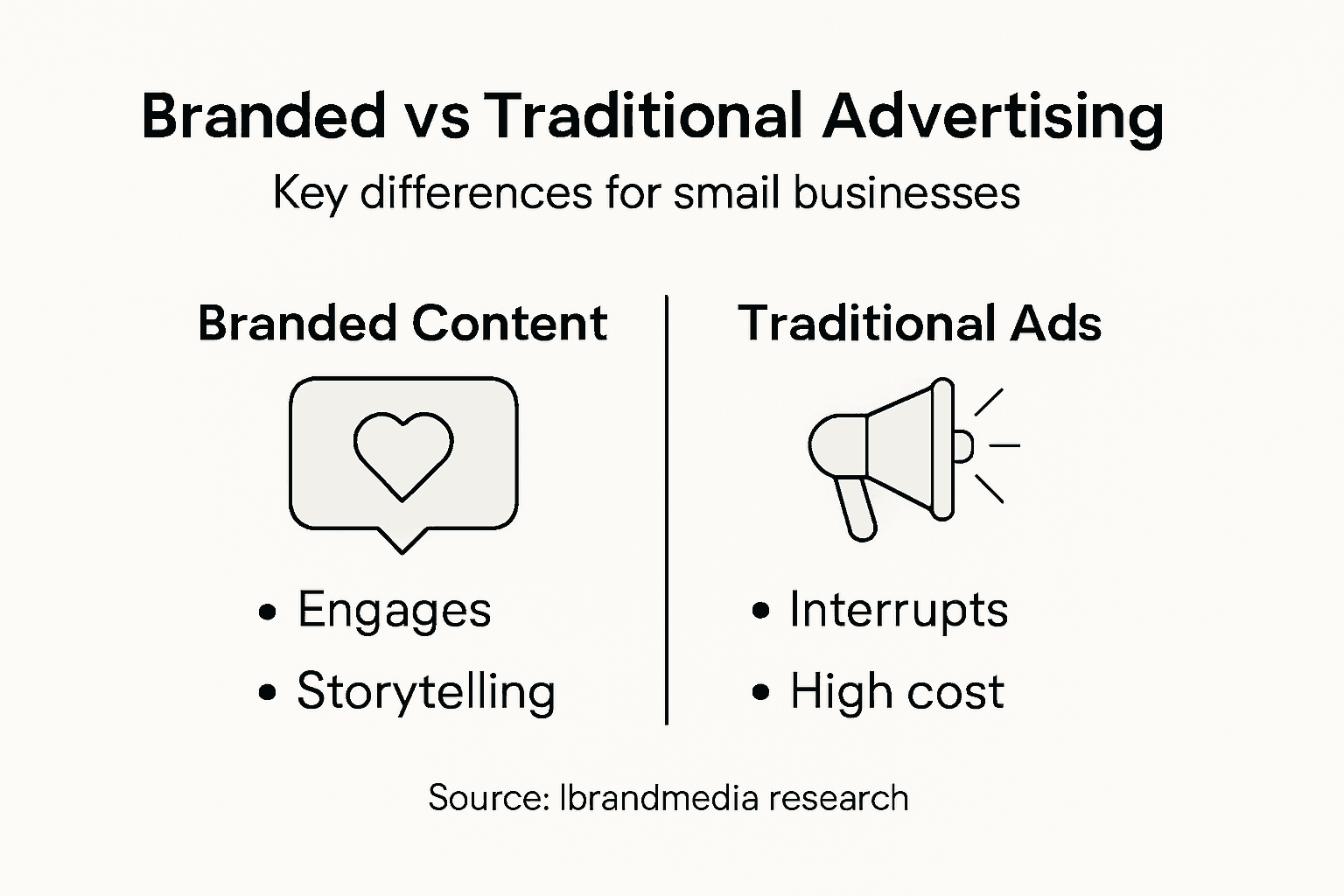
There’s another critical advantage branded content holds: trust building. Branded content offers a complementary approach by engaging audiences more deeply through meaningful content that builds trust and loyalty, contrasting with the overt promotion style of traditional ads. When someone experiences your expertise through helpful content over time, they develop genuine trust in your ability to solve their problems. This trust translates directly into sales. Someone who reads your educational content regularly becomes a warmer prospect than someone who sees your billboard. They’ve experienced your value firsthand. They know how you think and whether your approach aligns with theirs. Traditional advertising creates brand awareness. Branded content creates brand preference and loyalty.
This doesn’t mean traditional advertising is dead. Large companies still use it effectively for building broad awareness. But for small to medium-sized businesses operating with limited budgets, branded content delivers superior returns. You’re not competing on advertising spend. You’re competing on relevance, authenticity, and actual value provided to your audience. You’re building relationships rather than just reaching eyeballs. That distinction changes everything about your marketing effectiveness and your return on investment.
Here’s how branded content compares to traditional advertising for small businesses:
| Aspect | Branded Content | Traditional Advertising |
|---|---|---|
| Audience Targeting | Highly specific audiences | Broad, general audiences |
| Cost Structure | Lower, pay for creation | Higher, pay for exposure |
| Content Lifespan | Evergreen, long-term value | Short-lived, limited duration |
| Engagement Quality | Builds trust and loyalty | Generates basic awareness |
| Measurement | Easy to track & optimize | Difficult to measure impact |
| Main Objective | Build relationships | Drive immediate sales |
Pro tip: Repurpose one piece of branded content into multiple formats to maximize your investment. A blog post becomes a social media series, then a video, then email content, then a podcast discussion, reaching different audience segments across different platforms without creating from scratch each time.
Common Pitfalls and Legal Considerations
Branded content success depends on more than just compelling storytelling and audience engagement. Legal compliance and ethical practices form the foundation of sustainable marketing. Many small business owners create branded content without fully understanding the regulations that govern it, which can lead to costly mistakes. The Federal Trade Commission (FTC) enforces strict rules about branded content, and violations damage both your reputation and your bottom line. Understanding these requirements from the start protects your business and builds trust with your audience.
The most critical requirement is disclosure. When your branded content is paid for or sponsored, you must clearly disclose that relationship. This doesn’t mean hiding it in fine print or burying it at the end of a video. The disclosure needs to be upfront and obvious so anyone consuming your content knows it’s sponsored material. Legal pitfalls for branded content include false advertising claims, failure to disclose paid promotions, and advertising to vulnerable groups such as children. A social media post featuring a product should include hashtags like #ad or #sponsored. A blog post created with a partner company should clearly state that relationship at the beginning. A video where you mention a brand you work with should include on-screen text identifying it as sponsored content. The FTC takes these requirements seriously, and ignorance is not a defense. Violations result in fines, required corrections, and reputational damage that affects future customer relationships.
False claims represent another major legal pitfall. Your branded content cannot make claims you cannot substantiate. If you claim your product reduces weight loss time by 50 percent, you need solid evidence to back that up. If you suggest a service solves a problem it doesn’t actually solve, you’re committing false advertising. This applies even when you’re creating content that looks entertaining or informative rather than promotional. A financial advisor can share investment tips, but cannot guarantee specific returns. A fitness brand can show transformation stories, but must ensure those results are typical and achieved through the methods promoted. A supplement company cannot claim to cure diseases without FDA approval. The line between enthusiastic marketing and false claims is clear in the eyes of regulators. When in doubt, understate rather than overstate what your product or service delivers.
Targeting considerations matter too, especially regarding vulnerable populations. The FTC has specific rules about advertising to children. Content directed at people under 13 has different requirements than content aimed at adults. If you’re selling products that appeal to children, you need to be especially careful about claims, disclosures, and the overall messaging. Similarly, financial products, health products, and services targeting vulnerable populations face heightened scrutiny. This doesn’t mean you cannot market to these groups, but you must do so responsibly and truthfully.
Beyond legal requirements, ethical considerations affect your long-term success. Creating branded content that misleads people, even if it technically complies with regulations, damages trust. When customers discover they’ve been misled, they share that experience widely. Your reputation suffers. Future marketing becomes harder. The businesses that win long-term are those that treat branded content as an opportunity to genuinely serve their audience, not as a loophole to avoid traditional advertising restrictions. Your branded content should reflect the same values and commitment to truth that you’d want from any company you do business with.
Key legal and ethical risks in branded content to consider:
| Risk Type | What It Means | Example |
|---|---|---|
| Disclosure Violation | Not making sponsorship clear | No #ad on a paid post |
| False Claim | Statement not backed by evidence | Promising guaranteed results |
| Vulnerable Audiences | Unethical targeting or messaging | Advertising to children under 13 |
| Misleading Content | Content intentionally deceives | Exaggerating typical outcomes |
Pro tip: Create a compliance checklist before publishing any branded content: Is this truthful and substantiated? Is the sponsorship or paid relationship clearly disclosed? Does this comply with FTC guidelines for my industry? Am I targeting any vulnerable populations that require special consideration? Using a simple checklist prevents costly mistakes and keeps your business protected.
Boost Your Sales with Branded Content and Expert Digital Marketing
If you are ready to transform your small or medium-sized business by creating valuable branded content that truly connects with your audience consider partnering with a team that understands the power of relevance trust and emotional engagement. At Ibrandmedia, we specialize in crafting tailored digital marketing strategies that align perfectly with your customer’s needs and preferences. From SEO optimization and local marketing to social media management and mobile-friendly web design we help you tell your story in formats your audience chooses to engage with.
Explore our Uncategorized | Ibrandmedia category to discover insights and ideas on how branded content can fit into your marketing plan. Don’t wait to build genuine connections that drive real sales. Visit https://ibrand.media now to request a custom plan designed specifically for your business goals and start turning content into lasting customer relationships today.
Frequently Asked Questions
What is branded content?
Branded content is a form of marketing that integrates brand messaging into entertaining or informative content. Unlike traditional ads that interrupt, branded content engages audiences by telling stories that align with a brand’s values and image.
How does branded content drive sales?
Branded content drives sales by building trust and demonstrating expertise over time. When consumers engage with genuinely helpful or entertaining content, they develop a positive perception of the brand, making them more likely to choose it when the time comes to buy.
What types of formats can small businesses use for branded content?
Small businesses can use various formats for branded content, including social media posts, blog articles, videos, podcasts, email campaigns, and events. The key is to choose formats that resonate with the target audience and align with the business’s strengths.
What are the main advantages of branded content over traditional advertising?
Branded content offers better audience targeting, lower costs, and a longer content lifespan compared to traditional advertising. It also builds trust and loyalty through meaningful engagement rather than just generating awareness, making it more effective for small businesses.
Recent Comments