
Trying to stand out in a crowded local market can feel like an uphill battle for plumbers and HVAC technicians. Customers today want answers to their problems before they ever pick up the phone. Content marketing gives small businesses the power to share helpful, relevant information that builds trust and credibility with local homeowners. This approach helps you show expertise, attract the right customers, and keep them coming back—all while spending much less on advertising.
Table of Contents
- Defining Content Marketing for Small Business
- Types of Content Marketing Strategies
- Key Benefits for Local Service Businesses
- Building Trust and Customer Loyalty Online
- Common Pitfalls and How to Avoid Them
Key Takeaways
| Point | Details |
|---|---|
| Focus on Trust | Content marketing is about building trust through valuable information, not just selling products. |
| Customer Engagement | Effective content addresses customer problems, fostering relationships and enhancing visibility. |
| Optimize Content | Regularly measure the performance of your content to ensure it drives genuine business results. |
| Diversify Strategies | Utilize a mix of content types to cater to different stages of the customer journey for maximum impact. |
Defining Content Marketing for Small Business
Content marketing isn’t about selling directly. It’s about building trust through valuable information your customers actually want to read.
At its core, content marketing means creating and sharing valuable, relevant content designed to attract and keep customers engaged. You’re providing solutions to their problems, not just pushing a sales pitch.
For a plumber or HVAC technician, this might mean publishing articles about seasonal maintenance tips, explaining why regular filter changes matter, or sharing videos showing how to spot common heating problems. Your customers benefit, and you build credibility in the process.
Why This Matters for Local Service Businesses
Traditional advertising tells people you exist. Content marketing proves you know what you’re doing.
When a homeowner searches “why is my AC running all summer,” your helpful blog post appears instead of a competitor’s. That reader trusts you before they even call. This approach works because people prefer businesses that educate them over ones that just advertise.
Content marketing differs from typical ads in key ways:
- Educates rather than interrupts – You give first, ask for business second
- Builds authority – Consistent helpful content positions you as the expert
- Creates lasting relationships – Customers remember businesses that helped them solve problems
- Costs significantly less – A blog post keeps working for months; an ad stops when you stop paying
- Improves search visibility – Google ranks websites with quality content higher than those without
Quality content doesn’t compete on price. It competes on trust and usefulness, which is exactly where small service businesses win.
The beauty of this approach lies in longevity. A paid advertisement runs for a few weeks and disappears. A well-written article about common HVAC problems continues attracting customers months or even years later.
Here is a comparison of traditional advertising and content marketing for local service businesses:
| Approach | Visibility Duration | Customer Relationship | Typical Cost Structure |
|---|---|---|---|
| Traditional Advertising | Short-term; ends quickly | Minimal trust, transactional | Ongoing, pay-per-campaign |
| Content Marketing | Long-lasting; months/years | Builds trust, educational | Upfront/time-heavy, lower recurring |
The Simple Content Marketing Formula
You don’t need fancy strategies. Follow this basic formula:
- Identify problems your customers face regularly
- Create content that solves those problems
- Share that content where customers search for answers
- Track which content brings actual business
That’s it. No complex funnels or confusing terminology required.
Pro tip: Start by listing the five most common questions customers ask during service calls, then create simple blog posts answering each one. This instantly gives you valuable content that addresses real customer needs.
Types of Content Marketing Strategies
Not all content works the same way. Different strategies reach different customers at different times in their buying journey.
The most effective approach combines multiple content types. Blogs, videos, and social media posts each serve a specific purpose, and successful businesses use all three rather than relying on just one.
For service businesses like plumbing or HVAC, this means mixing written guides, how-to videos, customer testimonials, and quick social media tips. Each format captures attention differently and reaches people in different moods and contexts.
Core Strategy Types
Most effective content marketing strategies fall into these categories:
- Audience-focused content – Create material specifically for your target customer, not everyone
- Educational guides – Blog posts and articles that solve real problems homeowners face
- Video content – Demonstrations, maintenance tips, and before-and-after transformations
- Social media – Quick tips, seasonal reminders, and customer success stories
- Case studies – Real examples of problems you’ve solved for past customers
- Interactive content – Quizzes, assessments, or tools that engage visitors
The key is aligning your content strategy with where your customers actually search for answers, not where you assume they look.
Matching Content to the Customer Journey
Customers follow a path from problem awareness to decision. Different content types work at each stage.
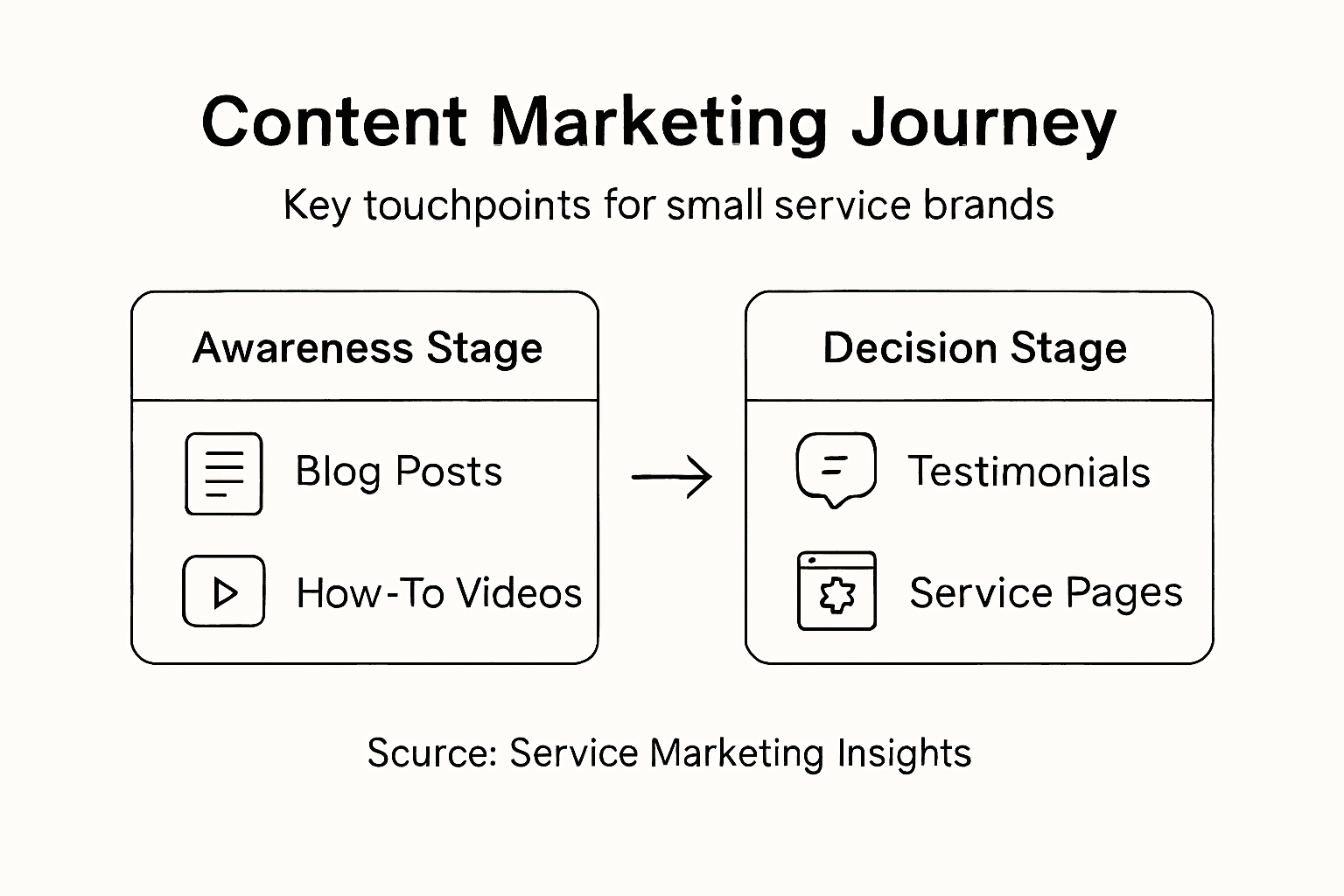
When someone searches “why is my water heater making noise,” they’re in the awareness stage. A blog post answering this question works perfectly. Later, when they’re ready to call someone, customer testimonials and service guarantees matter more.
This alignment between content type and decision stage dramatically improves results. You’re not forcing the same message at everyone regardless of where they are in their journey.
This chart summarizes which content formats are most effective at various stages of the customer journey:
| Stage in Journey | Best Content Types | Main Customer Need |
|---|---|---|
| Awareness | Blog posts, how-to videos | Clear answers to new problems |
| Consideration | Case studies, testimonials | Evidence of your expertise |
| Decision | Service guarantees, reviews | Assurance and trust to take action |
Practical Strategy Implementation
Data-driven measurement and continuous optimization separate successful strategies from wasted effort. Track which content actually brings customers, not just which gets views.
Start simple:
- Choose two content types (blog posts and short videos work well together)
- Create content targeting common customer questions
- Track which pieces generate actual calls or appointments
- Double down on what works; adjust what doesn’t
You don’t need a complex strategy. Focus on producing genuinely helpful content consistently, and measure the results.
Pro tip: Record a quick 60-second video answering one common customer question each week, then repurpose that same information as a blog post. This doubles your content output with minimal extra effort.
Key Benefits for Local Service Businesses
Content marketing isn’t just about getting views online. For plumbers and HVAC technicians, it directly translates to more calls, higher prices, and stronger customer loyalty.

When you invest in content marketing, you’re building something that works for you continuously. Digital marketing strategies like content significantly improve sales growth and market share for local service businesses. You’re not just staying visible; you’re dominating your market.
Here’s what makes content marketing different from traditional advertising: Your competition pays constantly for visibility. You create content once and it works for months or years.
Specific Benefits for Your Business
Content marketing delivers measurable wins that matter to your bottom line:
- Increased local visibility – Show up when homeowners search for solutions in your area
- Higher-quality leads – People who find your content are already interested and educated
- Premium pricing power – Customers who trust your expertise pay more and complain less
- Reduced advertising costs – Quality content replaces expensive paid ads over time
- Customer loyalty – Helpful content keeps customers coming back and referring friends
- Competitive advantage – Most local competitors aren’t doing this effectively yet
Building Trust and Brand Authority
Trust is everything in service businesses. You’re inviting strangers into homes. Content marketing builds brand awareness and strengthens customer loyalty by proving you know your craft.
When a homeowner reads ten articles from your HVAC business about energy efficiency, they trust you before they even call. When a plumber posts before-and-after photos of complex repairs, customers understand the value.
This trust allows you to charge fair prices instead of competing on cost alone.
Real Revenue Impact
The numbers speak clearly. Businesses that consistently produce helpful content see measurable revenue growth.
You don’t need massive reach. A single blog post about seasonal maintenance or a video addressing common problems can generate multiple service calls over months. Each piece compounds, building your visibility and authority steadily.
Content marketing is the only marketing strategy that actually becomes more valuable with age. Your paid ads stop working the moment you stop paying. Your helpful blog post keeps generating leads indefinitely.
Pro tip: Start tracking which topics bring actual phone calls over the next three months. Double down on the content types and topics that generate real business, then expand from there.
Building Trust and Customer Loyalty Online
Trust is the currency of service businesses. Online, you can’t shake a customer’s hand or look them in the eye. Content marketing solves this problem by proving your expertise before they ever call.
When customers read your helpful articles, watch your instructional videos, or see real problems you’ve solved, they develop confidence in your abilities. Consistent delivery of high-quality, relevant content builds the strong customer relationships that lead to repeat business and referrals.
This is how small businesses compete with larger companies. You can’t outspend them on advertising, but you can out-educate them through content.
How Content Builds Customer Loyalty
Loyalty isn’t created by one interaction. It develops through repeated positive experiences that prove you care about solving problems, not just making sales.
When a homeowner reads five blog posts from your plumbing business about preventing frozen pipes, maintaining their water heater, and fixing common leaks, they’ve experienced your expertise multiple times. By the time they need service, they’ve already chosen you mentally.
This reduces price haggling. Customers who trust your expertise pay for quality rather than shopping around for the cheapest option.
Creating Content That Builds Trust
Not all content builds trust equally. Focus on these elements:
- Transparency – Explain problems clearly without overcomplicating them
- Authenticity – Share real stories and results from actual customers
- Accuracy – Get technical details right; errors destroy credibility instantly
- Helpfulness – Always prioritize solving the customer’s problem over promoting yourself
- Consistency – Publish regularly so customers know what to expect
- Responsiveness – Answer questions and comments promptly
Turning Content Into Customer Advocacy
Authentic brand stories and meaningful customer engagement transform satisfied customers into active promoters. When customers see themselves reflected in your content, they become advocates who refer their friends.
Before-and-after photos of complex repairs. Testimonials from real customers. Videos showing your process. These create emotional connections that spreadsheets never will.
Your best marketing comes from customers who volunteer to recommend you because you’ve genuinely helped them understand their situation.
The most loyal customers aren’t those who had the cheapest experience. They’re customers who felt understood and well-informed throughout the entire process.
Pro tip: Ask three recent customers to share their experience solving a problem with you, then feature those stories across your blog, social media, and website. Real customer voices build far more trust than anything you write about yourself.
Common Pitfalls and How to Avoid Them
Content marketing sounds simple until you start doing it. Most small business owners make predictable mistakes that waste time and money without generating results.
The good news? These mistakes are completely avoidable once you know what they are. Understanding lack of strategic clarity and poor alignment with goals helps you sidestep the biggest pitfalls before they drain your budget.
The Most Common Mistakes
Small businesses typically stumble in the same ways:
- Inconsistent posting – Publishing sporadically kills momentum and confuses your audience about when to expect content
- Wrong audience focus – Creating content you think is interesting instead of content customers actually search for
- Ignoring performance data – Publishing without tracking which topics bring actual business leads
- Irrelevant or generic content – Writing vague articles that could apply to any business instead of your specific market
- No clear strategy – Posting randomly without connection to actual business goals
- Set it and forget it – Expecting old content to keep working without updates or optimization
The Audience Problem
Many plumbers and HVAC technicians create content about topics they find interesting instead of what homeowners actually need. This is backwards thinking.
Your audience doesn’t care about industry jargon or complex technical explanations. They care about solving their specific problem. Write about burst pipes, not copper piping standards. Write about high utility bills, not SEER ratings.
Failure to understand target audience needs wastes your entire content marketing effort. Research what customers actually search for, then answer those questions.
Measurement and Optimization
You can’t improve what you don’t measure. Track which blog posts generate phone calls, which videos get shared, and which topics bring actual customers.
Spend more time on content that works. Adjust or remove content that doesn’t. This continuous optimization separates successful content strategies from frustrating ones.
Without measurement, you’re just guessing about what works.
Content marketing fails not because the strategy is flawed, but because businesses abandon it before it gains traction or never measure whether it’s actually working.
Getting Back on Track
If your current content marketing isn’t delivering results, the fix is straightforward:
- Audit existing content for relevance and accuracy
- Identify top-performing pieces and understand why
- Develop a consistent publishing schedule you can maintain
- Track metrics that matter (actual business leads, not just views)
- Adjust based on data, not gut feeling
Pro tip: Before creating new content, spend one week tracking the actual questions customers ask during service calls and the search terms they use to find you. This research alone guides your entire content strategy and prevents wasted effort on irrelevant topics.
Unlock Growth Through Smarter Content Marketing
Struggling to turn your content efforts into real business results is common among small businesses. This article highlights how inconsistent posting, ignoring customer needs, and lack of measurement stall your growth. You want to build trust, attract quality leads, and boost long-term visibility without wasting time or money. At Uncategorized | Ibrandmedia, we understand these challenges and specialize in tailored digital marketing strategies that align with your audience’s actual search behavior. From SEO optimization to local marketing and real-time tracking, we help you transform your content into an engine for sustainable growth.
Ready to break free from ineffective content tactics and start growing your small business with a focused digital marketing partner? Visit ibrand.media today to explore customized solutions designed specifically for your needs. Take control of your online presence, attract higher-quality leads, and start seeing measurable results now.
Frequently Asked Questions
What is content marketing and how does it benefit small businesses?
Content marketing involves creating and sharing valuable content to attract and engage customers. It builds trust, educates potential clients, and fosters long-lasting relationships, ultimately leading to more business.
How can content marketing improve my local service business’s visibility?
By producing high-quality, relevant content, your website ranks higher on search engines. This means when potential customers search for solutions, your business appears more prominently, increasing its chances of being contacted.
What types of content should I create for my small service business?
Effective content types include blog posts answering common customer questions, how-to videos demonstrating services, and social media posts showcasing customer testimonials and tips. Combining these strategies can reach customers at different stages of their buying journey.
How do I measure the success of my content marketing efforts?
Track which content generates actual leads or service calls rather than just views. Use tools to monitor engagement, feedback, and conversion rates from different content pieces to optimize your strategy continuously.
Recent Comments