
Many small business owners believe local marketing simply means running ads or posting online, but this approach often misses the real heart of the strategy. Reaching people in your own neighborhood requires more than generic campaigns—it takes real connection and understanding with those around you. By focusing on community engagement and genuine relationships, you set your business apart, growing trust and visibility where it matters most.
Table of Contents
- Local Marketing Defined And Common Myths
- Types Of Local Marketing Strategies Explained
- How Local Marketing Drives Community Engagement
- Key Benefits: Visibility, Trust, And Affordability
- Common Pitfalls And How To Avoid Them
Key Takeaways
| Point | Details |
|---|---|
| Local Marketing Focuses on Community | Tailor your marketing efforts to the local audience’s unique needs and preferences for better engagement. |
| Blending Traditional and Digital Strategies | Use a combination of traditional and digital marketing to create a cohesive presence in your community. |
| Genuine Community Involvement Matters | Authentic participation in local events and causes fosters trust and loyalty among customers. |
| Track and Adapt Your Strategies | Regularly measure the effectiveness of your marketing initiatives to optimize your approach based on results. |
Local Marketing Defined and Common Myths
Local marketing targets customers in your specific geographic area—the neighborhood, town, or region where your business operates. It’s fundamentally different from national or broad-based marketing strategies.
When you think of local marketing, consider it a direct conversation with people nearby who need your services. Your plumber, electrician, salon owner, or contractor already knows this instinctively.
What Local Marketing Actually Includes
Local marketing spans multiple channels and tactics:
- Google My Business optimization and local search visibility
- Location-based social media marketing and community engagement
- Local directory listings and citations across platforms
- Community event sponsorships and partnerships
- Localized content that addresses neighborhood-specific needs
- Mobile-friendly website optimization for “near me” searches
- Customer reviews and reputation management
- Location-specific email campaigns and offers
Each of these works together to create a presence where your customers actually search and spend time.
Breaking Down the Myths
Local marketing isn’t just about flashy media campaigns—it’s about meeting real community needs and building lasting relationships.
Many small business owners believe local marketing relies solely on paid ads. The reality? Organic search, reviews, and community engagement often drive more qualified leads than traditional advertising alone.
Another widespread misconception is that one generic brand message works for everyone. Different neighborhoods have different needs, preferences, and demographics. A successful local strategy acknowledges these differences and adapts accordingly.
Some owners think that promotion alone guarantees results. But promotion without addressing actual community needs falls flat. Your customers want solutions to their specific problems, not just clever messaging.
A final myth: ignoring longtime residents while chasing outsiders. This approach erodes your foundation. Local loyalty and word-of-mouth referrals come from serving your community well consistently.
Why This Matters for Your Business
Local marketing efficiency wins here. You’re not spending money reaching people three states away who’ll never visit your location. Instead, you’re investing in relationships with people who can actually become paying customers.
Your competition in the local space is also typically smaller businesses, not major corporate chains. This gives you room to win with authenticity and genuine community connection.
Pro tip: Start by claiming and optimizing your Google My Business profile today—this single step improves local visibility more than most small businesses realize, and it’s completely free.
Types of Local Marketing Strategies Explained
Local marketing strategies break into two main categories: traditional and digital approaches. Both work together to build visibility and customer loyalty in your specific area.
The key is choosing strategies that match where your customers actually spend their time and attention.
Traditional Local Marketing Strategies
These proven methods have worked for decades and still deliver results:
- Event sponsorships and community involvement
- Print advertising in local publications
- Direct mail and flyers to targeted neighborhoods
- In-store promotions and signage
- Local partnerships with complementary businesses
- Radio or local TV advertising
- Word-of-mouth referral programs
Traditional tactics build real community presence and create face-to-face connections that digital alone cannot replicate.
Here’s how traditional and digital local marketing compare on core business factors:
| Factor | Traditional Strategies | Digital Strategies |
|---|---|---|
| Audience Reach | Local community events | Targeted online ads |
| Speed of Results | Takes longer to build | Can generate leads quickly |
| Cost Control | Often fixed per event | Flexible, scalable budgets |
| Measurability | Harder to track ROI | Detailed analytics tools |
| Relationship Strength | Builds in-person trust | Enables lasting online engagement |
Digital Local Marketing Strategies
Online channels reach customers at the exact moment they search for your services:
- Local search engine optimization (SEO) for “near me” queries
- Google My Business optimization and local citations
- Geotargeted social media advertising
- Online review management across platforms
- Location-based email campaigns
- Local content marketing addressing neighborhood needs
- Geolocation tracking for foot traffic analysis
- Digital storytelling through video and social content
Targeted segmentation and digital tools allow you to reach specific customer groups in your area with personalized messaging.
Blending Both Approaches
The most effective local marketing combines traditional community presence with modern digital visibility—neither works as well alone.
Your offline reputation feeds your online presence. A satisfied customer from a community event becomes a positive review online. That review then attracts more local customers.
Both traditional and online marketing tools work best when coordinated around the same message and brand identity across all channels.
Adapting to Your Local Market
Not every strategy works equally in every location. Your neighborhood’s demographics, competition level, and customer preferences matter significantly.
A successful local strategy considers your specific area’s economic conditions, local trends, and what competitors are doing.
Pro tip: Start with one digital strategy (Google My Business) and one traditional strategy (local event sponsorship) that fit your budget, then measure results before expanding.
How Local Marketing Drives Community Engagement
Community engagement isn’t just about making sales—it’s about building real relationships with the people around you. Local marketing naturally creates opportunities for these connections to flourish.

When your business shows up in the community, people notice and remember you differently than they would from a distant advertisement.
Building Trust Through Local Presence
Trust develops when people see your business invested in their neighborhood. This happens through consistent, genuine interaction over time.
Community engagement strategies based on resident perspectives create stronger relationships than one-way marketing messages ever could.
Your customers want to know you care about more than just their money. They want to support businesses that support their community.
How Engagement Translates to Business Growth
Engaged communities become loyal customers. Here’s the chain reaction:
- People feel connected to your business through community involvement
- They become regular customers and refer friends
- Positive word-of-mouth spreads organically
- Your reputation strengthens in the local market
- New customers arrive with built-in trust before you even meet them
Each engagement point reinforces the next. Your local roots become your competitive advantage.
Practical Ways to Engage Your Community
Real community engagement means listening to what neighbors actually need, not just telling them what you sell.
Start with these approaches:
- Sponsor local sports teams, school events, or charity fundraisers
- Host workshops or free consultations addressing neighborhood challenges
- Partner with other local businesses for cross-promotion
- Support local causes your customers care about
- Create social media content celebrating community members and local wins
- Participate in farmers markets, street fairs, or community festivals
Local economic and social benefits develop through cooperative initiatives that bring businesses and residents together around shared goals.
The Multiplier Effect
When you engage locally, your impact multiplies. A business sponsoring a youth soccer league reaches not just the kids, but their families, coaches, and friends.
That single sponsorship might generate more goodwill and customer loyalty than thousands spent on distant advertising.
Pro tip: Choose one community cause or event that genuinely aligns with your values and commit to supporting it consistently for at least a year—consistency builds stronger community bonds than sporadic involvement.
Key Benefits: Visibility, Trust, and Affordability
Local marketing delivers three critical advantages that most small businesses desperately need: getting noticed, earning credibility, and doing it without breaking the bank.
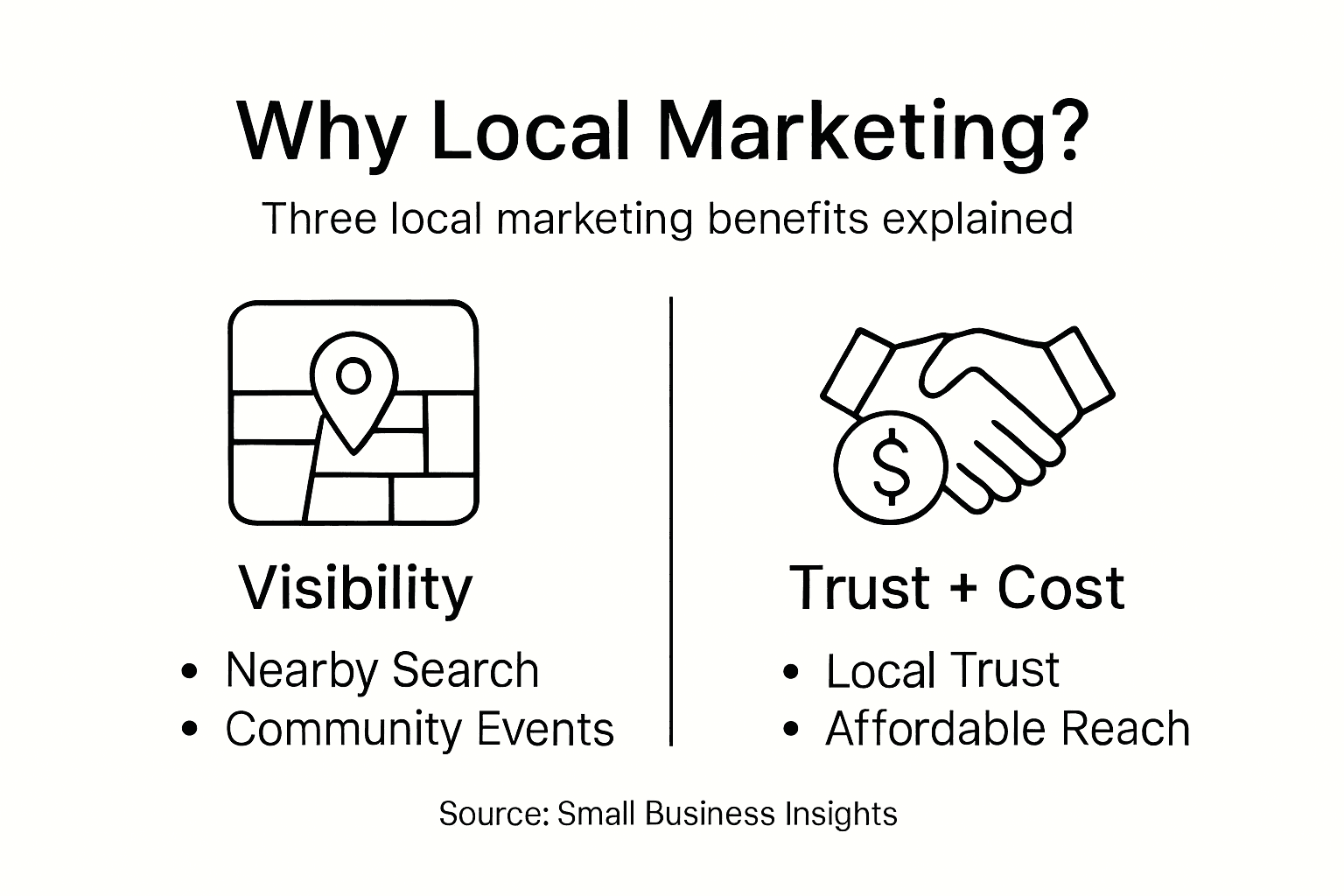
These benefits work together to create sustainable growth in your market.
Visibility in Your Local Market
Local marketing puts your business exactly where customers search for you. When someone types “plumber near me” or “salon in my neighborhood,” you appear.
This targeted visibility is fundamentally different from broadcasting to millions who’ll never visit. You’re reaching people ready to buy from someone local.
Local marketing enhances visibility and identity for small businesses by connecting emotional values and cultural authenticity that resonate in your neighborhood.
Building Trust Through Local Presence
Trust doesn’t come from national brand recognition for you. It comes from being the business people see consistently in their community.
When neighbors know you sponsor the local soccer team or support the food bank, they trust you differently than a stranger. You’re part of their world.
Authentic relationships through hyperlocal campaigns combine online visibility with physical community presence, creating the foundation for lasting customer loyalty.
Customers with trust become repeat customers and referral sources.
Affordability: The Real Game-Changer
Here’s what makes local marketing accessible to small business owners:
- Google My Business optimization costs nothing to set up
- Local social media campaigns cost significantly less than national advertising
- Community sponsorships offer affordable visibility compared to media buys
- Word-of-mouth referrals have zero marketing cost
- Email campaigns to local customers cost pennies per person
- Local partnerships eliminate or reduce individual marketing expenses
Unlike national campaigns requiring thousands monthly, local marketing starts with small investments and scales with your budget.
Why These Three Benefits Matter Together
Visibility without trust doesn’t convert. Trust without visibility reaches nobody. Affordability without both is just cheap waste.
When combined, these benefits create a powerful cycle. Visibility brings potential customers. Trust converts them. Affordability means you can sustain both long-term.
Small businesses win by leveraging what large corporations can’t: genuine community connection at sustainable cost.
Pro tip: Start tracking your local marketing results using Google My Business insights and simple customer surveys to identify which local strategies drive your highest-quality leads, then double down on those winners.
Common Pitfalls and How to Avoid Them
Local marketing sounds simple, but many small business owners stumble on the same mistakes repeatedly. Knowing what to avoid saves time, money, and frustration.
These pitfalls are common because they seem like good ideas at first—until results disappoint.
Pitfall 1: Insincere Community Involvement
Sponsoring a local event just for the logo placement rarely works. Community members can sense when your participation is purely transactional.
Instead, pick causes you genuinely care about and commit long-term. Authentic involvement builds real relationships and trust.
Pitfall 2: Treating All Locations the Same
What works in one neighborhood may flop in another. Different areas have different demographics, needs, and preferences.
Tailoring campaigns based on local consumer behavior ensures your message resonates where it matters most rather than spreading yourself thin with generic content.
Pitfall 3: Using Generic, Uncreative Campaigns
Copy-pasting the same marketing message everywhere signals you don’t really know your community. Local customers want to feel understood.
Create localized creative content that speaks directly to your neighborhood’s values, challenges, and interests.
Pitfall 4: Ignoring Mobile Users
Most local searches happen on phones. If your website or ads don’t work on mobile devices, you’re losing customers actively looking for you.
Optimize everything for mobile—your website, ads, and Google My Business profile.
Pitfall 5: Skipping Data and Analytics
Wouldn’t you like to know which local marketing strategies actually drive sales? Many businesses guess instead of measure.
Common mistakes include:
- Not tracking which channels bring qualified leads
- Ignoring customer feedback about your local presence
- Failing to measure campaign performance
- Skipping internal communication about what’s working
- Missing automation opportunities that save time
Pitfall 6: Lack of Internal Knowledge Sharing
If only one person knows your local marketing strategy, critical details get lost. Your team should understand the plan.
Document what works and share wins across your organization.
This table summarizes the key local marketing pitfalls and effective fixes:
| Common Pitfall | Impact on Business | Fix in Practice |
|---|---|---|
| Generic messaging | Low local relevance | Customize for each neighborhood |
| Ignoring mobile users | Missed sales opportunities | Make all content mobile-friendly |
| Skipping analytics | Wasted budget, poor ROI | Track results, adjust monthly |
| Insincere involvement | Low community trust | Support causes you truly value |
The most expensive local marketing mistake is wasting money on strategies you never measure or improve based on results.
How to Fix These Issues
Start here:
- Define which neighborhoods matter most to your business
- Research what those communities actually need
- Create messaging that reflects local values
- Track results using Google Analytics and customer surveys
- Adjust based on what you learn
- Keep doing what works
Pro tip: Set up a simple monthly check-in where you review which local marketing channels generated your highest-quality leads, then reallocate budget toward those winners the following month.
Unlock the Full Potential of Local Marketing for Your Small Business
Local marketing can be challenging when trying to reach your community authentically while standing out from the competition. This article highlights common pitfalls like generic messaging, ignoring mobile users, and insincere community involvement that hold many businesses back from building trust and generating real local visibility. If you want to connect with your neighborhood effectively and turn local engagement into lasting customers
iBrandmedia specializes in helping small to medium-sized businesses overcome these exact challenges. Our tailored local marketing strategies focus on Google My Business optimization, mobile-friendly digital campaigns, and genuine community partnerships that create real impact without wasting your budget. Discover how our proven SEO, social media management, and web design services can help you build strong local trust and skyrocket your visibility. Visit Uncategorized | Ibrandmedia to learn more and take the first step.
Don’t wait to grow your local presence and lock in loyal customers. Start your personalized local marketing plan today at ibrand.media and watch your business thrive.
Frequently Asked Questions
What is local marketing?
Local marketing refers to strategies focused on reaching customers in a specific geographic area, enhancing visibility, and building relationships with local communities.
How can local marketing benefit small businesses?
Local marketing increases visibility among potential customers nearby, builds trust through community engagement, and is often more affordable than national marketing campaigns, making it accessible for small business budgets.
What are some effective local marketing strategies?
Effective local marketing strategies include optimizing Google My Business profiles, engaging in community event sponsorships, utilizing local search engine optimization (SEO), and conducting location-based social media marketing.
Why is community engagement important for local marketing?
Community engagement fosters trust and loyalty among customers, turning them into repeat buyers and advocates for your business, which ultimately leads to organic growth through positive word-of-mouth referrals.
Recommended
- What Is Local Marketing? Simple Guide for Small Businesses 2025 | Ibrandmedia
- Top Benefits of Local Marketing for Small Businesses 2025 | Ibrandmedia
- Top Benefits of Local Advertising for Small Businesses in 2025 | Ibrandmedia
- How to Target Local Audience for Your Business Effectively | Ibrandmedia
- Understanding the Importance of Local SEO for Businesses|BM
- Master Digital Advertising Workflow for Local Businesses
- Why Choose Local Marketing for Service Businesses
Recent Comments