
Getting more local customers often starts with how your business looks online, especially in a service industry where trust matters most. For many American plumbers and HVAC owners, even one critical Google Review can send new leads to a competitor. By focusing on a digital reputation audit, you can uncover strengths and weaknesses in your online presence and learn practical steps to build trust with future clients. This guide highlights proven methods to manage, optimize, and grow your reputation in today’s market.
Table of Contents
- Step 1: Assess Current Online Reputation
- Step 2: Claim and Optimize Business Profiles
- Step 3: Encourage and Manage Customer Reviews
- Step 4: Respond to Feedback Professionally
- Step 5: Monitor Reputation and Track Improvements
Quick Summary
| Key Insight | Explanation |
|---|---|
| 1. Assess Your Online Reputation | Analyze reviews and feedback across key platforms to uncover strengths and weaknesses. |
| 2. Optimize Your Business Profiles | Ensure profiles on platforms like Google and Yelp are accurate and engaging to attract customers. |
| 3. Actively Manage Customer Reviews | Implement strategies to encourage reviews while professionally addressing all feedback. |
| 4. Respond Professionally to Feedback | Address both positive and negative reviews promptly to build customer trust and loyalty. |
| 5. Monitor and Track Reputation | Regularly check and analyze your online presence to identify trends and make improvements. |
Step 1: Assess Current Online Reputation
Understanding your online reputation is the crucial first step in improving how potential customers perceive your small business. By systematically examining your current digital presence, you’ll uncover opportunities for enhancement and reputation management.
Start by conducting a comprehensive digital reputation audit across multiple platforms. This involves methodically searching and reviewing your business profiles on key websites like Google Reviews, Yelp, Facebook, and industry-specific review sites. Consumer review monitoring statistics reveal that 68% of businesses actively track their online reputation, making this process standard practice for successful companies.
To perform a thorough assessment, focus on these critical areas:
Here’s a comparison of popular online review platforms small businesses should monitor:
| Platform | Audience Type | Key Advantage | Common Business Use |
|---|---|---|---|
| Google Reviews | General public | High search visibility | Local search reputation |
| Yelp | Consumer-focused | Trusted for service businesses | Service and hospitality |
| Social & community | Easy review sharing | Community engagement | |
| Industry Sites | Niche professionals | Targeted credibility | Sector-specific proof |
- Gather existing reviews: Collect and categorize all current online reviews
- Analyze review sentiment: Determine the overall positive and negative feedback
- Check multiple platforms: Investigate Google, Yelp, Facebook, and industry-specific sites
- Document review trends: Note common themes in customer experiences
- Benchmark against competitors: Compare your reputation with similar local businesses
Reputation management starts with honest, comprehensive self-assessment.
Pro tip: Use free tools like Google Alerts to automatically track new mentions of your business name online and stay proactive about your digital reputation.
Step 2: Claim and Optimize Business Profiles
Claiming and optimizing your business profiles is a critical step in establishing a strong online presence that attracts potential customers. By strategically managing your digital listings, you’ll improve your visibility and credibility in local search results.
Small business registration resources highlight the importance of creating comprehensive and accurate online profiles across multiple platforms. Begin by identifying key directories where your business should have a presence, including Google Business Profile, Yelp, Facebook, and industry-specific platforms relevant to your local market.
Focus on these essential steps for profile optimization:
- Verify your business ownership: Complete all verification processes on each platform
- Ensure consistent information: Match your business name, address, and contact details exactly across all listings
- Add high-quality images: Upload professional photos of your business, products, and services
- Write compelling descriptions: Craft clear, keyword-rich descriptions that highlight your unique value
- Update regularly: Keep your profiles current with latest business information and offerings
A well-maintained online profile is your digital storefront – make it count.
Pro tip: Set a quarterly reminder to review and update your business profiles, ensuring your online presence remains accurate and engaging.
Step 3: Encourage and Manage Customer Reviews
Customer reviews are the lifeblood of your online reputation, serving as powerful social proof that can attract or repel potential clients. By developing a strategic approach to soliciting and managing reviews, you’ll transform customer feedback into a valuable marketing tool for your small business.

Federal guidelines on review management emphasize the critical importance of maintaining transparency and ethical practices when encouraging customer feedback. Your goal is to create a systematic process that makes leaving reviews easy and comfortable for satisfied customers while demonstrating professionalism in handling all types of feedback.
Implement these key strategies for effective review management:
- Create multiple review channels: Offer easy ways to leave feedback on Google, Yelp, Facebook, and industry-specific platforms
- Timing is crucial: Request reviews immediately after positive customer interactions
- Personalize review requests: Use individual customer names and reference specific services
- Train staff on review response protocols: Develop a consistent approach for addressing both positive and negative feedback
- Respond promptly and professionally: Address all reviews within 24-48 hours
Authentic customer reviews are more valuable than manufactured praise.
Pro tip: Consider creating a simple review request card or email template that makes it incredibly easy for satisfied customers to share their experiences.
Step 4: Respond to Feedback Professionally
Professional feedback response is an art that can transform potentially negative situations into opportunities for building customer trust and demonstrating your business’s commitment to exceptional service. Your approach to handling both positive and negative reviews will significantly impact your online reputation and customer perception.
Business review response principles underscore the importance of crafting thoughtful, empathetic replies that address customer concerns directly and constructively. The key is to remain calm, objective, and solution-oriented, regardless of the review’s tone or content.
Develop a strategic approach to feedback management:
- Stay calm and professional: Never respond emotionally or defensively
- Acknowledge the specific concern: Reference exact details from the customer’s feedback
- Take responsibility: Avoid making excuses or shifting blame
- Offer a concrete solution: Propose specific steps to resolve the issue
- Move communication offline: Provide contact information for further discussion
- Follow up: Check back to confirm the issue has been satisfactorily resolved
Every response is an opportunity to showcase your business’s character and commitment.
Pro tip: Create a standard response template with placeholders for personalization, allowing quick yet thoughtful replies while maintaining a consistent professional tone.
Step 5: Monitor Reputation and Track Improvements
Professional online reputation management requires consistent tracking and strategic analysis of your digital presence. By implementing systematic monitoring techniques, you can quickly identify trends, address potential issues, and continuously enhance your business’s public image.
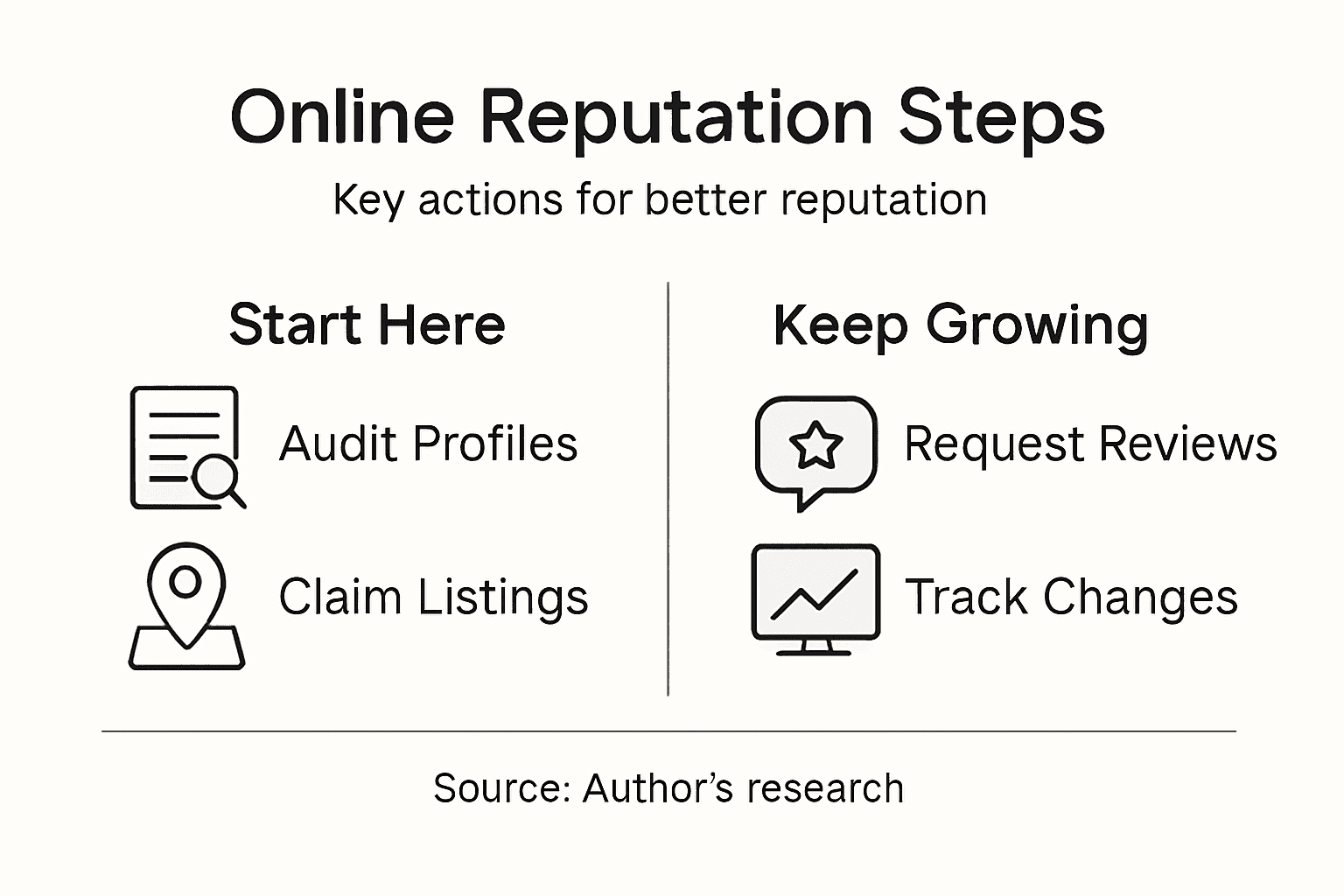
Online reputation tracking strategies emphasize the importance of real-time monitoring across multiple digital platforms. This proactive approach allows small businesses to stay ahead of potential reputation challenges and demonstrate ongoing commitment to customer satisfaction.
Utilize these comprehensive monitoring techniques:
Below is a summary of digital reputation monitoring tools and their benefits:
| Tool Type | What It Tracks | Business Benefit |
|---|---|---|
| Google Alerts | Brand mentions | Early issue detection |
| Social Listening Apps | Social media sentiment | Track public opinion trends |
| Spreadsheet Tracker | Reviews & responses | Organized analytics dashboard |
- Set up Google Alerts: Track mentions of your business name across the web
- Monitor review platforms: Regularly check Google, Yelp, Facebook, and industry-specific sites
- Use social media listening tools: Track brand mentions and sentiment on social channels
- Analyze review trends: Look for recurring themes in customer feedback
- Compare against competitors: Benchmark your reputation against similar local businesses
- Create a tracking spreadsheet: Document reviews, ratings, and response effectiveness
Consistent monitoring transforms reputation management from reactive to strategic.
Pro tip: Dedicate 30 minutes weekly to reviewing your online reputation metrics, ensuring you catch and address feedback quickly and systematically.
Take Control of Your Small Business Online Reputation Today
Improving your online reputation is essential for gaining trust and driving customer growth. This article highlights common challenges like managing reviews, maintaining consistent business profiles, and monitoring feedback effectively. If you want to turn these challenges into opportunities, a tailored digital marketing strategy that includes SEO, local marketing, and social media management can make all the difference. ibrand.media specializes in empowering small businesses to enhance their digital presence with affordable and results-driven solutions.
Don’t wait for negative feedback to catch you off guard. Partner with ibrand.media and start building a positive online reputation right away. Explore how our Uncategorized | Ibrandmedia services can help you claim your business profiles, manage customer reviews professionally, and track your progress in real time. Take the first step toward standing out in your local market with a personalized plan designed for your unique needs.
Frequently Asked Questions
How can I assess my small business’s current online reputation?
To assess your small business’s current online reputation, conduct a digital reputation audit across platforms like Google Reviews, Yelp, and Facebook. Start by gathering existing reviews, analyzing sentiment, and documenting trends within 30 days to identify areas for improvement.
What steps should I take to optimize my business profiles online?
To optimize your business profiles, first, claim ownership on key platforms like Google Business Profile and Yelp. Then, ensure consistent information across all listings, add high-quality images, and write keyword-rich descriptions that highlight your unique offerings within the next month.
How can I encourage customers to leave reviews for my small business?
Encourage customers to leave reviews by creating multiple review channels and asking for feedback right after positive interactions. Personalize these requests with customer names and specific services to boost response rates, aiming for a 20% increase in collected reviews within two months.
What is the best way to respond to negative feedback?
Respond to negative feedback by staying calm and professional, acknowledging the specific concerns raised by the customer. Offer concrete solutions and encourage further offline communication to resolve issues, aiming to respond within 24-48 hours to demonstrate your commitment to customer satisfaction.
How often should I monitor my online reputation?
Monitor your online reputation at least weekly to stay proactive about any emerging issues. Dedicate 30 minutes each week to track reviews and sentiment, which can help you adjust strategies and maintain a positive public image over time.
Recommended
- Complete Guide to Managing Online Business Reputation | Ibrandmedia
- Protecting Online Business Reputation Easily for SMBs | Ibrandmedia
- How to Manage Online Reputation: A 2025 Guide for Local Businesses | Ibrandmedia
- Why Is Online Reputation Important for Small Businesses in 2025? | Ibrandmedia
- Content marketing vs social media | The difference and why you need both
Recent Comments