
Scheduling appointments through endless phone calls and handwritten logs can slow down the day for American business owners and service providers. Reliable, affordable online scheduling software brings relief by replacing manual methods with a centralized digital platform. These solutions offer real-time availability tracking, automated confirmations, and customer-friendly self-service booking. Online scheduling software helps businesses minimize scheduling conflicts and improve customer interactions, making every appointment easier to manage and boosting satisfaction.
Table of Contents
- What Is Online Scheduling Software?
- Popular Types and Key Features Explained
- How Online Scheduling Streamlines Operations
- Enhancing Customer Experience and Satisfaction
- Financial Impact: Costs, Revenue, and ROI
- Common Pitfalls and How to Avoid Them
Key Takeaways
| Point | Details |
|---|---|
| Online Scheduling Software Enhances Efficiency | Automating scheduling processes reduces administrative overhead, allowing businesses to focus on enhancing customer service. |
| Diverse Software Types Address Different Needs | Different online scheduling solutions cater to specific sectors, ensuring effective management of appointments, classrooms, and resources. |
| Improved Customer Experience Drives Satisfaction | 24/7 booking capabilities and automated reminders significantly enhance customer engagement and satisfaction. |
| Strategic Planning is Essential for Implementation | Successful adoption of online scheduling requires thorough training and integration planning to avoid common pitfalls. |
What Is Online Scheduling Software?
Online scheduling software represents a digital solution designed to automate and streamline booking processes for businesses across multiple industries. At its core, this technology enables organizations to manage appointments, classes, and resource allocation through a centralized digital platform that eliminates traditional manual scheduling methods.
Modern online scheduling solutions offer comprehensive features that transform how businesses manage time and customer interactions. These platforms typically provide capabilities like:
- Real-time availability tracking
- Automated appointment confirmations
- Customer self-service booking options
- Integration with existing calendars and communication tools
- Customizable scheduling rules and restrictions
In educational settings, academic scheduling software plays a crucial role in managing complex administrative tasks. Higher education institutions use these tools to coordinate course schedules, track faculty availability, and efficiently allocate limited classroom resources.

The primary advantage of online scheduling software lies in its ability to reduce administrative overhead and minimize human error. By automating scheduling processes, businesses can focus more on delivering quality services rather than managing complex booking logistics. Higher education scheduling platforms demonstrate how these tools can adapt to dynamic environments, handling unexpected changes like instructor absences or facility maintenance with remarkable efficiency.
Key Benefits of Online Scheduling Software:
- Eliminates manual scheduling processes
- Reduces administrative workload
- Improves customer booking experience
- Provides real-time scheduling flexibility
- Minimizes scheduling conflicts
Pro tip: Start with a free trial of online scheduling software to understand how it can specifically improve your business’s booking efficiency.
Popular Types and Key Features Explained
Online scheduling software comes in diverse types, each designed to address specific business and institutional needs. Academic scheduling software represents one prominent category, offering specialized solutions for educational institutions to manage complex administrative processes.
Types of Online Scheduling Software:
Here’s a quick comparison of common online scheduling software types and their main business impact:
| Software Type | Primary Use Case | Typical Users | Major Benefit |
|---|---|---|---|
| Service-Based | Managing client appointments | Salons, clinics, consultants | Reduces client no-shows |
| Educational Scheduling | Organizing courses and resources | Universities, K-12 schools | Maximizes room utilization |
| Resource Allocation | Booking equipment/rooms | Enterprises, agencies | Optimizes asset usage |
| Event & Appointment | Scheduling events and sessions | Small businesses, freelancers | Speeds up booking process |
- Service-Based Scheduling: For businesses like salons, medical practices, and consulting firms
- Educational Scheduling: For universities and schools managing course registrations
- Resource Allocation: For organizations tracking equipment and meeting room bookings
- Enterprise Scheduling: For large corporations managing multiple departments
- Event and Appointment Scheduling: For small businesses and individual service providers
Key Features Across Different Platforms:
- Automated booking confirmations
- Real-time availability updates
- Multi-platform synchronization
- Customizable scheduling rules
- Integrated payment processing
- Client communication tools
Student scheduling software demonstrates remarkable complexity in managing intricate scheduling requirements. These platforms can handle dynamic scenarios like coordinating classroom capacities, tracking faculty assignments, and managing exam schedules with remarkable precision.
Advanced scheduling systems go beyond simple booking – they become strategic tools for operational efficiency.
The most sophisticated scheduling solutions offer robust analytics and reporting features. These tools enable businesses to track performance metrics, understand booking patterns, and make data-driven decisions about resource allocation and service optimization.
Pro tip: When evaluating scheduling software, prioritize platforms that offer seamless integration with your existing business tools and provide comprehensive reporting capabilities.
How Online Scheduling Streamlines Operations
Online scheduling software transforms business operations by dramatically reducing administrative overhead and introducing unprecedented efficiency. Operational efficiency technologies enable organizations to eliminate time-consuming manual processes and create more streamlined workflow management.
Key Operational Improvements:
- Automatic appointment management
- Reduced administrative workload
- Enhanced customer communication
- Real-time schedule tracking
- Minimized scheduling conflicts
- Improved resource allocation
Strategic Operational Benefits:
By integrating advanced technologies, businesses can achieve remarkable operational transformations. AI-powered scheduling technologies provide dynamic decision-making capabilities that adapt to changing organizational needs, enabling more responsive and intelligent scheduling approaches.
Intelligent scheduling goes beyond simple time management – it becomes a strategic operational tool that drives organizational effectiveness.
Modern scheduling platforms offer sophisticated analytics that help businesses understand complex patterns in their operations. These insights allow managers to optimize resource deployment, predict potential bottlenecks, and make data-driven decisions about staffing and service delivery.
Efficiency Metrics That Matter:
- Time saved on manual scheduling
- Reduction in scheduling errors
- Improved customer satisfaction rates
- Increased operational transparency
- Enhanced team collaboration
Pro tip: Implement a gradual transition to online scheduling, training staff incrementally to ensure smooth adoption and maximum operational benefit.
Enhancing Customer Experience and Satisfaction
Online scheduling platforms have revolutionized customer interactions by providing unprecedented convenience and accessibility. Electronic appointment systems fundamentally transform how businesses manage customer engagement, reducing traditional barriers to scheduling and improving overall satisfaction.
Customer Experience Advantages:
- 24/7 booking availability
- Instant confirmation and reminders
- Simplified scheduling process
- Reduced waiting times
- Personalized communication
- Greater flexibility for customers
Online booking systems offer remarkable features that directly enhance customer satisfaction. These platforms enable clients to schedule appointments at their convenience, receive automated reminders, and easily modify or cancel bookings without extensive communication.
Customer experience is no longer about transactions – it’s about creating seamless, personalized interactions that make clients feel valued and understood.
Modern scheduling technologies go beyond simple appointment management. They provide intelligent insights that help businesses anticipate customer needs, customize service offerings, and create more meaningful engagement opportunities.
Key Customer Satisfaction Metrics:
- Reduced booking friction
- Increased service accessibility
- Enhanced communication channels
- Faster response times
- Improved overall customer experience
Pro tip: Regularly collect and analyze customer feedback about your online scheduling experience to continuously refine and improve your booking process.
Financial Impact: Costs, Revenue, and ROI
Online scheduling technologies represent a strategic investment that delivers substantial financial benefits across multiple business dimensions. Healthcare appointment systems demonstrate how intelligent scheduling solutions can generate significant operational cost savings and revenue improvements.
Financial Advantages of Online Scheduling:
- Reduced administrative labor costs
- Minimized revenue loss from missed appointments
- Lower overhead expenses
- Enhanced staff productivity
- Improved resource allocation
- Increased service capacity
Direct Financial Impact Metrics:
Businesses implementing online scheduling can expect measurable financial improvements. By automating scheduling processes, organizations typically reduce administrative overhead by 30-50%, translating into direct cost savings and improved operational efficiency.
Effective scheduling technologies are not expenses – they are strategic investments that generate measurable financial returns.
The most sophisticated scheduling platforms provide advanced analytics that help businesses track key performance indicators. These insights enable precise financial planning, allowing companies to optimize staffing, predict revenue streams, and identify potential efficiency improvements.
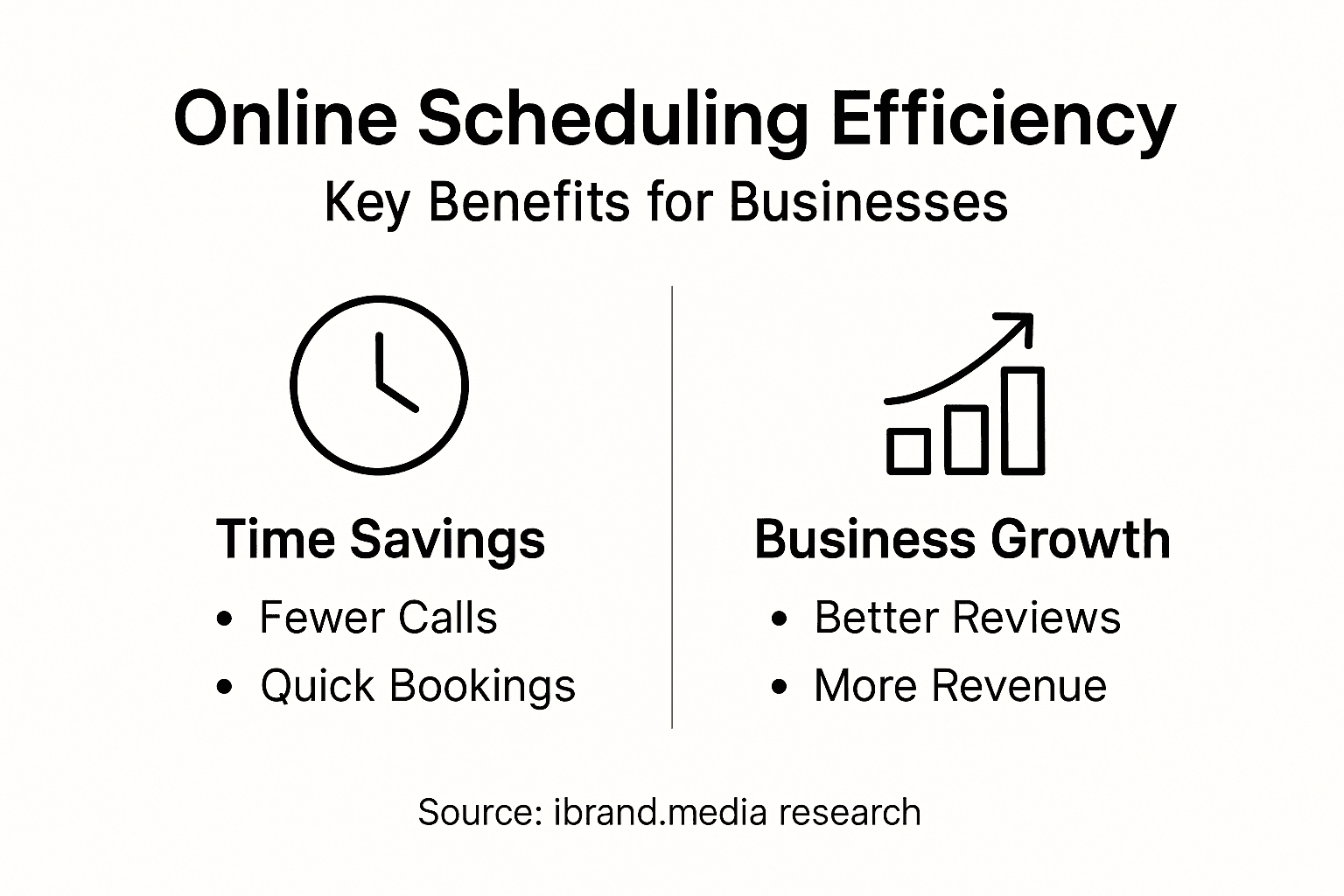
Key ROI Calculation Components:
Below is a summary of financial metrics to track when evaluating return on investment for online scheduling solutions:
| Metric | Why It Matters | Example Improvement |
|---|---|---|
| Staff Time Saved | Cuts labor costs | 40% less admin hours |
| Fewer No-Shows | Boosts revenue consistency | 25% drop in missed visits |
| Booking Rate Increase | Grows customer base | 20% more appointments |
| Customer Retention | Drives recurring revenue | 15% higher repeat clients |
- Staff time saved
- Reduction in no-show rates
- Increased booking conversions
- Enhanced customer retention
- Operational efficiency gains
Pro tip: Calculate your potential return on investment by tracking scheduling-related expenses before and after implementation to demonstrate the tangible financial benefits.
Common Pitfalls and How to Avoid Them
Implementing online scheduling software requires strategic planning to avoid potential operational challenges. Scheduling research pitfalls reveal critical considerations that businesses must address to ensure successful technology adoption.
Common Implementation Challenges:
- Inadequate staff training
- Poor system integration
- Overlooking user experience
- Ignoring data security requirements
- Selecting overly complex platforms
- Failing to customize settings
Potential Operational Risks:
Many organizations make critical mistakes when transitioning to online scheduling systems. Empirical scheduling research highlights the importance of comprehensive evaluation and thorough implementation strategies.
Technology adoption is not just about implementing a solution – it’s about creating a seamless, user-friendly experience that meets your specific business needs.
Successful online scheduling implementation requires a holistic approach that goes beyond simply selecting software. Businesses must consider factors like team adaptability, existing workflow integration, and long-term scalability.
Key Strategies to Mitigate Risks:
- Conduct thorough software demos
- Request comprehensive staff training
- Start with pilot programs
- Gather continuous user feedback
- Maintain flexible implementation timelines
- Prioritize user-friendly interfaces
Pro tip: Always allocate additional time and resources for staff training and system adaptation to ensure smooth technological transition.
Maximize Your Business Efficiency with Smart Online Scheduling and Digital Marketing
The article highlights how online scheduling software dramatically reduces administrative workload and enhances customer satisfaction by automating appointment management and minimizing no-shows. If managing bookings efficiently feels overwhelming and you want to improve your customer interaction while boosting operational productivity, combining these scheduling benefits with a strong digital marketing strategy is essential. Businesses that leverage both see quicker results from streamlined processes and enhanced online visibility.

Take the next step toward transforming your business operations and reaching more customers today. At ibrand.media, we specialize in creating tailored digital marketing plans that complement your enhanced scheduling systems. From SEO optimization to mobile-friendly web design, our affordable services amplify your booking efficiency and customer engagement. Don’t wait to boost your business efficiency and sales. Visit ibrand.media now and start your personalized campaign to power growth with smart scheduling and digital marketing combined.
Frequently Asked Questions
What are the main benefits of using online scheduling software?
Online scheduling software reduces administrative workload, eliminates manual scheduling processes, improves customer booking experiences, provides real-time flexibility, and minimizes scheduling conflicts.
How does online scheduling software enhance customer experience?
It allows for 24/7 booking availability, instant confirmations and reminders, a simplified scheduling process, reduced waiting times, and personalized communication.
What features should I look for in online scheduling software?
Key features include automated booking confirmations, real-time availability updates, multi-platform synchronization, customizable scheduling rules, integrated payment processing, and client communication tools.
How can online scheduling software impact my business financially?
Businesses can expect reduced administrative labor costs, minimized revenue loss from missed appointments, enhanced staff productivity, improved resource allocation, and ultimately, a positive return on investment through increased service capacity.
Recommended
- 7 Productivity Hacks for Small Business Owners to Boost Results | Ibrandmedia
- Managing Business Listings Online: Essential Strategies for 2025 | Ibrandmedia
- Time-Saving Marketing Strategies for Small Business Growth | Ibrandmedia
- Managing Business Listings Online: Essential Strategies for 2025 | Ibrandmedia
- Automation for Non-Techies: Easy Ways Small Teams Can Save Time on Marketing
Recent Comments