
Over 60 percent of American marketing leaders admit they are not fully confident in how their current budgets are allocated. In today’s competitive landscape, making every dollar count is crucial for American businesses that want to thrive. Understanding the best ways to assess results, set clear goals, estimate true costs, and continuously refine your approach positions you to outpace rivals and grow with confidence.
Table of Contents
- Step 1: Assess Current Marketing Performance
- Step 2: Set Clear Marketing Objectives and KPIs
- Step 3: Estimate Required Resources and Costs
- Step 4: Allocate Budget Across Marketing Channels
- Step 5: Monitor Results and Adjust Allocations
Quick Summary
| Key Insight | Explanation |
|---|---|
| 1. Assess Current Marketing Performance | Gather data on key metrics to identify effective channels and strategies before planning your budget. |
| 2. Set SMART Objectives and KPIs | Define specific, measurable, achievable, relevant, and time-bound goals connected directly to revenue generation. |
| 3. Estimate Resources and Costs Accurately | Conduct a digital marketing audit to understand resource needs and create an accurate budget estimation, including hidden costs. |
| 4. Allocate Budget Intelligently Across Channels | Distribute your budget based on historical performance and potential reach, focusing on high-impact marketing channels. |
| 5. Monitor and Adjust Budget Regularly | Continuously track performance metrics and remain flexible in your budget allocations to optimize results and respond to changes. |
Step 1: Assess Current Marketing Performance
Before plotting your marketing budget for 2025, you need a clear snapshot of your existing marketing performance. This critical assessment helps identify what strategies are working, where you are spending unnecessarily, and which channels deliver the best return on investment.
To effectively track digital marketing success, start by gathering comprehensive performance data across all marketing channels. Review key metrics like website traffic, conversion rates, social media engagement, email open rates, and customer acquisition costs. The goal is understanding your current marketing ecosystem with precision. Systematic measurement allows you to optimize resource allocation and sustain competitive advantage.
Pay special attention to performance benchmarks. Research indicates that successful firms compare their marketing performance against both internal historical data and external industry standards. This approach provides a nuanced view of your marketing effectiveness. Look beyond surface level numbers and analyze deeper indicators like customer lifetime value, lead quality, and marketing qualified leads.
Warning: Avoid the common mistake of only tracking vanity metrics. Clicks and likes mean little if they do not translate into actual business growth. Focus on metrics directly tied to revenue and business objectives.
With a comprehensive performance assessment complete, you are now ready to move into the strategic budget planning phase of your marketing roadmap.
Step 2: Set Clear Marketing Objectives and KPIs
Transforming your marketing performance assessment into actionable strategies requires setting precise objectives and key performance indicators (KPIs). This critical step transforms broad aspirations into measurable targets that will guide your entire marketing budget and strategy.
When setting digital marketing goals for small businesses, focus on creating specific, quantifiable objectives aligned with your overall business growth. The most effective KPIs connect directly to revenue generation and business expansion. Key performance indicators help measure the effectiveness of your advertising and marketing efforts across different channels.
Start by establishing SMART objectives: Specific, Measurable, Achievable, Relevant, and Time-bound. For instance, instead of a vague goal like “increase website traffic,” define a precise target such as “grow organic website traffic by 25% in the next two quarters through targeted content marketing and SEO optimization.” Break down these objectives into specific metrics like conversion rates, customer acquisition cost, lead generation volume, and return on marketing investment.
Warning: Avoid the trap of tracking too many KPIs. Select 3-5 core metrics that truly reflect your business objectives. Quality trumps quantity when measuring marketing performance.
With clear objectives and KPIs established, you are now prepared to align your marketing budget strategically to achieve these targeted outcomes.
Step 3: Estimate Required Resources and Costs
Transforming your marketing objectives into reality requires a comprehensive understanding of the resources and financial investments needed to achieve your goals. This critical step bridges the gap between strategic planning and practical execution.

Begin by conducting a thorough digital marketing audit to evaluate your past marketing efforts and identify potential opportunity gaps. Analyze metrics used to assess online marketing performance to create an accurate resource estimation framework. Break down your costs into specific categories such as personnel, technology platforms, advertising spend, content creation, design resources, and external service providers.
Calculate your estimated budget by mapping each marketing objective to its corresponding resource requirements. For digital channels like social media, search engine marketing, email campaigns, and content marketing, consider both hard costs (advertising spend, software subscriptions) and soft costs (team time, creative development). Factor in potential scalability and flexibility to accommodate unexpected market shifts or emerging opportunities.
Warning: Avoid underestimating hidden costs. Always include a 10 15% contingency buffer in your budget to account for unexpected expenses or potential strategy pivots.
With a detailed resource and cost estimation complete, you are now prepared to allocate your marketing budget strategically and efficiently.
Step 4: Allocate Budget Across Marketing Channels
Successful marketing budget allocation requires a strategic approach that balances potential return on investment with your specific business objectives. Your goal is to distribute resources intelligently across channels that will deliver the most meaningful results.
Choosing the right marketing channels demands careful analysis of your target audience, business goals, and performance indicators that measure marketing progress. Start by prioritizing digital channels that offer the most direct path to your established objectives. Consider allocating budget percentages based on historical performance data and potential reach digital advertising, social media marketing, content marketing, email campaigns, and search engine optimization.
Establish a flexible allocation strategy that allows for reallocation as you track channel performance. A typical distribution might look like 40% to proven high-performing channels, 30% to experimental or emerging channels, and 30% as a strategic reserve for quick pivots or unexpected opportunities. Regularly review and adjust your channel investments based on real time performance metrics.
Warning: Avoid spreading your budget too thin across too many channels. Focus on mastering 3 to 4 channels where your target audience is most actively engaged.
With a thoughtful channel allocation strategy in place, you are now ready to develop a detailed implementation plan for your marketing initiatives.
Step 5: Monitor Results and Adjust Allocations
The final stage of marketing budget planning involves continuous monitoring and strategic refinement of your marketing investments. Your goal is to transform raw performance data into actionable insights that optimize your marketing strategy.
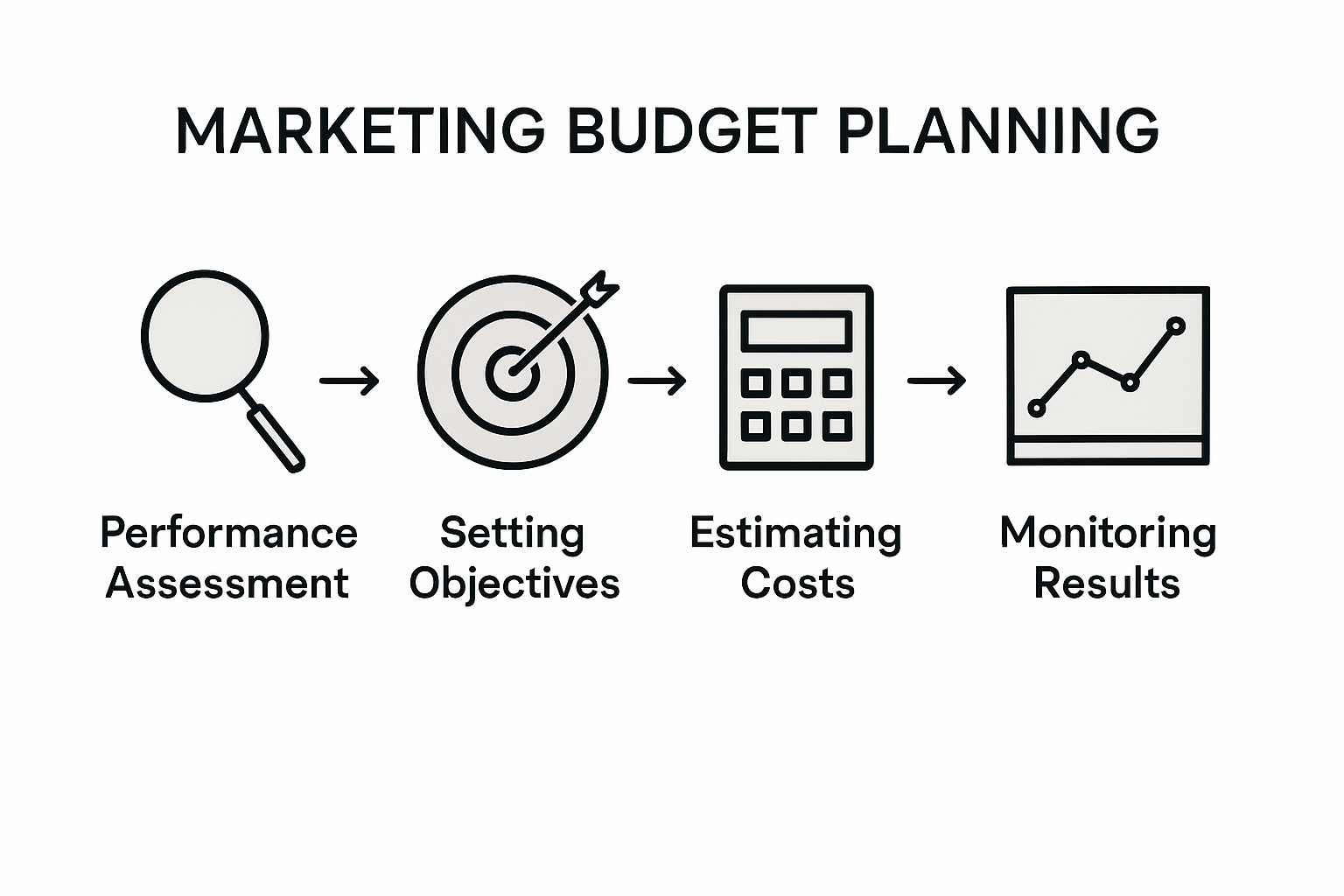
Track key performance indicators systematically across all marketing channels, establishing a robust framework for measuring campaign effectiveness. Online marketing metrics provide critical signals about which strategies are delivering tangible results. Implement a monthly review process where you analyze conversion rates, customer acquisition costs, return on ad spend, engagement metrics, and revenue generated from each marketing channel.
Create a dynamic budget allocation model that allows for rapid reallocation of resources. If a particular channel consistently underperforms, be prepared to shift funds to more productive strategies. Aim to maintain a flexible approach where 20 30% of your budget remains adaptable for quick pivots based on real time performance data.
Warning: Avoid making knee jerk reactions to short term data. Establish a minimum testing period of 60 to 90 days for each marketing channel to gather statistically significant insights before making major budget adjustments.
With a systematic monitoring and adjustment strategy in place, you have completed a comprehensive marketing budget planning process that positions your business for strategic growth in 2025.
Take Control of Your 2025 Marketing Budget with Expert Support
Planning your marketing budget for 2025 can feel overwhelming when faced with assessing performance, setting clear KPIs, and allocating resources effectively. If you are struggling to translate your marketing objectives into precise spending or worried about tracking results that truly matter you are not alone. Many businesses find it challenging to focus on measurable outcomes like customer acquisition cost and return on marketing investment while avoiding distractions from vanity metrics.
At ibrand.media we specialize in helping small to medium-sized businesses overcome these exact hurdles. Our tailored digital marketing solutions include SEO optimization, targeted advertising, and real-time performance tracking designed to maximize your budget and deliver quick results. Don’t let uncertainty hold you back from achieving your growth goals. Take the next step today by exploring how our personalized plans can turn your strategic budget allocation into measurable success.
Discover practical strategies and expert support now at ibrand.media and transform your marketing budget planning into a powerful growth engine for 2025.
Frequently Asked Questions
How do I assess my current marketing performance for 2025?
To assess your current marketing performance, gather data on key metrics such as website traffic, conversion rates, social media engagement, and customer acquisition costs. Analyze this data over the past year to identify which strategies are effective and where you can optimize spending.
What are SMART objectives in marketing budget planning?
SMART objectives are Specific, Measurable, Achievable, Relevant, and Time-bound goals that guide your marketing strategies. For example, instead of a general goal like “increase website traffic,” set a specific target such as “grow organic website traffic by 25% in the next two quarters.”
How can I estimate the costs needed to achieve my marketing goals?
To estimate the costs for your marketing goals, conduct a thorough audit of past efforts and categorize expenses into personnel, technology, advertising, and content creation. Map your budget to these resource requirements, including a contingency buffer of 10-15% for unexpected expenses.
What factors should I consider when allocating my marketing budget across channels?
When allocating your marketing budget, prioritize channels based on historical performance and alignment with your business objectives. A typical strategy might allocate 40% to high-performing channels, 30% to emerging channels, and reserve 30% for flexibility and pivots.
How do I monitor the results of my marketing budget allocations?
To monitor results effectively, track key performance indicators across all channels monthly, focusing on metrics like conversion rates and customer acquisition costs. Use a dynamic budget model that allows for reallocating resources as needed, aiming to maintain flexibility for up to 20-30% of your budget.
How long should I test each marketing channel before making changes?
Establish a minimum testing period of 60 to 90 days for each marketing channel to gather significant performance data. This approach helps you avoid knee-jerk reactions to short-term fluctuations in results.
Recommended
- Developing a Digital Marketing Plan: A 2025 Guide for Small Businesses | Ibrandmedia
- Developing a Digital Marketing Plan: A 2025 Guide for Small Businesses | Ibrandmedia
- Choosing a Marketing Agency in 2025: A Small Business Guide | Ibrandmedia
- Choosing Marketing Channels for Maximum Growth Success | Ibrandmedia
- Tech for Small Businesses: Complete Guide for 2025 – Projector Display
Recent Comments